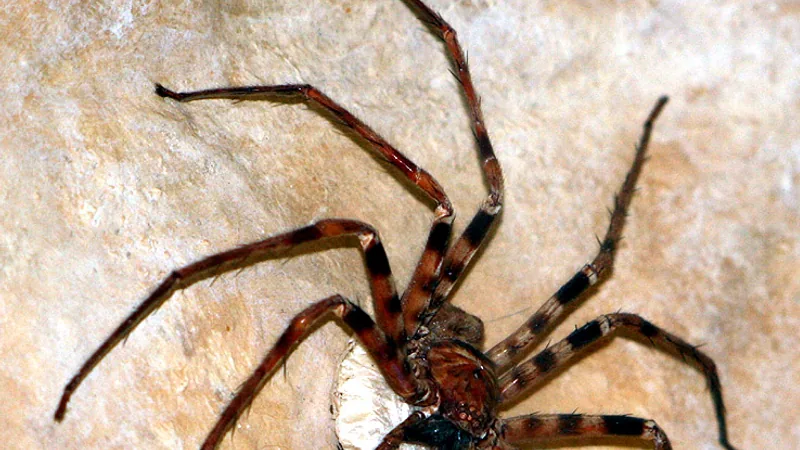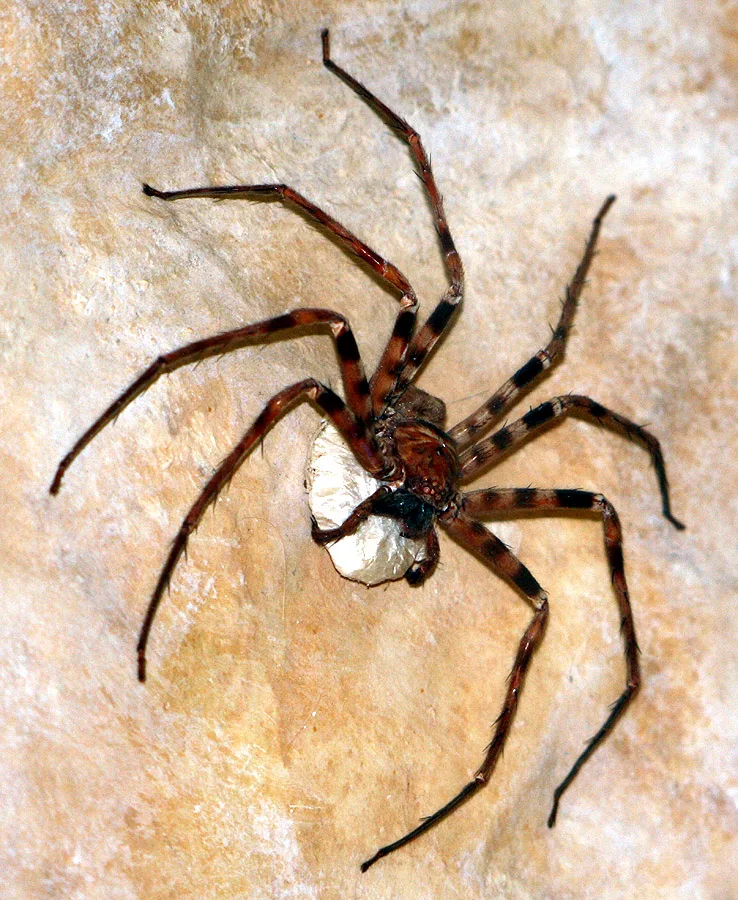
A female with her egg sac on a cave wall in Laos.
Field
notes
A 30 cm leg span
The giant huntsman spider (Heteropoda maxima) has legs that can stretch 30 cm across. One review of spider records says it is most likely the species with the absolute longest walking legs. The scientist who named it, Peter Jäger, wrote that it could be the largest huntsman spider, with a body length of over 46 mm and a leg span of 250 to 300 mm. Its species name comes from the Latin for “the largest”.
In the male holotype, the specimen the name rests on, one leg of the second pair measured 128.1 mm. The females measured had longer abdomens, 18.0 to 29.3 mm, against 12.6 and 14.6 mm in the two males. Both sexes are yellowish-brown with banded legs. Only two specimens were measured in full, because the specimens were in a fragile condition.
Leg span record Guinness World Records gives the giant huntsman a leg span of up to 30 cm, just ahead of the goliath bird-eating spider at up to 28 cm. The bird-eater is the heavier spider.
Found in a museum collection
Science had no name for it until 2001. Jäger came across it while sorting huntsman spiders at the Muséum national d’Histoire naturelle in Paris. A small group of large huntsman spiders from Laos stood out. He asked whether they could be the largest members of their family, the Sparassidae. The largest previously known, the Australian Beregama aurea, measured 41 mm in body length. Jäger called the new species the largest known sparassid spider.
Caves in Laos
The specimens came from the province of Cammon in Laos, from the villages of Tham, Kouan Pha Vang and Na Kay Khia. At least one label says they were caught in a grotto. Its long legs, pale colour and special hairs on the male’s second pair of legs suggest it may live in caves, and Jäger found all three traits in other cave-dwelling huntsman spiders.
Its eyes, however, are not reduced. Within the huntsman family, a distinct reduction of the eyes is known so far in only one species of another genus.
Published
Traits
Intel
& FAQ
Guess
first
How big is a Giant Huntsman Spider, really? Slide, lock in, and see what the sources say. Every answer is a figure from this page, quoted from where it came from.
Sources
- 01Huntsman Spiders. Australian Museum.
- 02Jäger (2001). A new species of Heteropoda (Araneae, Sparassidae, Heteropodinae) from Laos, the largest huntsman spider? Zoosystema 23(3): 461-465.
- 03Jäger (2001). A new species of Heteropoda (Araneae, Sparassidae, Heteropodinae) from Laos, the largest huntsman spider? (full article). Zoosystema 23(3): 461-465.
- 04Mammola et al. (2017). Record breaking achievements by spiders and the scientists who study them. PeerJ.
- 05Largest arachnid leg span. Guinness World Records.
What the sources say: 39 claims checked word for word against these sources →