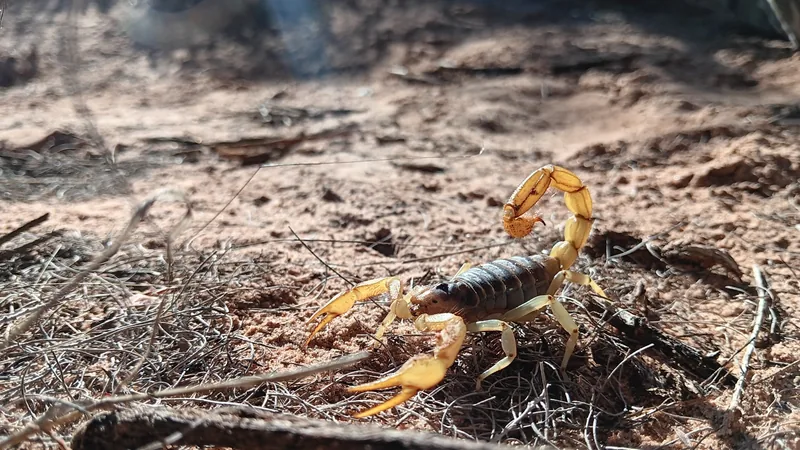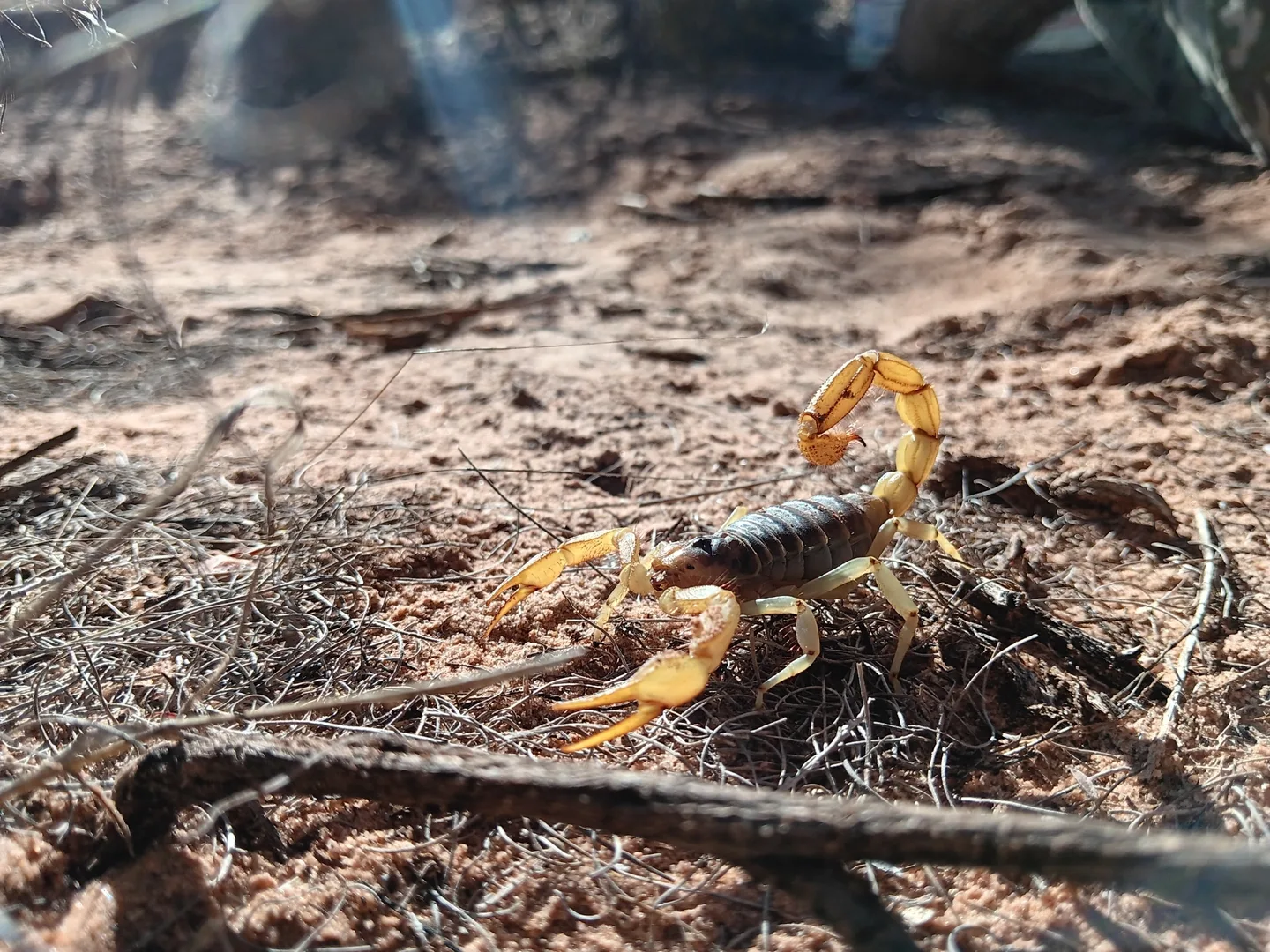
A desert hairy scorpion in the open near Hurricane, Utah.
Field
notes
The Desert Hairy Scorpion (Hadrurus arizonensis) is the largest scorpion species in North America. It grows 10 to 18 centimeters long, about four to seven inches, and weighs 4 to 7 grams, up to a quarter of an ounce. It lives across the Mojave and Sonoran Deserts of the southwestern United States, reaching into Utah, Nevada and northern Mexico. It is usually found in low valleys, where it digs its own burrows, and it also occupies abandoned burrows, small caves and crevices. In the wild it lives an average of seven to ten years; in human care it can reach 15 to 20.
A Predator That Feels Its Prey Coming
Its common name comes from the brown hairs covering its body, which pick up vibrations moving through the air and the ground. Those hairs alert it to potential prey and to predators. A nocturnal predator, it often waits inside a burrow and ambushes prey once it comes in range, grabbing it with its pincers and stinging it.
Its large size lets it feed on invertebrates, including other scorpions, and on small vertebrates such as rodents, lizards and snakes. Scorpions have tiny mouths and can only suck up liquid, so a catch is mashed up and bathed in enzymes that dissolve its insides.
An Underground Fortress
It avoids the heat of the desert day by burrowing into rock crevices and holes, and its burrows can reach 2.5 meters, more than eight feet, deep.
Active Waterproofing A desert hairy scorpion’s water-loss rate is well below that of other desert arthropods under similar conditions. In dead scorpions, water lost through the cuticle, the outer covering, alone exceeds the total water loss of living ones, which the study’s author read as evidence of an active water-retaining mechanism in the cuticle.
The cuticle becomes abruptly more permeable, or leakier to water, between 35 and 40°C, and again between 65 and 70°C.
A Weak Sting and a Blind Swing
Its venom is fairly weak compared with most scorpions’. It is not considered a public health threat, and its sting is comparable to a bee sting. The venom immobilizes small insects and other invertebrates but has little effect on vertebrates such as lizards and small mammals, and when prey struggles, it fights for its meal. When provoked, it stands erect on its legs, flails its stinger and strikes blindly at anything it takes as a threat.
Its predators include owls, bats, lizards and snakes, and other scorpions prey on it both for food and to assert dominance.
Published Updated
Traits
Intel
& FAQ
Guess
first
How big is a Desert Hairy Scorpion, really? Slide, lock in, and see what the sources say. Every answer is a figure from this page, quoted from where it came from.
Sources
- 01Hadrurus arizonensis (North American hairy scorpion). Animal Diversity Web, University of Michigan.
- 02Desert hairy scorpion. Oregon Zoo.
- 03Desert Hairy Scorpion. Los Angeles Zoo and Botanical Gardens.
- 04Scorpion. San Diego Zoo Wildlife Alliance.
- 05Hembree, Johnson & Tenwalde (2012). Neoichnology of the desert scorpion Hadrurus arizonensis: burrows to biogenic cross lamination. Palaeontologia Electronica.
- 06Hadley (1970). Water Relations of the Desert Scorpion, Hadrurus Arizonensis. Journal of Experimental Biology.
- 07Fox, Cooper & Hayes (2015). The Dilemma of Choosing a Reference Character for Measuring Sexual Size Dimorphism, Sexual Body Component Dimorphism, and Character Scaling: Cryptic Dimorphism and Allometry in the Scorpion Hadrurus arizonensis. PLOS ONE.
What the sources say: 50 claims checked word for word against these sources →