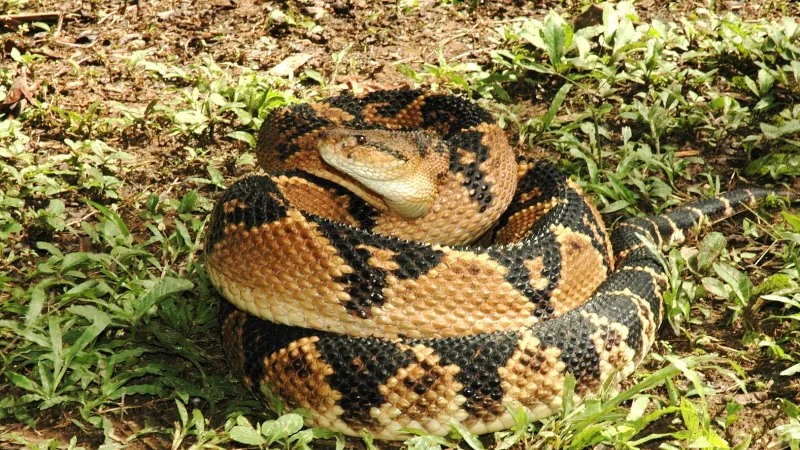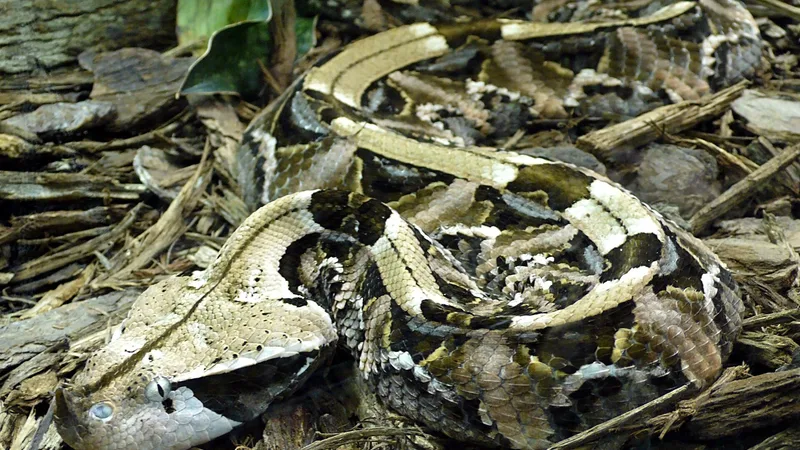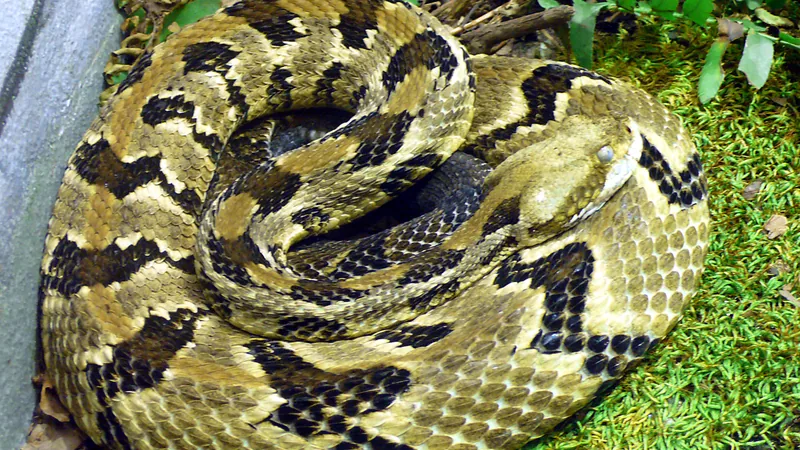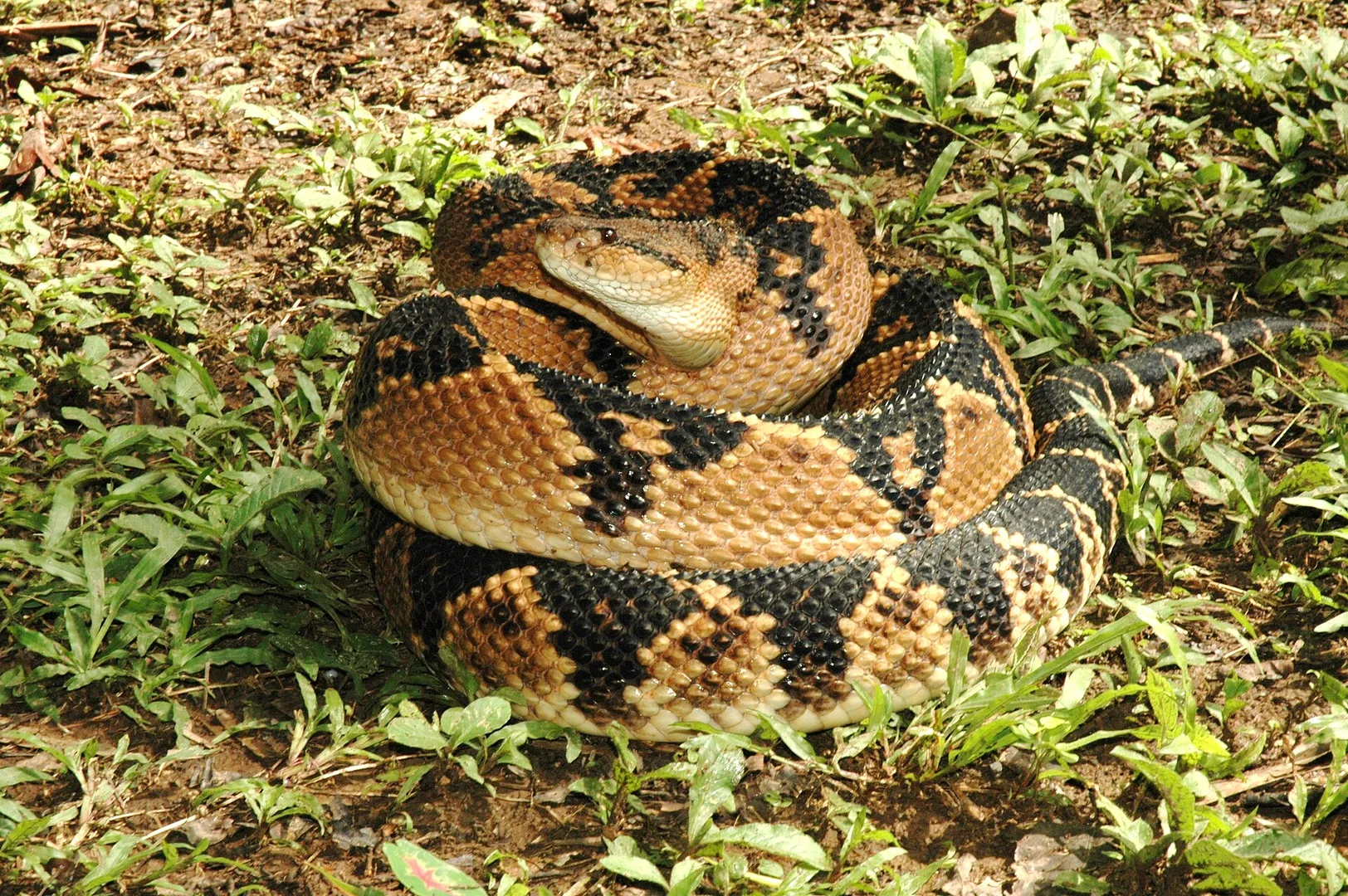
Lachesis muta muta (bushmaster)
Field
notes
By day the South American bushmaster (Lachesis muta) rests in a burrow it did not dig, stolen from or shared with an agouti or an armadillo, and it moves infrequently and very slowly. Adults are usually well over 2.5 meters long and weigh 3 to 5 kilograms, and some of the longest reach about 3.5 meters, making it the longest of all vipers. The longest-lived on record reached 31.6 years in captivity. Its scientific name means “silent fate,” a nod to the tail it shakes when threatened, though it has no rattle.
Striking by Heat
A bushmaster hunts at night by ambush, hidden under leaves or dense foliage until prey comes within range. A pair of pits between its eyes and nostrils reads infrared heat, and if a warm body comes within 50 centimeters, the snake can aim its strike from that heat signature alone, with no other senses involved. Its favorite meal in the wild is the small rice rat. Prey over 120 grams is usually struck, released and trailed by scent. Its venom is relatively weak next to its close relatives’, but it comes in volume: up to 400 milligrams, one of the largest amounts produced by any snake, enough that even released prey usually dies within minutes.
A Viper’s Venom with Cobra Parts Geneticists sequencing bushmaster venom genes found atypical molecules “never observed in the hundreds of Viperidae snakes studied so far,” including one from a class of toxins described from Elapidae, the snake family that includes cobras and mambas.
The Egg-Laying Exception
Bushmasters are the only pit vipers in the Western Hemisphere that lay eggs. A female lays 8 to 12 white eggs, each a little larger than a chicken egg, coils her body around the clutch, and does not leave it for any reason until the eggs hatch roughly 78 days later. Hatchlings emerge at approximately 30 to 50 centimeters long with a bright orange or yellow tail tip used to lure prey, a color that fades as they grow older.
Bites in Brazil
A 2001 Brazilian medical review notes that most of the country’s snakebites come from lanceheads and rattlesnakes, and that bites by Lachesis are rare. Their systemic effects can include low blood pressure, dizziness, darkened vision, a slowed heartbeat, abdominal cramps and diarrhea, grouped as a “vagal syndrome.” The bushmaster lives in forest across the Amazon and the Atlantic Forest, with pockets of humid forest in Brazil’s northeast, and the IUCN lists the species as Least Concern.
Published Updated
Traits
Intel
& FAQ
Guess
first
How big is a South American Bushmaster, really? Slide, lock in, and see what the sources say. Every answer is a figure from this page, quoted from where it came from.
Sources
- 01Lachesis muta (South American bushmaster). Animal Diversity Web, University of Michigan.
- 02Lachesis muta (Bushmaster or Mapepire Zanana). The Online Guide to the Animals of Trinidad and Tobago, University of the West Indies.
- 03AnAge entry for Lachesis muta. AnAge: The Animal Ageing and Longevity Database.
- 04Gutiérrez-Cárdenas et al. (2021). Lachesis muta. The IUCN Red List of Threatened Species 2021: e.T62254A44946798.
- 05Pinho & Pereira (2001). Ofidismo. Revista da Associação Médica Brasileira.
- 06Junqueira-de-Azevedo et al. (2006). Lachesis muta (Viperidae) cDNAs Reveal Diverging Pit Viper Molecules and Scaffolds Typical of Cobra (Elapidae) Venoms: Implications for Snake Toxin Repertoire Evolution. Genetics.
What the sources say: 48 claims checked word for word against these sources →