Eciton burchellii, Estrada do Dae, 1000 - Jardim Nossa Senhora das Gracas, Cotia - SP, cep - Cotia, SP, 06722-500, Brasil, 2023-09-03...
Field
notes
Hooks, jaws and up to a million sisters
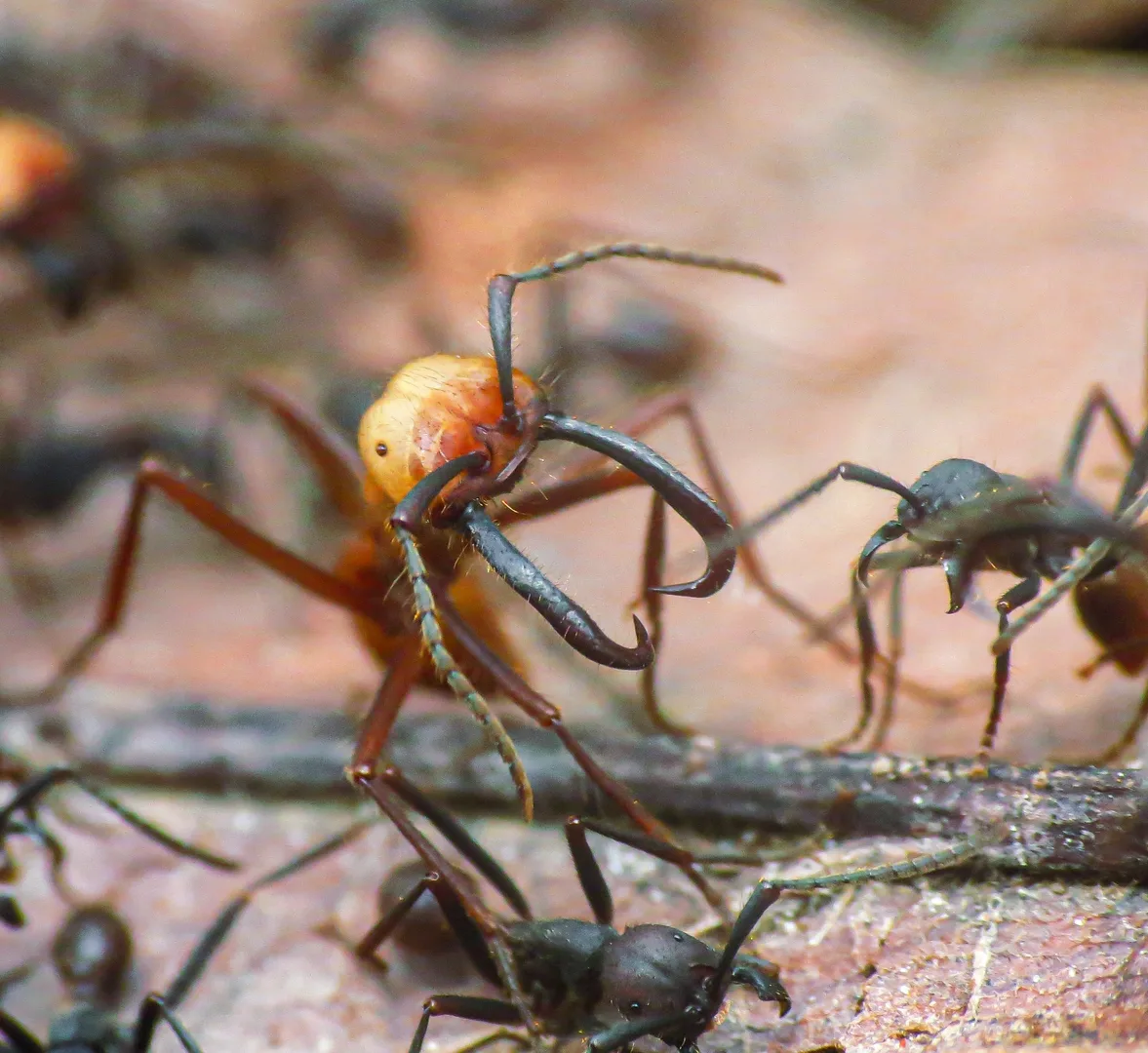
The army ant Eciton burchellii lives in the tropical regions of Central and South America, and it prefers heavily forested places. Its workers come in many sizes, from 3 to 12 millimetres long. They have long, hook-shaped jaws, and tiny hooks on their feet that they use to grip each other as they form bridges and nests. A colony can number up to a million sisters. Queens have no wings.
The colony’s temporary nest, called a bivouac, is built from the bodies of its own members at a protected site such as a hollow tree.
Egg factory Within the bivouac, a single queen lays up to 300,000 eggs in a few days.
A raid that moves house
On some days in its settled phase, the colony picks a direction at dawn and raids as a fan-shaped “army” across the forest floor. Large raids can sometimes be more than 30 metres wide. The colony subdues and transports a wide variety of social and non-social arthropods back to the bivouac for consumption. (Arthropods are animals with jointed legs, such as insects and spiders.) More than 50% of its diet is social ant prey. Animal Diversity Web lists tarantulas, scorpions and cockroaches too. The ants subdue prey with stings and pull off legs and antennae with their jaws.
Researchers report that this is the only Eciton that preys on large arthropods as well as ants. It also has submajors, an exaggerated transport caste that specialise in carrying non-ant prey.
In the nomadic phase that follows, colonies at a study site in Peru raided in one direction for an average of 78 metres and set up a new bivouac almost every night.
Birds on the payroll
Some Neotropical birds follow these raids. They prey on arthropods and small vertebrates flushed from the forest floor by the swarm. One group, the typical antbirds, includes species that appear incapable of foraging independently of swarms. Molecular dating indicates that army-ant-following has persisted in antbirds since the late Miocene.
A study of leaf-litter invertebrates in four countries found that, contrary to its popular image, this species did not consistently reduce their biomass. Its impact was concentrated on rich patches of invertebrates.
Workers have a well-developed sting. Animal Diversity Web calls it painful. The same account says the species does not frequently come into contact with people.
Published
Traits
Intel
& FAQ
Guess
first
How big is a Army Ant, really? Slide, lock in, and see what the sources say. Every answer is a figure from this page, quoted from where it came from.
Sources
- 01Eciton burchellii. Animal Diversity Web, University of Michigan.
- 02Kunhart & Willson (2024). Intercolony Avoidance Optimizes Foraging in Eciton burchellii Army Ants. Sociobiology.
- 03Powell & Franks (2005). Caste evolution and ecology: a special worker for novel prey. Proceedings of the Royal Society B: Biological Sciences.
- 04Kaspari et al. (2011). Predation and patchiness in the tropical litter: do swarm-raiding army ants skim the cream or drain the bottle? Journal of Animal Ecology.
- 05Brumfield et al. (2007). Phylogenetic conservatism and antiquity of a tropical specialization: Army-ant-following in the typical antbirds (Thamnophilidae). Molecular Phylogenetics and Evolution.
- 06Kronauer et al. (2006). A reassessment of the mating system characteristics of the army ant Eciton burchellii. Naturwissenschaften.
- 07Meisel (2006). Thermal Ecology Of The Neotropical Army Ant Eciton Burchellii. Ecological Applications.
What the sources say: 43 claims checked word for word against these sources →