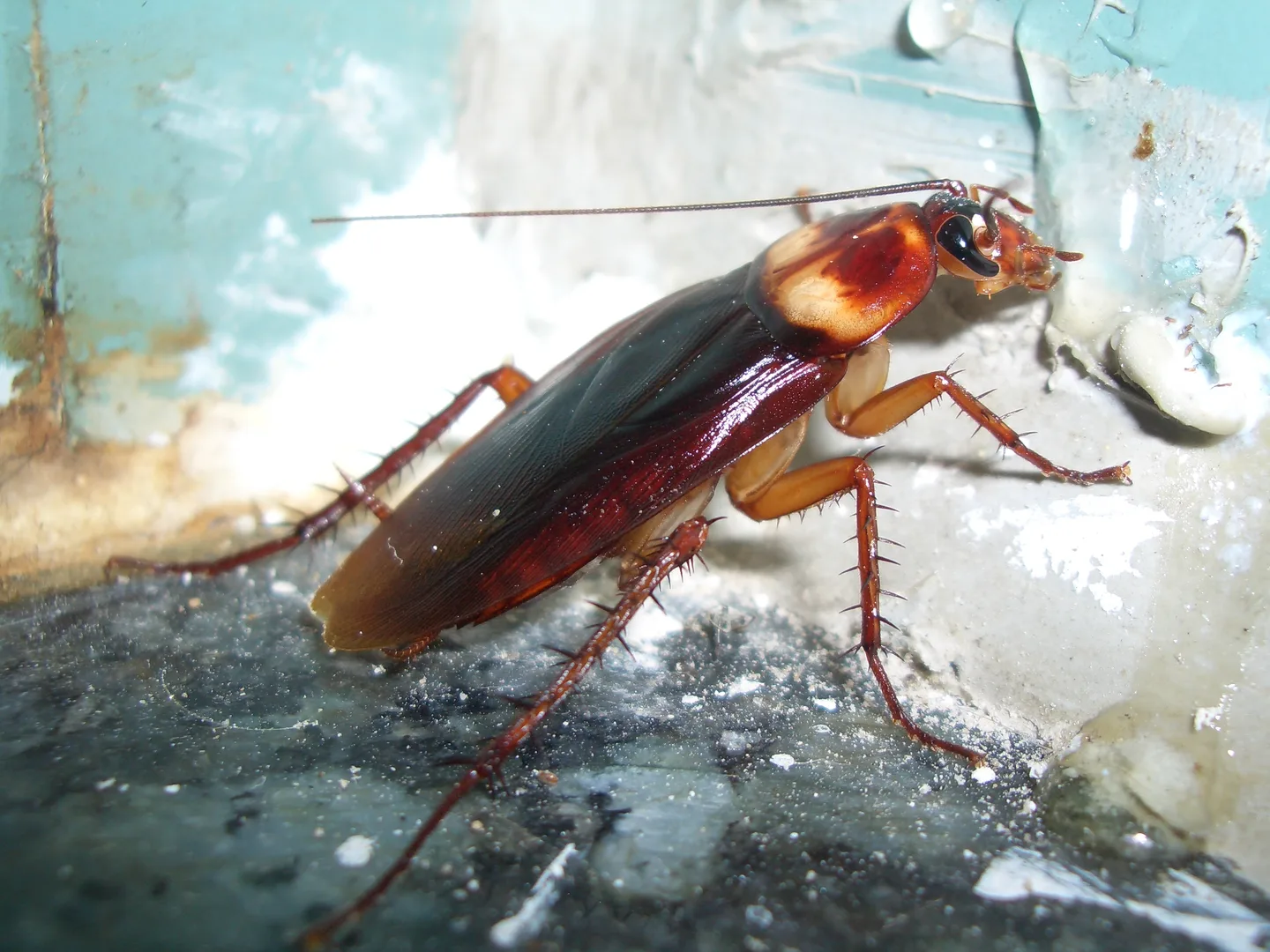
American cockroach feeding on bait gel.
Field
notes
A Sprinter That Changes Gears
The American cockroach, Periplaneta americana, is built for speed. In a 1991 study, scientists measured its running on a miniature force platform, a sensor that records how hard the feet push on the ground. The study calls it, relative to its mass, one of the fastest invertebrates ever studied, and gives that mass as 0.83 grams.
Between 0.44 and 1.0 metres per second, it ran with an alternating tripod stepping pattern. At the highest speeds, 1.0 to 1.5 metres per second or 50 body lengths per second, it switched to running on four legs and on two. Its stride frequency came close to the 27 beats per second of its wings in flight.
Eats Almost Anything
A University of Florida guide calls it an omnivorous, opportunistic feeder that will eat almost anything. It prefers sweets, but has been seen eating paper, boots, hair and dead insects.
Bacteria Inside the Fat Cockroaches, unlike most terrestrial insects, excrete waste nitrogen within their fat bodies as uric acids. In most cockroaches a bacterium called Blattabacterium lives in those fat bodies, and the genome of the one from P. americana indicates it can recycle nitrogen and make all of the essential amino acids.
The authors say this ancient partnership has allowed cockroaches to subsist on nitrogen-poor diets.
From Africa to the Sewers
Despite its name, the species was introduced to the United States from Africa as early as 1625. It has spread throughout the world by commerce. Animal Diversity Web lists it as worldwide in distribution.
It is found mainly in basements, sewers, steam tunnels and drainage systems. More than 5,000 are sometimes found in individual sewer manholes. Outdoors, it lives in moist, shady places such as hollow trees, wood piles and mulch. It responds negatively to light, and by day it rests near water pipes, sinks, baths and toilets.
Size, Eggs and Lifespan
It is the largest of the common peridomestic cockroaches, meaning the ones living around people, at an average of 4 centimetres long. A female lays her eggs in a hardened, purse-shaped egg case called an ootheca. On average she makes one a month for ten months, with 16 eggs in each, and produces about 150 young in her lifetime.
Growing from egg to adult averages about 600 days, and the adult life span may be another 400 days.
Published
Traits
Intel
& FAQ
Guess
first
How big is a American Cockroach, really? Slide, lock in, and see what the sources say. Every answer is a figure from this page, quoted from where it came from.
Sources
- 01Full & Tu (1991). Mechanics of A Rapid Running Insect: Two-, Four-and Six-Legged Locomotion. Journal of Experimental Biology.
- 02Sabree, Kambhampati & Moran (2009). Nitrogen recycling and nutritional provisioning by Blattabacterium , the cockroach endosymbiont. Proceedings of the National Academy of Sciences.
- 03Barbara. American Cockroach, Periplaneta americana (Linnaeus) (Insecta: Blattodea: Blattidae). University of Florida IFAS Extension, Featured Creatures (EENY-141).
- 04Periplaneta americana (American cockroach). Animal Diversity Web, University of Michigan.
- 05Sutherland, Choe & Rust (2019). Pest Notes: Cockroaches. UC Statewide IPM Program, UC ANR Publication 7467.
What the sources say: 38 claims checked word for word against these sources →