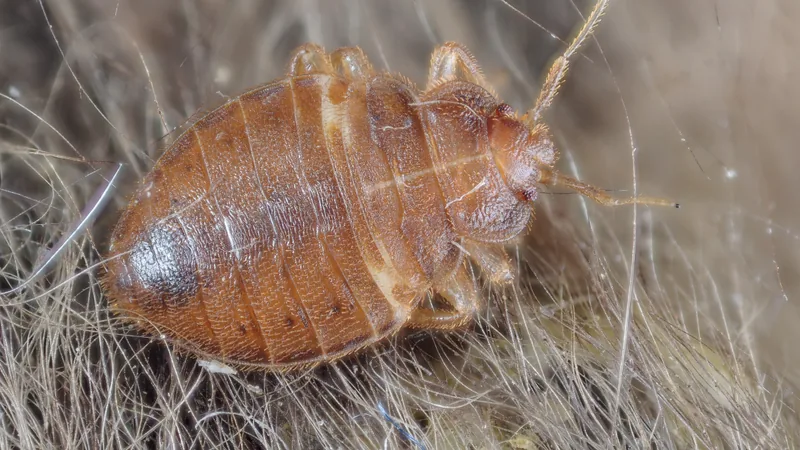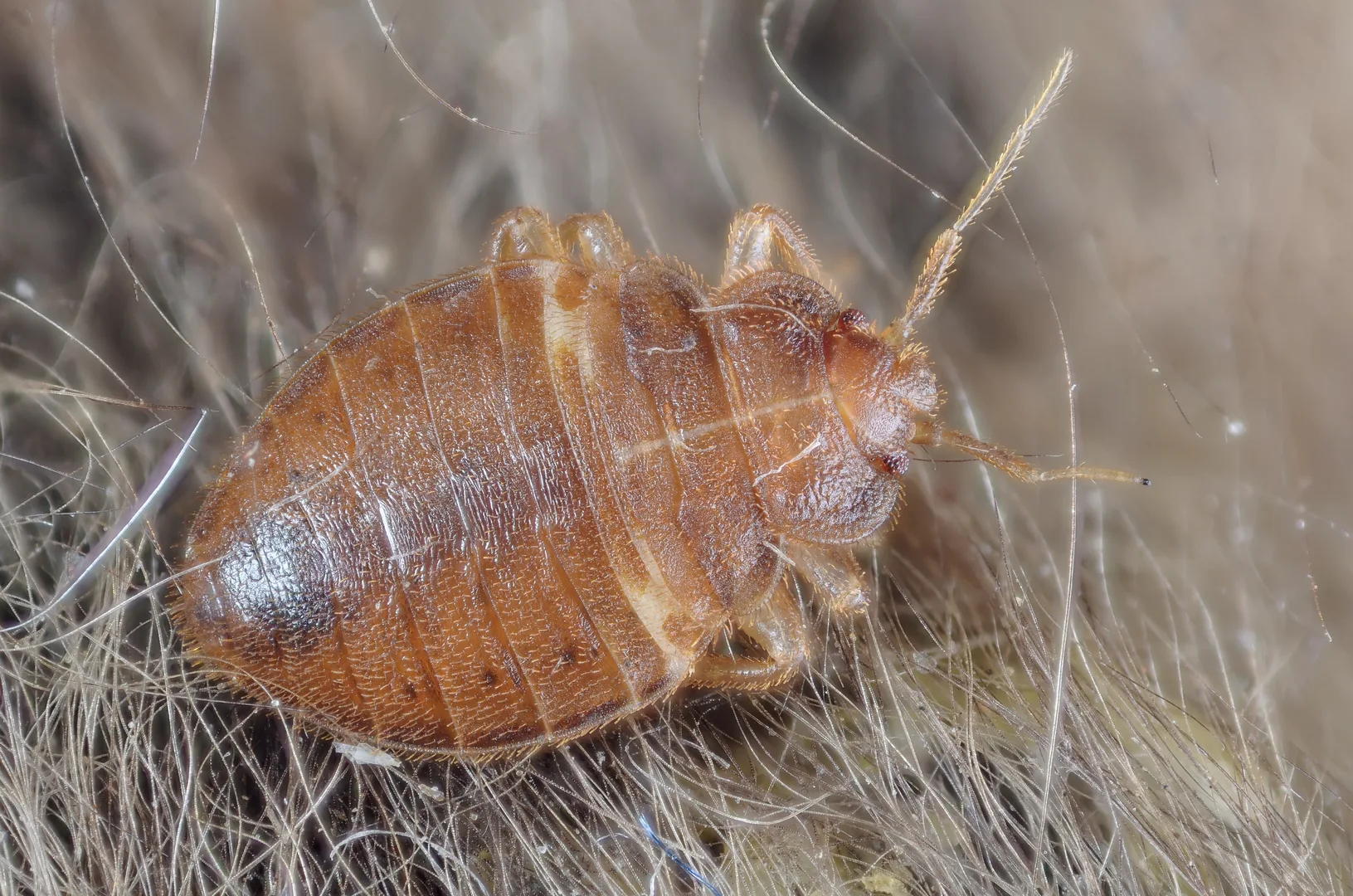
Bed bug nymph on the fur of a bat, one of its hosts.
Field
notes
Mating by Stabbing
The bed bug, Cimex lectularius, has a mating method called “traumatic” insemination. In it, the male pierces the female’s abdominal wall with his genitalia and injects sperm into her body cavity.
A 2001 study showed this costs females. Traumatic insemination reduced their longevity and reproductive success, and the authors concluded that it is probably a coercive male strategy that results in a sexual conflict of interests.
Females have a counter-move. They evolved an organ that reduces the physical trauma of mating, built from a dense patch of resilin, a super-elastic protein. The bed bug genome shows a recent expansion in pro-resilin genes, the ones that build resilin.
Fed Females Are the Target Males prefer recently fed females, which undergo about 5 traumatic inseminations per feeding.
A Confetti-Sized Blood Drinker
Adults are reddish-brown, flat, wingless ovals of 4 to 7 millimetres, which one medical review compares to confetti. Newly hatched nymphs are 1 to 3 millimetres long. Bed bugs feed on blood, and the University of Florida lists people, chickens and bats as hosts, with domestic animals occasionally.
The bite is sneaky. A feeding bed bug injects an anesthetic and an anticoagulant, a chemical that stops blood clotting. Most people do not notice the marks until one to several days later.
Built to Hide and Wait
A bed bug’s slim, flat body slips into very small spaces. By day it hides in spots such as mattress seams, bed frames, headboards and behind wallpaper. It can travel over 100 feet in a night, yet tends to live within 8 feet of where people sleep.
Waiting is a skill too. Unlike most blood-feeding insects, bed bugs can survive long periods of starvation, and the CDC says they can live several months without a blood meal.
The CDC, writing about Cimex bed bugs in general, says they turn up from North and South America to Africa, Asia and Europe, even in five-star hotels and resorts. How clean a place is does not decide whether they are there. They ride in the seams and folds of luggage, clothes and furniture. Besides homes, they live in bird nests and bat caves.
A Bacterial Roommate
Blood is short on some vitamins. The bed bug carries a bacterium called Wolbachia, which supplies a cocktail of B vitamins that are critical for its reproduction and development. After its eggs hatch, a nymph needs five molts to reach maturity.
Published
Traits
Intel
& FAQ
Guess
first
How big is a Bed Bug, really? Slide, lock in, and see what the sources say. Every answer is a figure from this page, quoted from where it came from.
Sources
- 01Stutt & Siva-Jothy (2001). Traumatic insemination and sexual conflict in the bed bug Cimex lectularius. Proceedings of the National Academy of Sciences.
- 02Benoit et al. (2016). Unique features of a global human ectoparasite identified through sequencing of the bed bug genome. Nature Communications.
- 03Delaunay et al. (2010). Bedbugs and Infectious Diseases. Clinical Infectious Diseases.
- 04About Bed Bugs. Centers for Disease Control and Prevention.
- 05Bed Bug, Cimex lectularius Linneaus (Insecta: Hemiptera: Cimicidae). University of Florida IFAS Extension (EDIS).
What the sources say: 41 claims checked word for word against these sources →