Myrmeleon formicarius
Field
notes
A trap dug by a backwards builder
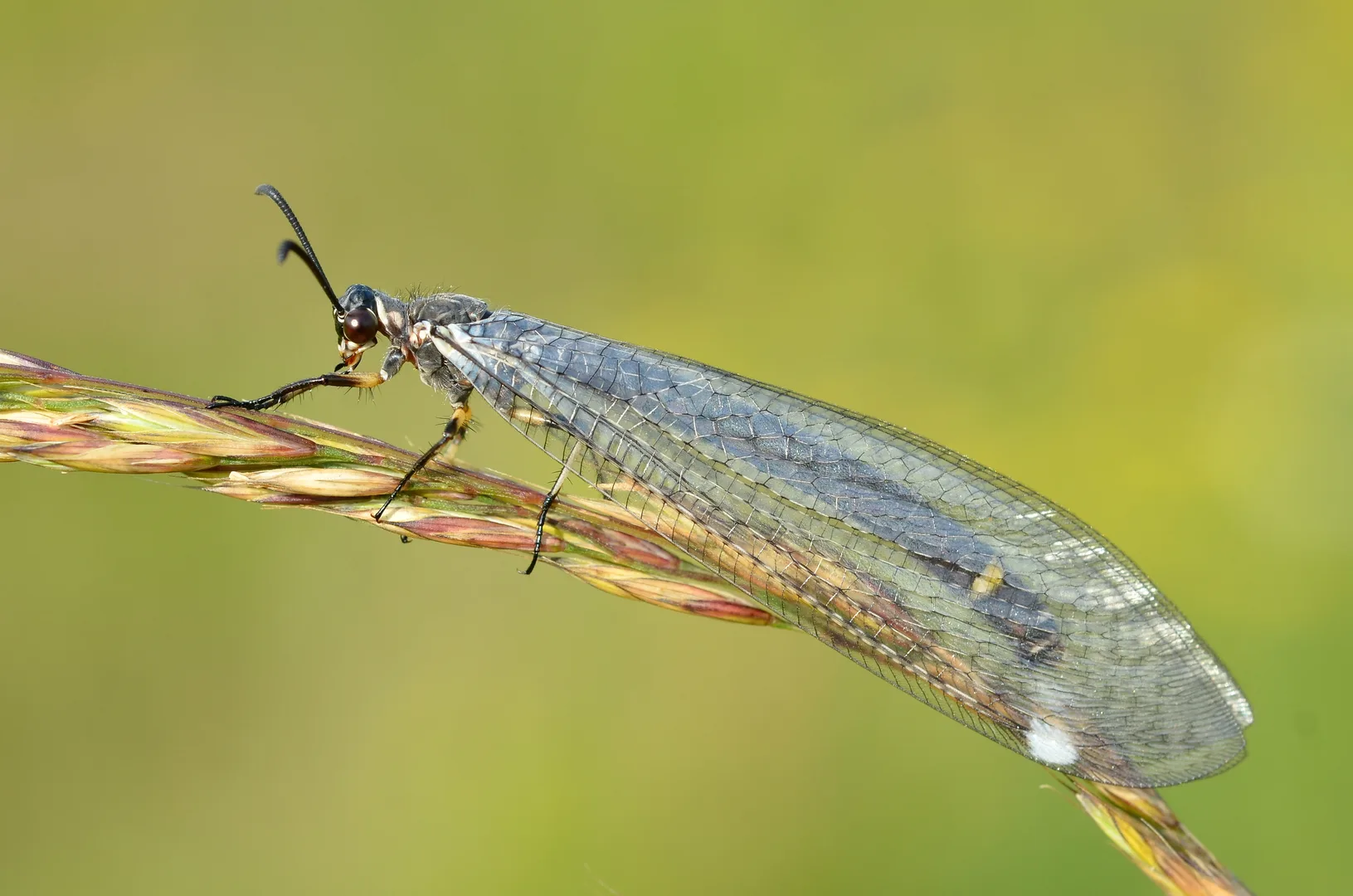
Not a lion and not an ant: Myrmeleon formicarius is an antlion, a member of the family Myrmeleontidae, named by Linnaeus in 1767. The Integrated Taxonomic Information System files it in the order Neuroptera, alongside lacewings and mantisflies, and records it from Africa, Europe, northern Asia (not China) and southern Asia.
The trapper is the larva, the young stage. In 1904 Dr T. A. Chapman collected larvae at La Granja in Spain, in rather dry, dusty earth (scarcely sand) in a pine forest. They were sometimes so crowded that eight or ten of “various sizes” shared one square foot. Back home they made typical pits, and he watched them throw out sand with a backward jerk of the head, either to dig a pit or to repair one.
Backwards and buried Chapman noted that the larva appeared always to travel backwards, and always under the sand. On the surface it was not very helpful, but it could bury itself with great rapidity.
What it eats and how long it waits
Over six weeks in Chapman’s care the larvae ate a good many larvae, chiefly those of small moths and butterflies. When hungry, an antlion sucked its victim so dry that only a minute shred remained.
Chapman then passed two larvae on to W. J. Lucas. They ate little or nothing until well into the spring of the next year, and Lucas suggested that possibly they do not feed during the winter. One of the two, collected in summer 1904, produced an adult of good size about midsummer 1905.
Sand, silk and a one-job jaw
The larva’s mandibles (jaws) are described as formidable, built to trap prey. When Lucas’s larva was ready to pupate, it made a round cocoon of sand grains cemented with a gummy material the paper calls liquid silk, about nine-sixteenths of an inch across, roughly 14 millimetres. Lucas noted that so small an insect had to produce a large adult. The pupa’s jaws are much reduced in size and do a single job: cutting an opening in the cocoon. The adult’s jaws end up quite simple.
A chemical study in 1989 looked at three antlion species and found the compounds nerol and 10-homonerol in M. formicarius. Its title calls such compounds volatile signals, meaning chemicals that evaporate easily into the air.
Published
Traits
Intel
& FAQ
Sources
- 01Lucas (1906). On the emergence of Myrmeleon formicarius from the pupa. Transactions of the Royal Entomological Society of London.
- 02Myrmeleon formicarius Linnaeus, 1767. Integrated Taxonomic Information System (ITIS).
- 03Baeckström et al. (1989). Structures, absolute configurations, and syntheses of volatile signals from three sympatric ant-lion species, Euroleon nostras, Grocus bore, and Myrmeleon formicarius (Neuroptera: Myrmeleontidae). Journal of Chemical Ecology.
What the sources say: 44 claims checked word for word against these sources →