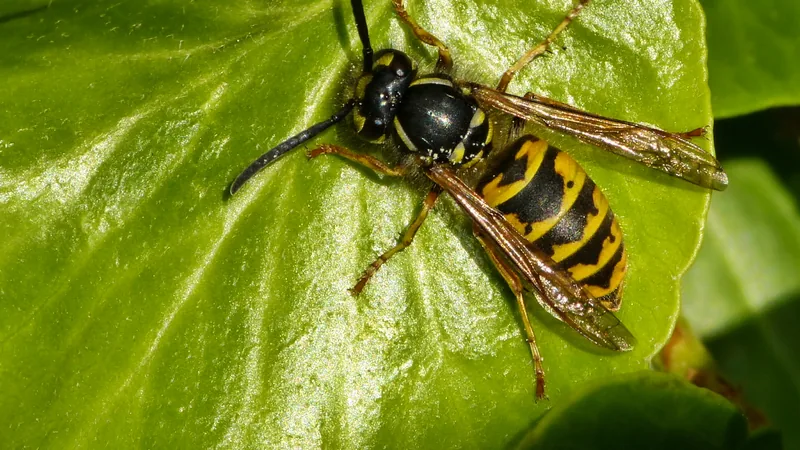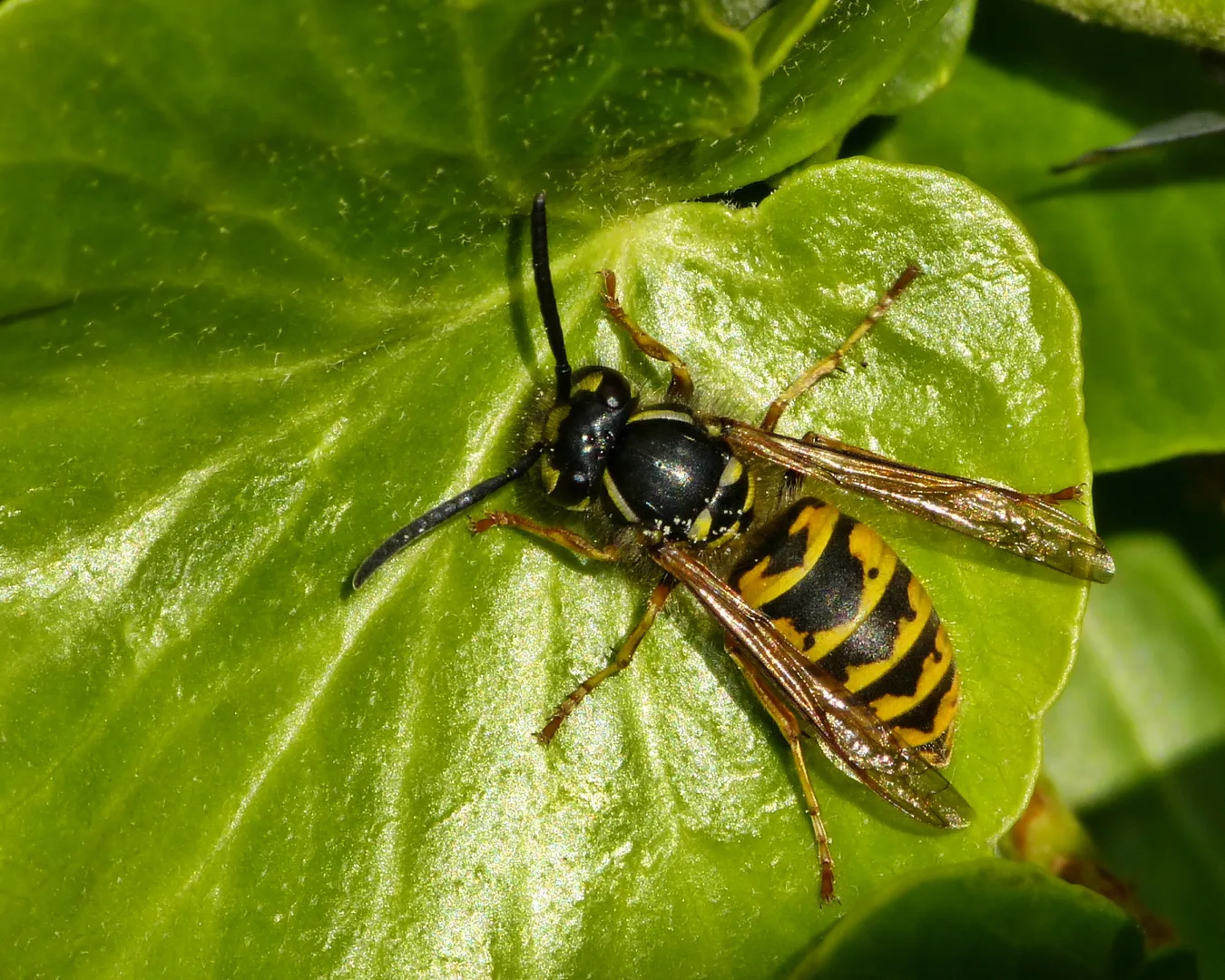
Common wasp in New Zealand, where it is an introduced species
Field
notes
A Wasp With Its Own Heater
A common wasp makes its own warmth. In a study comparing hornets with two Vespula wasps (this species and the German wasp), the insects had mean thorax temperatures of 30 to 40°C as they arrived at the nest entrance and 33 to 40°C as they left, about 5 to 18°C above the surrounding air. The thorax is the middle body section, and the authors read that gap as a high endothermic capacity, meaning the ability to generate body heat itself.
All that heat comes from a small package. Common wasps caught leaving their nests averaged 84.1 mg in that study, and the Welsh Wildlife Trust gives its length as up to 2 cm. Most common wasps live only a few weeks, says the insect charity Buglife, but a mated queen hibernates and may survive for up to a year. The study’s five common wasp colonies nested in wall hollows or lofts.
Colony Police
Common wasps live in large groups in nests of paper, which the queen makes by chewing up wood.
Worker policing Workers quickly clear away eggs laid by other workers while leaving the queen’s alone: after an hour, four of 120 worker eggs were still there, against 106 of 120 queen eggs.
Dissecting 1,150 workers from six colonies found that 4% had active ovaries, roughly five to 25 workers per colony. Yet microsatellite (DNA marker) analysis of 270 males detected no workers’ sons. Honeybees evolved the same egg-eating policing separately.
Sniffing Out Strangers
Wasps also judge by smell. Researchers stored dead nestmates in a freezer, then tested how aggressively colonies treated them. Aggression toward recently killed nestmates was about 12%, but about 30% toward nestmates killed 19 days earlier, which the authors say indicates a change of the nest odor within the colony.
Two neighbouring colonies, kept apart by a solid wall for 28 days, treated dead foragers from next door as harshly as dead strangers, about 39% each. Seventeen days after a metal grid replaced the wall, letting air pass between them, aggression toward dead neighbours had fallen to about 11%.
Vision gets tested too. In one experiment, free-flying wasps learned to tell apart similar photos of human faces, then picked the trained face out from new ones; they did significantly worse once the photos were rotated 180°.
Sugar, Insects and Seasons
Adults go for high-energy food: nectar, rotten fruit, sugary picnics. Their young get small insects instead. The Welsh Wildlife Trust calls them important pollinators and pest controllers, and says the species is widespread in the UK, with sightings from April to October.
In New Zealand it is an introduced species. In a 1987 to 1989 study in Christchurch, some German wasp nests survived the winter, but all common wasp nests died by June.
Published Updated
Traits
Intel
& FAQ
Guess
first
How big is a Common Wasp, really? Slide, lock in, and see what the sources say. Every answer is a figure from this page, quoted from where it came from.
Sources
- 01Common Wasp. Buglife.
- 02Common wasp. Welsh Wildlife (The Wildlife Trust of South and West Wales).
- 03Kovac & Stabentheiner (2012). Does size matter? Biology Open.
- 04Foster & Ratnieks (2001). Convergent evolution of worker policing by egg eating in the honeybee and common wasp. Proceedings of the Royal Society of London. Series B: Biological Sciences.
- 05Steinmetz & Schmolz (2005). Nest odor dynamics in the social wasp Vespula vulgaris. Naturwissenschaften.
- 06Avarguès-Weber et al. (2017). Recognition of human face images by the free flying wasp Vespula vulgaris. Animal Behavior and Cognition.
- 07Donovan et al. (1992). Comparative characteristics of nests of Vespula germanica (F.) and Vespula vulgaris (L.) (Hymenoptera: Vespinae) from Christchurch City, New Zealand. New Zealand Journal of Zoology.
- 08Blank et al. (2010). Identification, Recombinant Expression, and Characterization of the 100 kDa High Molecular Weight Hymenoptera Venom Allergens Api m 5 and Ves v 3. The Journal of Immunology.
What the sources say: 42 claims checked word for word against these sources →