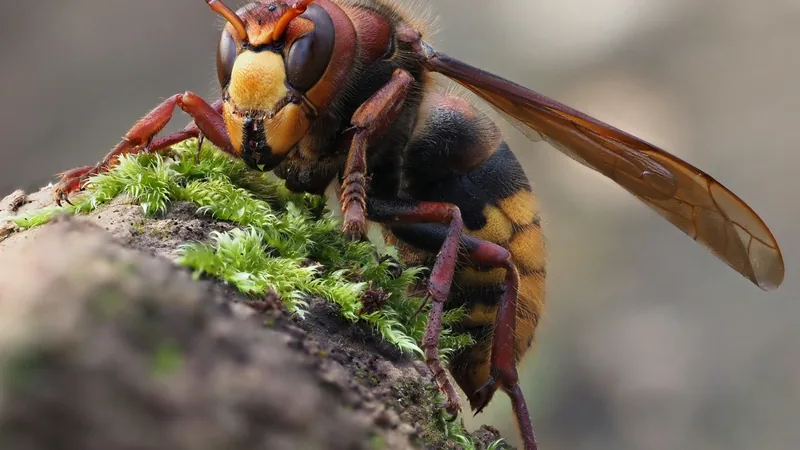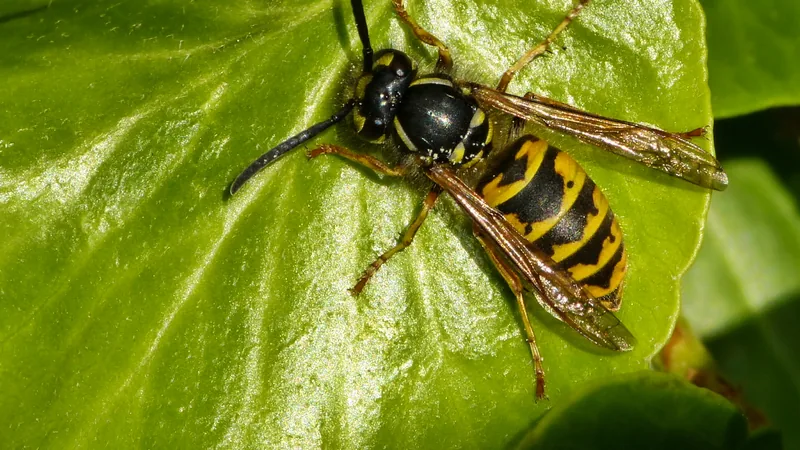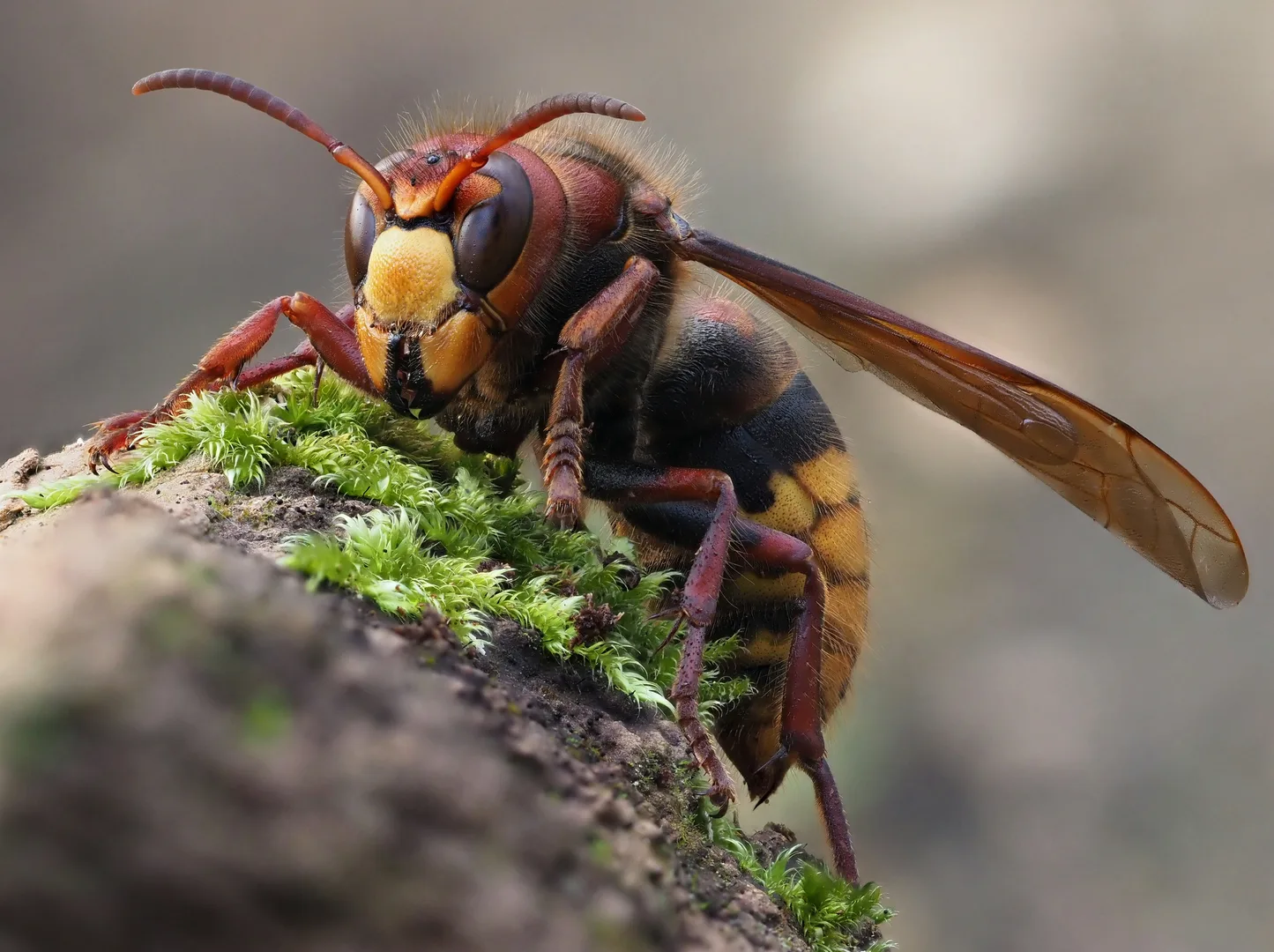
European hornet (Vespa crabro) in Parc de Woluwé, Brussels
Field
notes
A wasp with its own radiator
The European hornet (Vespa crabro) is the largest of Central Europe’s vespine wasps, the group that holds hornets and yellowjackets. Workers reach up to 25 millimetres, an inch, and queens up to 35. In one field study, hornets leaving the nest averaged 477.5 milligrams, more than five times the weight of the common wasps living in the same area.
Hornets also run warm. Hornets make their own body heat, a skill called endothermy, by working the thoracic muscles, the flight muscles in the middle of the body. The hornets in that study arrived back at the nest with a thorax averaging 30 to 40 °C, running roughly 5 to 18 °C above the surrounding air.
Grip strength Clamping the bumps of a rough surface between the claws of opposite legs, a hornet in a lab test withstood a pull almost 25 times its own weight.
Night shift with a sweet tooth
For most of the year hornets are hunters. They take grasshoppers, flies and even yellowjackets, and they sometimes attack honey bees, apparently more often in Europe than in North America. They add sugar to the diet too, especially in autumn, stripping bark off bushes such as lilac to feed on the sap.
They also keep odd hours. Penn State’s entomologists call the European hornet the only nocturnal wasp in Pennsylvania, and it is sometimes drawn to porch lights at night.
Big sting, calm temper
The sting is about as painful as a honey bee’s, says Penn State. The stinger is smooth, and a hornet can sting more than once. Virginia Cooperative Extension says hornets do not seem particularly aggressive unless they are defending the nest. The venom holds crabrolin, a short chain of 13 amino acids that, in lab tests, can act against bacteria and also damage red blood cells.
A one-summer empire
Each spring a queen leaves her winter hiding place and starts a nest, often in a hollow tree, chewing wood into paper. At the mid-September peak most nests hold 200 to 400 workers, and large ones up to 1,000. In a study of 15 hornet nests, the males were the queen’s sons and the workers never tried to lay eggs.
Then it ends. The workers die in autumn, and only mated queens survive the winter. The species is native to Europe and Asia. It was first detected in North America in the 1840s, and Penn State’s 2024 factsheet calls it widespread in the eastern United States.
Published
Traits
Intel
& FAQ
Guess
first
How big is a European Hornet, really? Slide, lock in, and see what the sources say. Every answer is a figure from this page, quoted from where it came from.
Sources
- 01Kovac & Stabentheiner (2012). Does size matter? Biology Open.
- 02Frantsevich & Gorb (2004). Structure and mechanics of the tarsal chain in the hornet, Vespa crabro (Hymenoptera: Vespidae): implications on the attachment mechanism. Arthropod Structure & Development.
- 03Foster, Ratnieks & Raybould (2000). Do hornets have zombie workers? Molecular Ecology.
- 04Krishnakumari & Nagaraj (1997). Antimicrobial and hemolytic activities of crabrolin, a 13-residue peptide from the venom of the European hornet, Vespa crabro, and its analogs. The Journal of Peptide Research.
- 05European Hornet. Penn State Extension.
- 06European Hornet. Virginia Cooperative Extension.
- 07Hornet (Vespa crabro). Welsh Wildlife Trust.
- 08Vespa crabro Linnaeus. Integrated Taxonomic Information System.
What the sources say: 46 claims checked word for word against these sources →