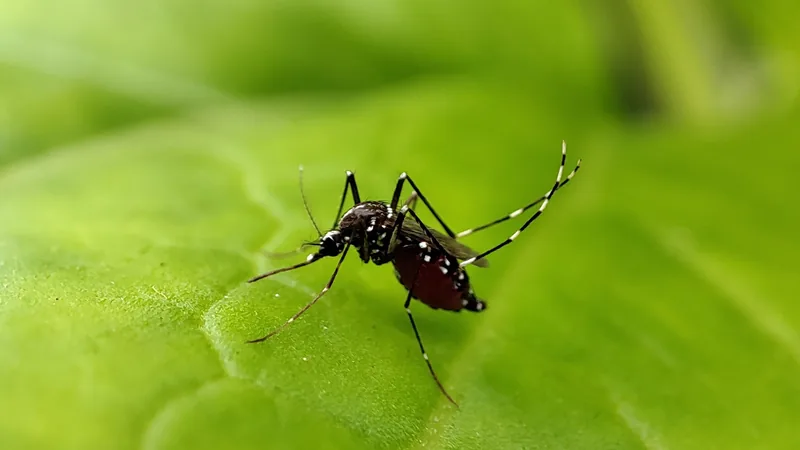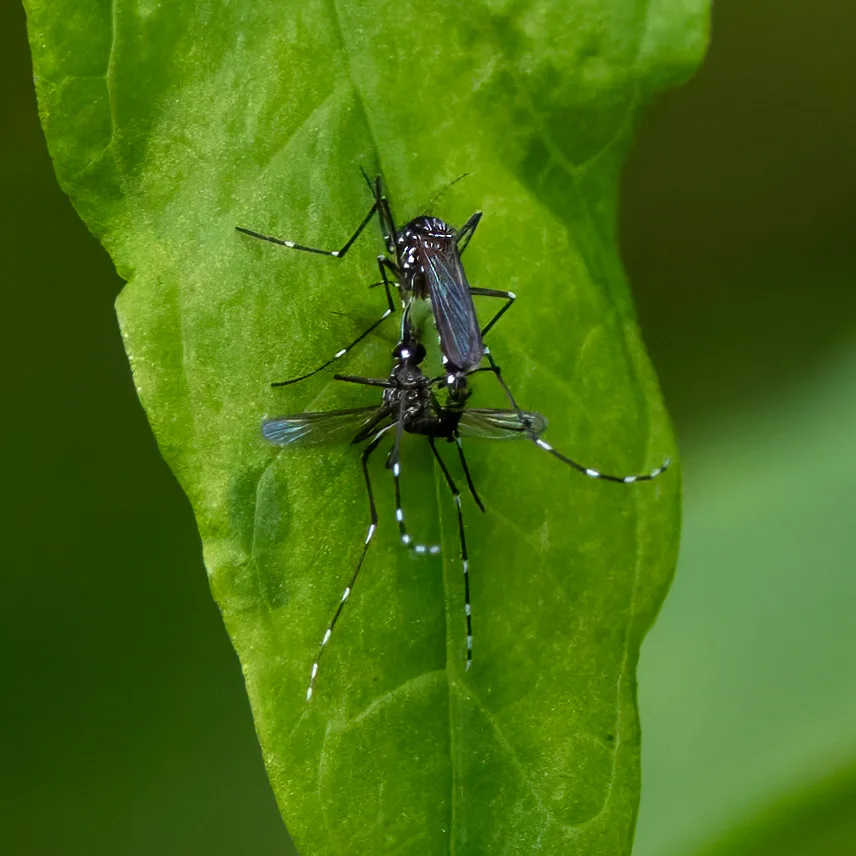
Asian tiger mosquito on a leaf in the United States
Field
notes
Eggs Built to Outwait the Winter
The Asian tiger mosquito, Aedes albopictus, began in the tropical forests of South-East Asia, yet it now lives in places with real winters. The secret is in its eggs. Females lay drought-resistant eggs above the water line. In cooler regions, eggs laid in late summer or early autumn, as daylight hours shrink, enter a winter pause. Biologists call that pause diapause.
The European Centre for Disease Prevention and Control (ECDC) reports that eggs from European populations, once in diapause, came through a -10 °C cold snap, while eggs from tropical populations could only take -2 °C. Animal Diversity Web adds that the eggs hatch once rising water covers them, and that the larvae grow in tyres, bird baths and clogged gutters.
Four Millimetres of Stripes
Animal Diversity Web gives adults an average length of 4 mm. They are black with white scale patches on the legs, which earns the tiger name, and a single white line runs down the middle of the thorax. The UK Health Security Agency gives the wingspan as 7 to 8 mm, against 13 to 15 mm for a native British mosquito, Culiseta annulata, that people often mistake for it.
The sexes differ. Males have bushy antennae with receptors that let them hear the whine of a female, and they gather in swarms a few feet off the ground. Mating happens in flight and lasts 5 to 15 seconds.
Life is short and depends on temperature. In a lab study of mosquitoes bred from a population collected in Phnom Penh, Cambodia, females kept at a constant 20 °C lived longest, averaging 22.6 days; at 35 °C the average was 1.41 days. ECDC says adult females can survive over three weeks.
A Hitchhiker on Used Tyres
Hitching a ride On its own wings its range is limited to about 200 metres. It mostly travels as a stowaway, when people transport and move goods that can hold water and larvae.
ECDC says its global expansion was helped by the movement of used tyres and “lucky bamboo”. It was first reported in Europe in 1979 in Albania, then in Texas in 1985 and in Brazil in 1986. It is on the Invasive Species Specialist Group’s list of the top 100 invasive species.
A Daytime Biter
Males live on nectar and sugary plant juices. Females need a blood meal to develop their eggs, and ECDC says they bite aggressively, usually during the day and preferably outdoors. It takes blood from people, from domestic and wild animals, and from reptiles, birds and amphibians, but lab tests and analysis of the blood in fed females show it prefers ours.
ECDC calls it a known vector of dengue, chikungunya and dirofilariasis, a disease caused by parasitic worms. A vector is an animal that carries a germ from one host to another. Italy’s chikungunya outbreak of 2006 to 2007 clearly demonstrated that it carries that virus. ECDC also considers it, from experiments, a competent carrier of at least 22 other arboviruses, which are viruses spread by insects, ticks and other arthropods, but ECDC cautions that lab infection and field finds alone do not prove a mosquito is involved in transmission.
Published Updated
Traits
Intel
& FAQ
Guess
first
How big is a Asian Tiger Mosquito, really? Slide, lock in, and see what the sources say. Every answer is a figure from this page, quoted from where it came from.
Sources
- 01Aedes albopictus. Animal Diversity Web, University of Michigan.
- 02Aedes albopictus - Factsheet for experts. European Centre for Disease Prevention and Control.
- 03Distinguishing Aedes albopictus, the Asian Tiger mosquito, from native British mosquitoes. UK Health Security Agency, GOV.UK.
- 04Doeurk et al. (2025). Impact of temperature on survival, development and longevity of Aedes aegypti and Aedes albopictus (Diptera: Culicidae) in Phnom Penh, Cambodia. Parasites & Vectors.
- 05Dengue and severe dengue. World Health Organization fact sheet.
What the sources say: 53 claims checked word for word against these sources →