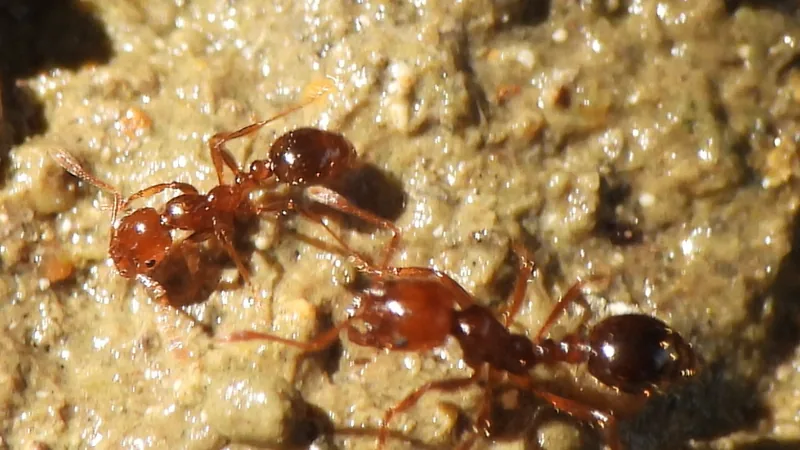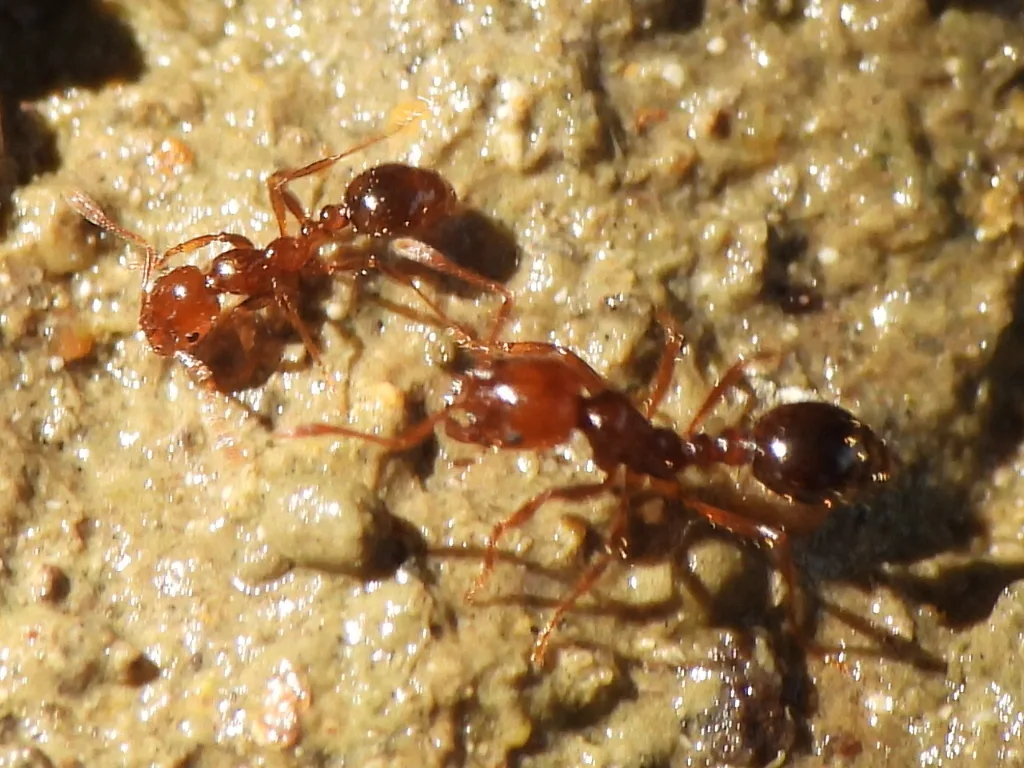
Workers on sand
Field
notes
The ant that builds a raft
When floodwater or heavy rain hits, a fire ant colony moves quickly to the surface and the ants link their bodies together. One ant on its own struggles in water, but a linked group can float for days. The study that filmed this describes a self-built water-repelling surface, a bit like weaving waterproof cloth. Animal Diversity Web adds that the queen and the brood sit in the middle of the raft, with older workers on the outer edge. When the raft reaches dry ground, several ants grip the surface and the colony begins to leave the raft.
Teamwork as waterproofing Alone, a fire ant struggles in water. Linked together, a group can stay afloat for days.
A sting with a name to match
Workers vary with the colony’s age. The first ones a new queen raises are usually about 2 mm long, and mature workers in a well-established nest may reach 6 mm. No one has reported a weight for a single fire ant. To sting, a worker clamps onto its victim with its jaws and uses that grip to push its stinger in. The venom is oily and contains insect-killing chemicals called solenopsins. Animal Diversity Web says the sting feels like intense burning, then turns into an itch, and that is where the name comes from.
Queens carry venom too. A queen founding a nest has to succeed alone, and a 2019 study expects her venom to matter against rival ant species. In lab tests, queen venom knocked out rival ants faster than worker venom did. An alarm signal made of pheromones, which are chemical messages, sends the whole colony swarming at a threat.
Half a million sisters
A mature, healthy colony can grow to 500,000 workers. The queen lays an average of 800 eggs a day, and she can lay up to a thousand when the weather and food are right. Queens live an average of 6.5 years in the wild. Foragers leave the nest through tunnels and find food mostly by smell, marking the way with pheromone trails. They eat nectar, sugar, sap, insect and other animal tissue, and seeds, and they carry decaying food out to dump areas outside the nest. Flies made up the majority of the insects found in those waste piles.
In winter the ants stay below the surface and stop foraging, and a colony may shrink by 75 percent.
From South America to the world
Fire ants are native to South America, including Argentina, Bolivia, Brazil, Paraguay, Peru and Uruguay. They do best in sunny, freshly disturbed soil, and where they have been introduced they settle in places people disturb, such as pastures, parks, roadsides and golf courses. In the US they probably arrived between 1933 and 1945, and now live across the Gulf states and the Carolinas. They are also found in southeastern China and most of Thailand, with established colonies in Queensland, Australia. A genetic study found at least nine separate introductions into newly invaded areas. In 2024 the USDA said imported fire ants, a name that also covers the black imported fire ant, have invaded about 350 million acres of the US and cause some $8 billion of damage a year.
Published
Traits
Intel
& FAQ
Guess
first
How big is a Red Imported Fire Ant, really? Slide, lock in, and see what the sources say. Every answer is a figure from this page, quoted from where it came from.
Sources
- 01Beach (2025). Solenopsis invicta. Animal Diversity Web, University of Michigan.
- 02Red Imported Fire Ant. National Invasive Species Information Center, U.S. Department of Agriculture.
- 03Mlot, Tovey & Hu (2011). Fire ants self-assemble into waterproof rafts to survive floods. Proceedings of the National Academy of Sciences.
- 04Fox et al. (2019). Queen venom isosolenopsin A delivers rapid incapacitation of fire ant competitors. Toxicon.
- 05Ascunce et al. (2011). Global Invasion History of the Fire Ant Solenopsis invicta. Science.
What the sources say: 61 claims checked word for word against these sources →