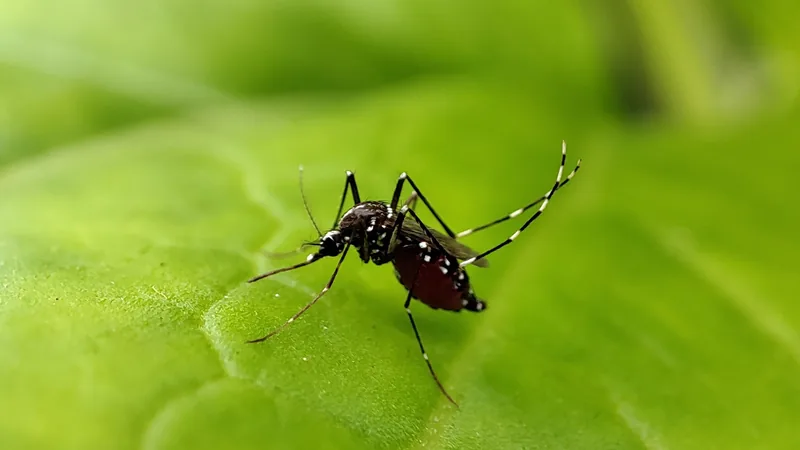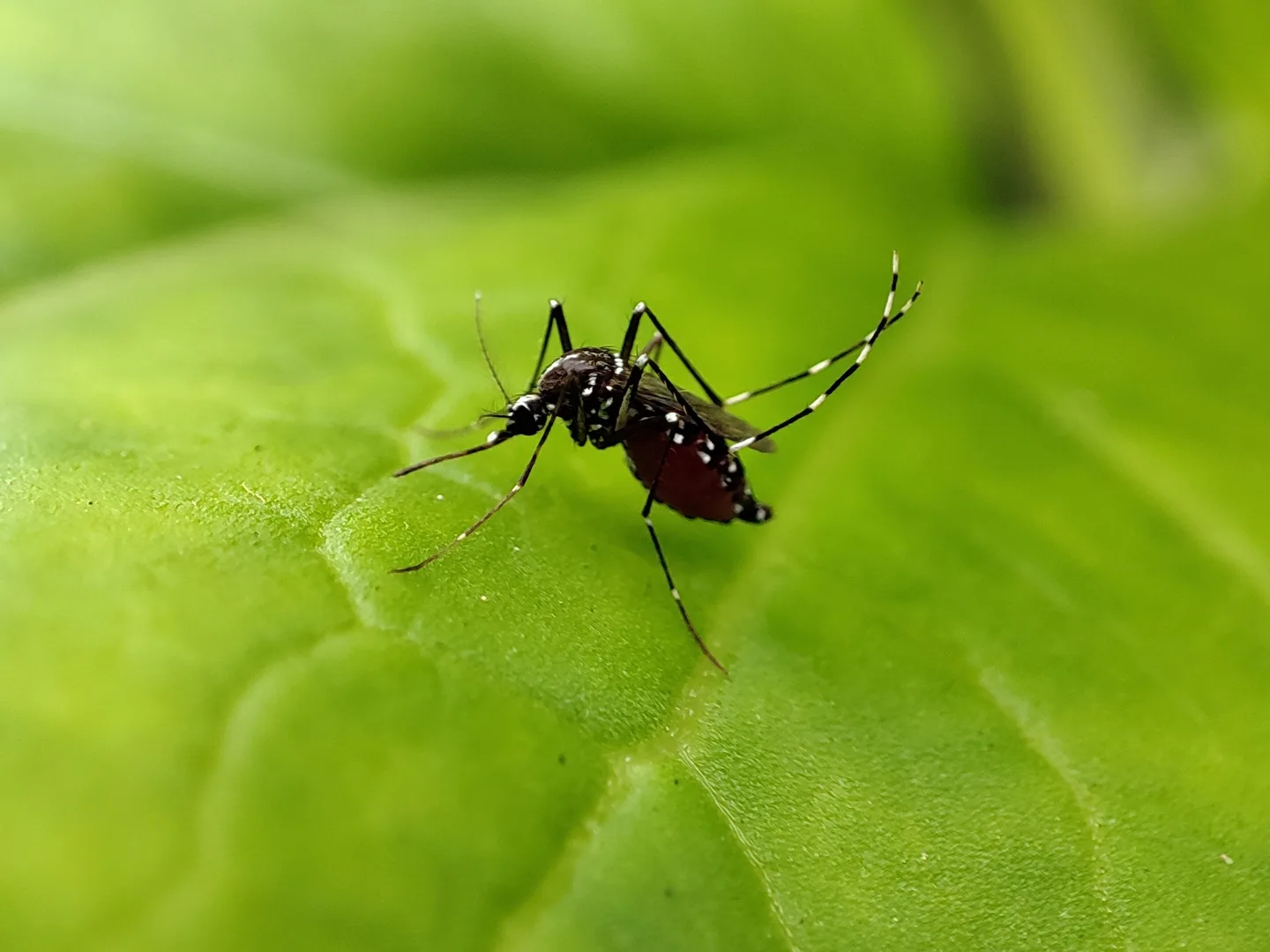
The mosquito in this photo is yellow fever mosquito, it can be identified by their white markings on legs.
Field
notes
A hunter that reads your smell
The yellow fever mosquito, Aedes aegypti, is about a quarter of an inch long. In one lab experiment, females weighed 0.69 to 3.35 mg on emerging as adults. An adult lives from two weeks to a month, depending on conditions.
Both sexes drink plant nectar. Females also bite, mostly people, to get the blood they need for making eggs. They find a meal by chemistry. One clue is octenol, a compound that people, cattle and other mammals give off. Octenol comes in a “right-handed” and a “left-handed” form, which are mirror images. Scientists put mosquito RNA into frog eggs and measured the electrical signals. The cells responded more strongly to the right-handed form.
A “domestic” form of the species has evolved to specialise in biting humans. Along the coast of Kenya it lives alongside an ancestral “forest” form that prefers to bite other animals. In the domestic form, a smell receptor called AaegOr4 is expressed more strongly and is more sensitive to a compound found at high levels in human odour.
Eggs that wait
After a full blood meal, a female produces 100 to 200 eggs per batch on average, and up to five batches in her life. Each egg is about 1 mm long. It is white when laid but turns shiny black within minutes.
The eggs can survive drying out for months. They hatch once they are submerged in water, which makes the species hard to control. The larvae that hatch, like other mosquito larvae, are often called “wrigglers.” They breathe through a siphon held above the surface and eat algae and other tiny organisms. The pupae, nicknamed “tumblers,” move but do not feed, and the pupal stage lasts about two days.
It often breeds in containers such as unused flowerpots, spare tires and rain barrels. Stopping containers around the home from collecting water is one of the most successful and cost-effective ways to cut numbers.
Spanish-American War U.S. troops suffered more casualties from yellow fever spread by Aedes aegypti than from enemy fire.
Small insect, big danger
As its name suggests, this mosquito is the primary vector of yellow fever. A vector is an animal that carries a disease from one host to another. It also spreads dengue. Most infections are mild, but severe dengue can kill: more than 12,000 dengue deaths were reported to the World Health Organization in 2024. In 1981 an outbreak in Cuba killed 159 people. It bites readily during the day, indoors and out.
Close to people
The species began in Africa. Today it lives in tropical and subtropical regions across the globe, and it thrives in urban areas. A 2015 mapping study of this species and its relative Aedes albopictus found the pair’s distributions to be the widest ever recorded, now extensive on all continents.
In Australia, scientists released mosquitoes carrying a bacterium, Wolbachia, into two wild populations. Within a few months the bacterium had reached near-fixation, meaning almost every mosquito there carried it.
Published
Traits
Intel
& FAQ
Sources
- 01Zettel Nalen & Kaufman. Yellow Fever Mosquito Aedes aegypti (Linnaeus) (Insecta: Diptera: Culicidae). EDIS, University of Florida IFAS Extension.
- 02Walker et al. (2021). Modeling the effects of Aedes aegypti’s larval environment on adult body mass at emergence. PLOS Computational Biology.
- 03McBride et al. (2014). Evolution of mosquito preference for humans linked to an odorant receptor. Nature.
- 04O'Brien (2010). ARS Study Provides a Better Understanding of How Mosquitoes Find a Host. USDA Agricultural Research Service.
- 05Kraemer et al. (2015). The global distribution of the arbovirus vectors Aedes aegypti and Ae. albopictus. eLife.
- 06Hoffmann et al. (2011). Successful establishment of Wolbachia in Aedes populations to suppress dengue transmission. Nature.
- 07Dengue and severe dengue. World Health Organization fact sheet.
What the sources say: 61 claims checked word for word against these sources →