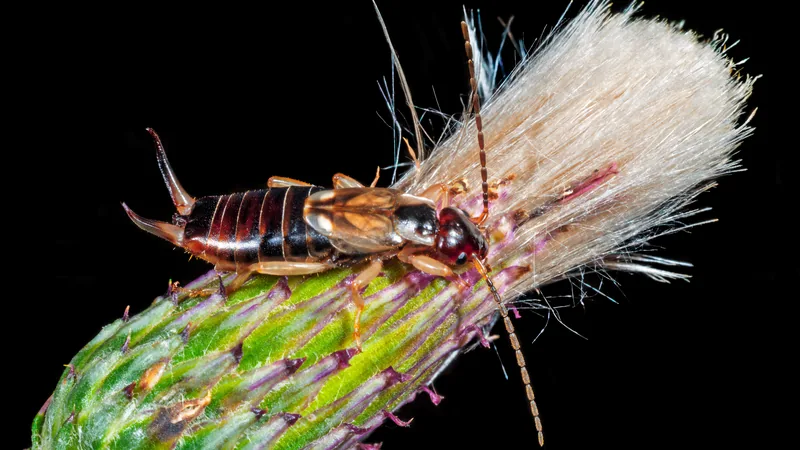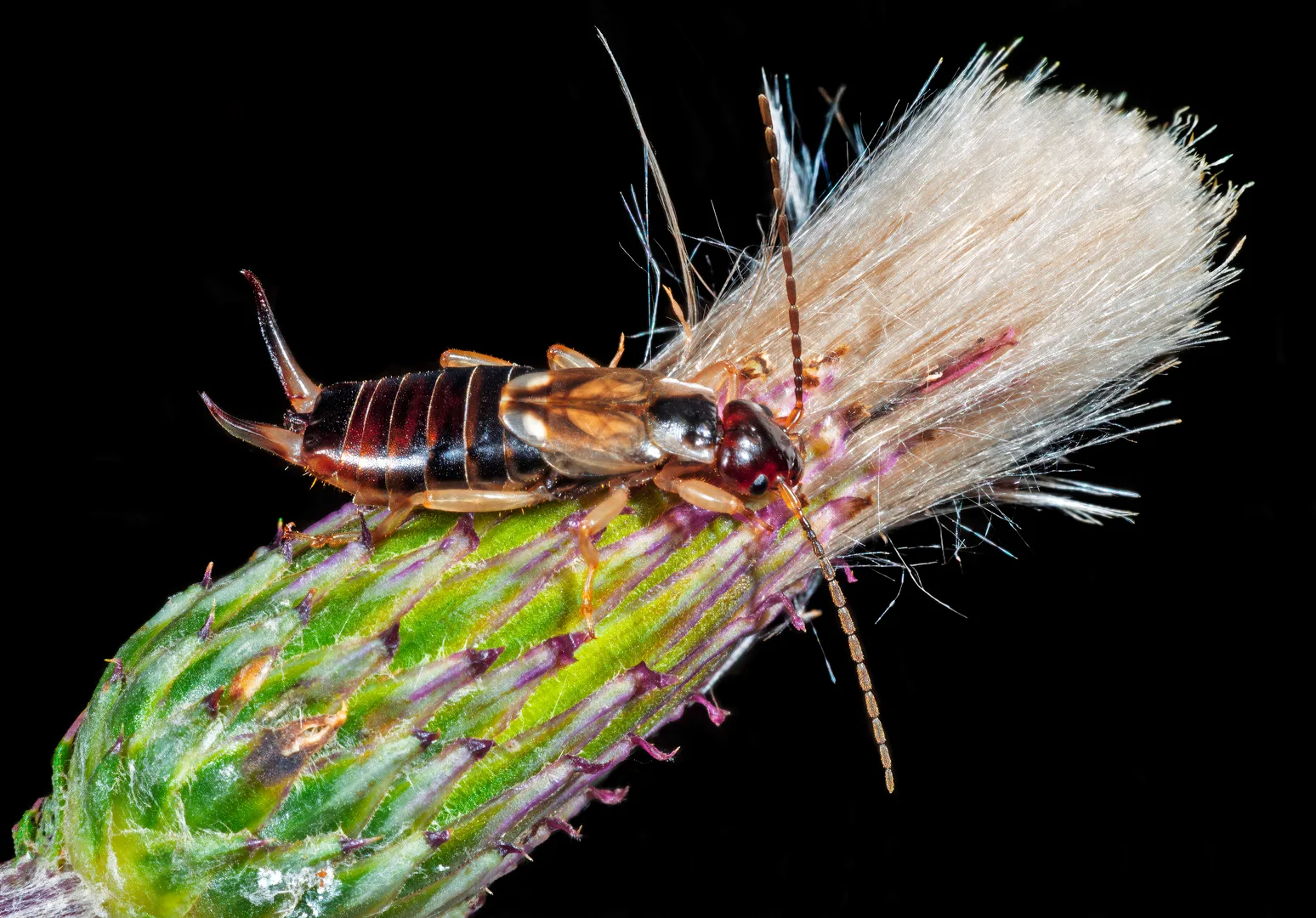
Common earwig in Fronton, Haute-Garonne, France.
Field
notes
A Mother Who Skips Dinner for Months
The European earwig, Forficula auricularia, has a trait that is rare among insects: the mother cares for her eggs and young. In late winter the female lays her eggs in a chamber in the soil and drives the male out. She grooms and turns the eggs much like a hen, frequently shifting their position. A first batch holds 30 to 55 eggs.
Once they hatch, she guards the young and feeds them until they have molted into the third stage. During this period the female does not eat, and she may not feed for as long as 7 months.
The nymphs, as young insects are called, share food with each other too. In an experiment, food eaten by one young earwig was passed to its siblings through mouth-to-anus contacts.
Pincers, Courtship and Folded Wings
The two pincers on the tail end are forceps, also called cerci. Males wave and bob them in courtship. When threatened, the earwig snaps them together. Its other defence is a set of glands in the abdomen that secrete chemicals to repel predators. Male forceps are longer and more curved than the female’s. Penn State notes that some males have forceps 5 mm long, while others have forceps 9.5 mm long.
A 2004 study of island populations found that population density drives whether males come in one forceps form or two, and traced the switch over a distance of only 40 km.
Wings Unfolded by the Tail The hind wings of Forficula auricularia fold from within the wing, driven mainly by resilin, a rubber-like protein. The wing cannot be unfolded from the thorax proper but must be unfolded by the cerci.
Size, Range and a Short Life
An adult is reddish brown. Penn State gives its length as 16 mm, and a Connecticut fact sheet as about ¾ inch. It is nocturnal, hiding by day in dark, moist places and emerging at night to hunt or scavenge. It eats aphids, maggots, mites and spiders, plus living and decaying plants.
It is native to Europe, eastern Asia and northern Africa, and today it lives on every continent except Antarctica. ADW gives a typical life of 1 year in the wild, and Penn State says the species has one generation per year.
One Name, Sibling Species
A 2000 study treats the name Forficula auricularia as a species complex. Its survey of nine populations in eastern North America found two sibling species there, called A and B.
Published
Traits
Intel
& FAQ
Guess
first
How big is a Common Earwig, really? Slide, lock in, and see what the sources say. Every answer is a figure from this page, quoted from where it came from.
Sources
- 01Forficula auricularia. Animal Diversity Web, University of Michigan.
- 02Ridge. European earwig (Forficula auricularia). The Connecticut Agricultural Experiment Station.
- 03European earwigs. Penn State Extension.
- 04Haas, Gorb & Wootton (2000). Elastic joints in dermapteran hind wings: materials and wing folding. Arthropod Structure & Development.
- 05Tomkins & Brown (2004). Population density drives the local evolution of a threshold dimorphism. Nature.
- 06Falk et al. (2014). Sibling Cooperation in Earwig Families Provides Insights into the Early Evolution of Social Life. The American Naturalist.
- 07Guillet, Josselin & Vancassel (2000). Multiple introductions of the Forficula auricularia species complex (Dermaptera: Forficulidae) in eastern North America. The Canadian Entomologist.
What the sources say: 42 claims checked word for word against these sources →