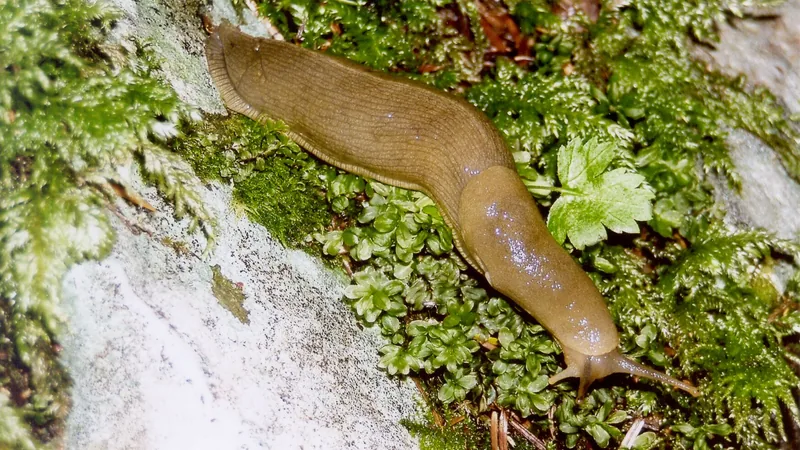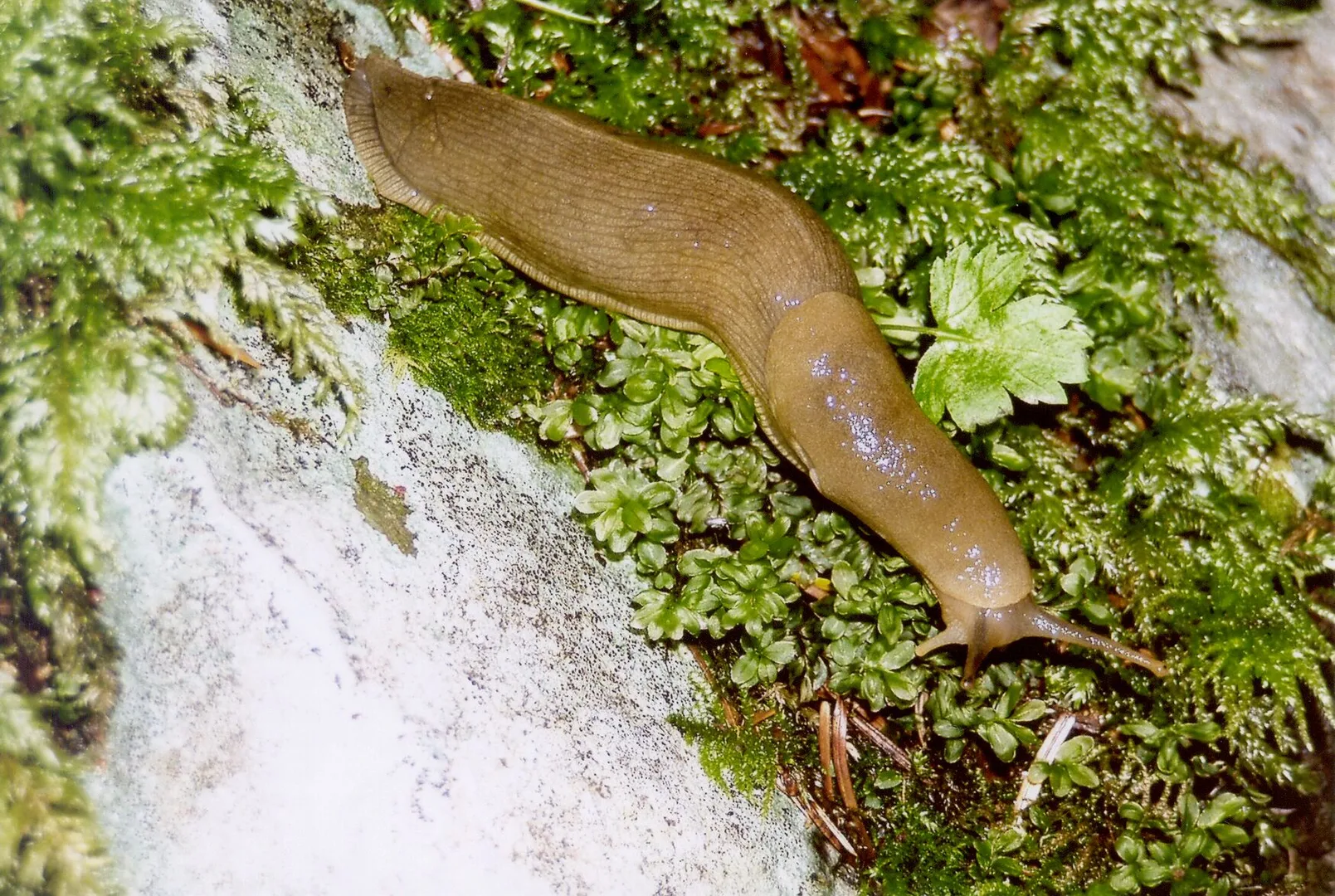
Banana Slug (Ariolimax columbianus) in the Hoh Rain Forest, Olympic National Park.
Field
notes
Slime on a hair trigger
A banana slug is wrapped in slime, and the slime comes pre-packed. The skin releases giant mucin granules, which burst outside the cell and, once hydrated, form the typical slug mucus. In lab tests, a trace of a chemical called ATP made newly secreted granules rupture. Mechanical stress and cold did the same.
Slime in a capsule The granules contain calcium, and calcium is released from a granule immediately before it bursts. The researchers propose that calcium shields the mucins, the long-chain molecules that make up slime, whose charges would otherwise stop them packing into the granule.
The coat also guards the slug. One national park page calls the mucus a defence against predators, numbing the mouth and tongue if ingested.
Yellow, long and heavy
The Pacific banana slug lives in coastal rainforests from southeast Alaska to central California. It may grow to 7 inches (20 cm) long or greater. Some are bright yellow like a banana, while others are greenish or brown. Banana slugs as a group are the largest terrestrial slug in North America, with lengths exceeding 26 cm. That 26 cm figure covers the whole genus, which holds up to six species in California.
How heavy? A two-year study of a backyard population in central California weighed 150 slugs, from 0.4 to 75.4 g. The yard was fed, though: the team kept a tray stocked with lettuce, melon rind and apples. Even so, a 107 g slug appeared on the deck in 2003, three years after the feeding ended.
Fast growth, short life
Those backyard slugs grew quickly. In both study years, slugs under a gram appeared in January and gained an average of 0.11 g a day. Weights peaked in summer, and in autumn slugs may lose up to 50% of their top weight.
Then comes the surprise. Older reports gave a lifespan of 4 to 6 years, but the team found no evidence that their backyard slugs lived more than a little over two years. That is one population, so treat it as a local result.
A forest recycler
Banana slugs eat detritus, which means decomposing plant and animal parts as well as feces. They also eat fruit, including raspberries and blackberries, and may help spread seeds. Five slugs per square meter are not uncommon. Raccoons, garter snakes, waterfowl and salamanders are known to prey on them, and shrews or moles sometimes eat the young.
Each slug is a hermaphrodite, carrying both sexes in one body. But they rarely fertilize themselves.
Published
Traits
Intel
& FAQ
Guess
first
How big is a Banana Slug, really? Slide, lock in, and see what the sources say. Every answer is a figure from this page, quoted from where it came from.
Sources
- 01Banana Slug & Millipede. National Park Service, Redwood National and State Parks.
- 02Banana Slug. National Park Service, Muir Woods National Monument.
- 03Pearson, Pearson & Ralph (2006). Growth and Activity Patterns in a Backyard Population of the Banana Slug, Ariolimax columbianus. The Veliger.
- 04Verdugo et al. (1987). Molecular Mechanism of Mucin Secretion: I. The Role of Intragranular Charge Shielding. Journal of Dental Research.
- 05Deyrup-Olsen et al. (1992). Triggering by ATP of product release by mucous granules of the land slug Ariolimax columbianus. American Journal of Physiology-Cell Physiology.
- 06Genetti et al. (2025). Secrets of the Goo: The genome assembly of the Pacific banana slug, Ariolimax columbianus. Journal of Heredity.
What the sources say: 43 claims checked word for word against these sources →