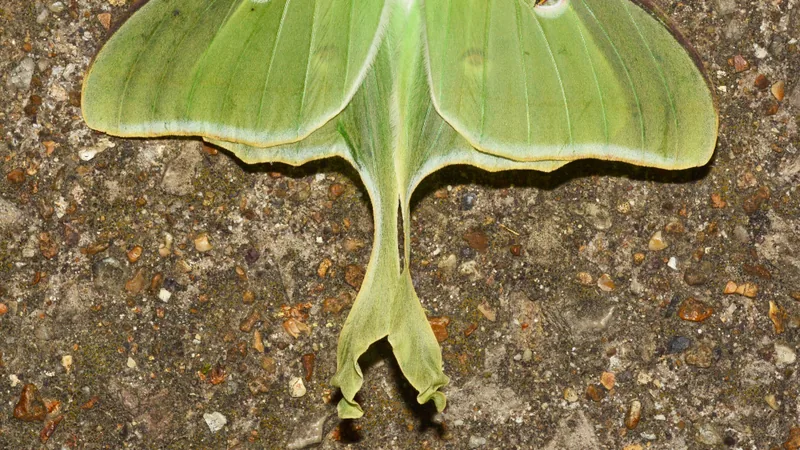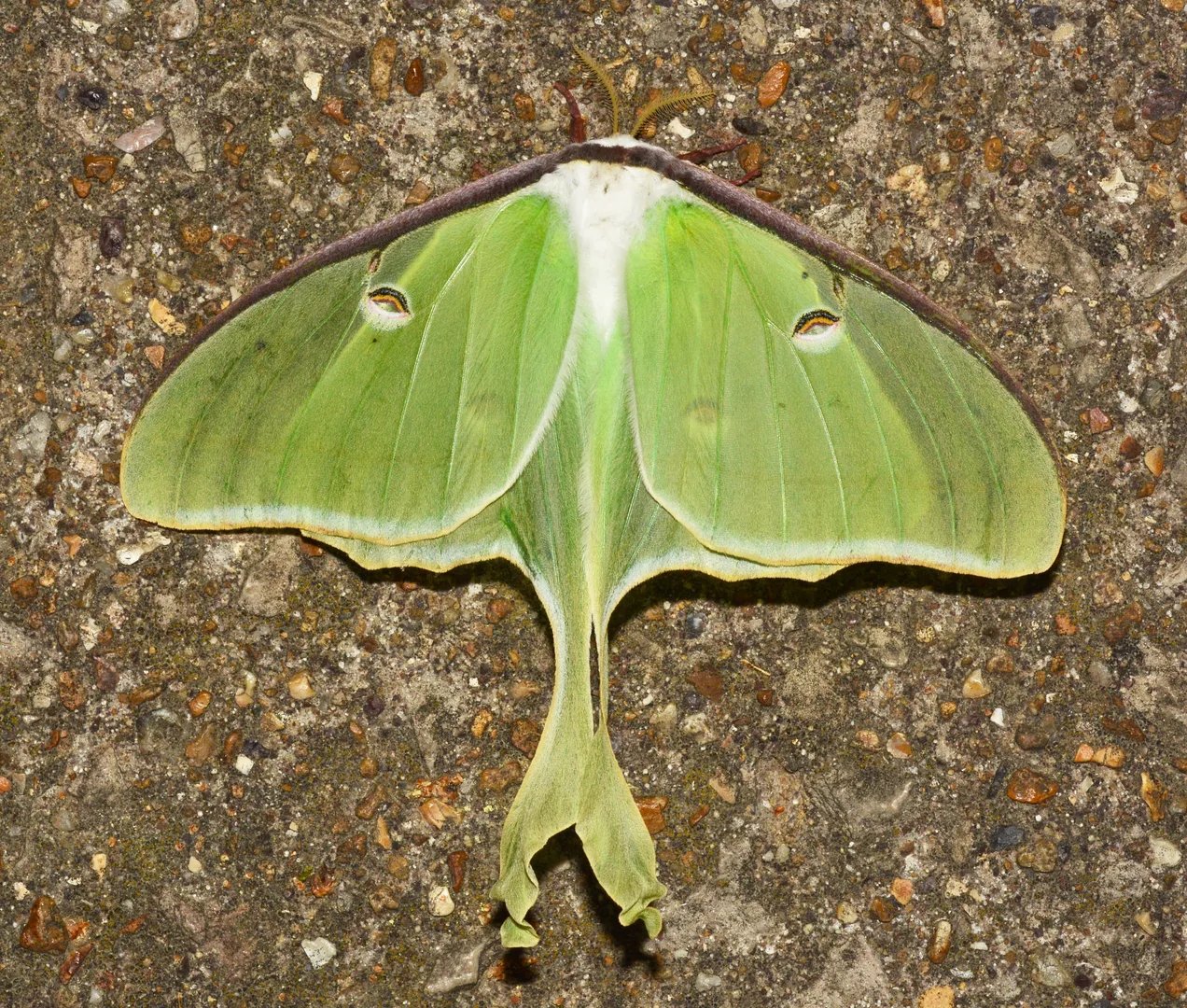
Resting with wings spread, tails trailing behind.
Field
notes
Tails that fool bats
The luna moth (Actias luna) is a pale green giant silk moth with a long tail trailing from each hindwing. Those tails are decoys. Researchers used high-speed infrared video to watch luna moths spin their tails to deflect attacks by echolocating bats (hunters that find prey by the echoes of their own calls) away from the body and toward the tails. Tails lured bat attacks to themselves in 55% of encounters with intact moths, and moths with tails had a survival advantage of about 47% over moths whose tails were removed.
Four times over Long spatulate (spatula-shaped) tails have evolved independently four times in saturniid moths, the family of giant silk moths the luna belongs to.
A second study found that the tail echoes are weak compared with those of the wings and body. Their twisted shape, though, creates echoes that persist from every angle, which may make a bat misjudge where the moth is.
An adult with no appetite
The adult wingspan is 75 to 105 mm, about 3 to 4 inches. Adults have vestigial (leftover) mouthparts and do not feed, so they are short-lived. A new adult cuts its way out of the cocoon with serrated, chitinous spurs on its thorax, and it usually emerges in the morning, which allows time for its wings to expand and dry before the evening flight period.
A female releases a sex-attractant pheromone, a scent signal, and may attract males from a distance. Researchers identified its compounds, made them artificially, and found in field trials in Ontario and Kentucky that male moths were attracted to one of them on its own. Mating usually takes place during the first couple of hours after midnight.
A caterpillar that clicks
A full-grown caterpillar is bright green and 55 to 70 mm long. Its green coloration hides it, and when threatened it often rears up the front of its body in a “sphinx” pose. If attacked, it also makes a clicking noise with its mandibles, sometimes as a prelude to, or alongside, spitting up distasteful fluid. A study of clicking caterpillars found that luna caterpillars make airborne sounds upon attack, and that the sounds precede regurgitation.
The northernmost populations most often eat white birch. Farther south, caterpillars use a variety of host plants, particularly walnuts and hickories, sumacs, sweetgum and persimmon. Development from hatching to pupation takes a month or longer, depending on temperature.
Where it lives
The luna moth is usually found in forested areas. In southern Canada it occurs from Nova Scotia to Saskatchewan. In the United States it is found in every eastern state from Maine south to Florida, and west to eastern Texas and eastern North Dakota. Moths from southern populations tend to be smaller.
Published
Traits
Intel
& FAQ
Guess
first
How big is a Luna Moth, really? Slide, lock in, and see what the sources say. Every answer is a figure from this page, quoted from where it came from.
Sources
- 01Hall (2007). Luna Moth, Actias (=Tropaea) luna (Linneaus) (Insecta: Lepidoptera: Saturniidae: Saturniinae). EDIS, University of Florida.
- 02Barber et al. (2015). Moth tails divert bat attack: Evolution of acoustic deflection. Proceedings of the National Academy of Sciences.
- 03Lee & Moss (2016). Can the elongated hindwing tails of fluttering moths serve as false sonar targets to divert bat attacks? The Journal of the Acoustical Society of America.
- 04Brown, Boettner & Yack (2007). Clicking caterpillars: acoustic aposematism in Antheraea polyphemus and other Bombycoidea. Journal of Experimental Biology.
- 05Millar et al. (2016). Sex Attractant Pheromone of the Luna Moth, Actias luna (Linnaeus). Journal of Chemical Ecology.
- 06Actias luna (luna moth). Animal Diversity Web, University of Michigan.
What the sources say: 49 claims checked word for word against these sources →