These are huge!
Field
notes
The Moth That Squeaks
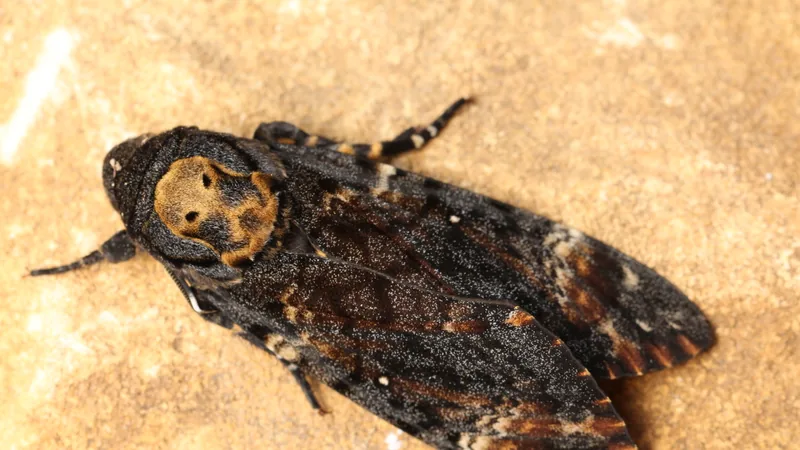
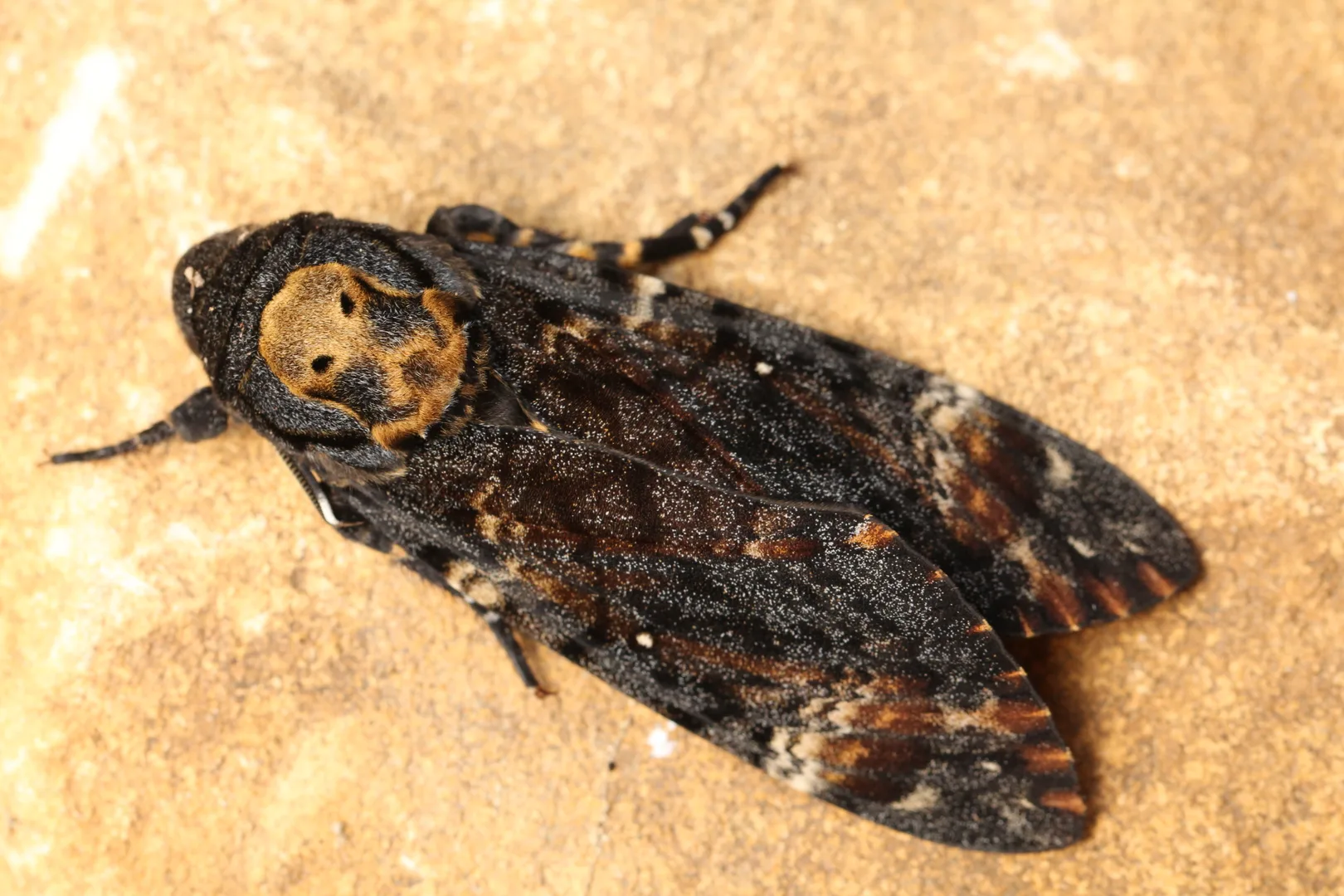
The death’s-head hawkmoth (Acherontia atropos) is a big, night-flying moth with a party trick. When it is alarmed, it squeaks, drawing air into its pharynx (throat) and pushing it back out.
Scientists studied six of these moths with X-ray video and sound recordings. One squeak lasts about 200 milliseconds. It opens with a burst of about 50 pulses as air is drawn in, with its strongest frequency at about 8 kHz and harmonics reaching past 60 kHz. After a short pause, the air goes back out in a quieter phase. The researchers call the squeak a defence mechanism.
Honey Thief
Sharp tongue In the two moths one 2022 study measured, the stout proboscis was 10.8 and 12.4 mm long. It ends in a sharp point, a tip shape the researchers call unique within the whole order of moths and butterflies.
These moths are known to invade beehives of the honey bee (Apis mellifera) and can penetrate sealed honeycombs. Biologists call that cleptoparasitism: stealing food that another animal collected. The proboscis is most likely an adaptation for getting honey inside a hive, and its length matches the depth of a honeycomb, typically 12.5 to 17.7 mm.
Honey is also 10 to 100 times thicker (more viscous) than nectar. This moth is fully nocturnal and does not hover as it feeds. In 2025, researchers reported the first documented record of it as a cleptoparasite of honey bees in Rahim Yar Khan, the southernmost district of Punjab, Pakistan.
The Skull on Its Back
The thorax (the middle body section) carries a famous skull-like mark. A 2020 paper offers a new reading of it: viewed upside-down, the whole moth gives the illusion of an eyed head. The skull’s “eye-sockets” become nostrils, and spots on the forewings become small eyes. In the author’s view, the function of such images is almost certainly to deter, distract or otherwise deceive predators.
A Big Visitor
With a wingspan of 80 to 120 mm, it is a large moth. It lives in southern Europe. Most years it arrives in south and east England as an immigrant, and it has been spotted as far north as the Shetland Islands. Its caterpillars feed on potato, deadly nightshade and other nightshade-family plants, and in a good immigration year they can be seen in potato fields. The moth cannot survive British winters.
Published Updated
Traits
Intel
& FAQ
Guess
first
How big is a Death's-Head Hawkmoth, really? Slide, lock in, and see what the sources say. Every answer is a figure from this page, quoted from where it came from.
Sources
- 01Death's-head Hawk-moth (Acherontia atropos). Butterfly Conservation.
- 02Brehm et al. (2015). The unique sound production of the Death’s-head hawkmoth (Acherontia atropos (Linnaeus, 1758)) revisited. The Science of Nature.
- 03Reinwald et al. (2022). Evolutionary functional morphology of the proboscis and feeding apparatus of hawk moths (Sphingidae: Lepidoptera). Journal of Morphology.
- 04Kornev et al. (2017). Structural and physical determinants of the proboscis–sucking pump complex in the evolution of fluid-feeding insects. Scientific Reports.
- 05Theobald, Warrant & O'Carroll (2009). Wide-field motion tuning in nocturnal hawkmoths. Proceedings of the Royal Society B: Biological Sciences.
- 06Craik (2020). A new interpretation of the 'skull' of the Death's-head Hawk-moth Acherontia atropos (Linnaeus, 1758) (Lepidoptera: Sphingidae). Entomologist's Gazette.
- 07Bodlah et al. (2025). First record of Deaths Head Hawkmoth Acherontia atropos (Linnaeus, 1758) (Lepidoptera: Sphingidae), A Kleptoparasite of Honey Bees from Rahim Yar Khan, Punjab, Pakistan. Journal of Agriculture and Veterinary Science.
- 08van Deijk, Parsons & van Swaay (2026). Acherontia atropos. The IUCN Red List of Threatened Species 2026: e.T260200203A260200213.
What the sources say: 49 claims checked word for word against these sources →