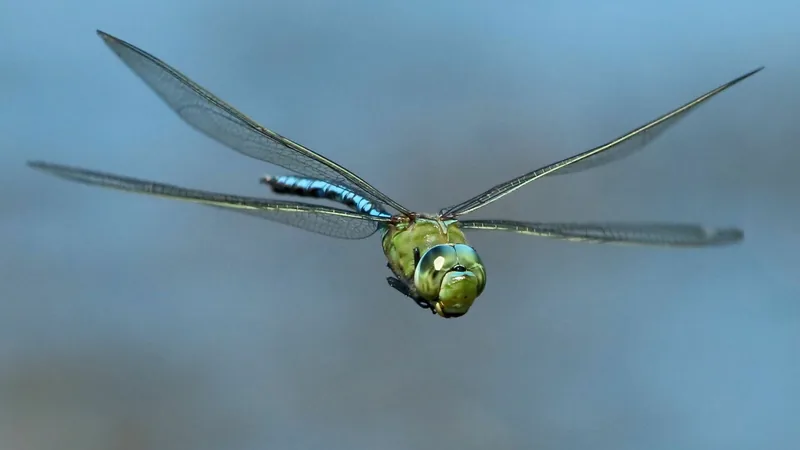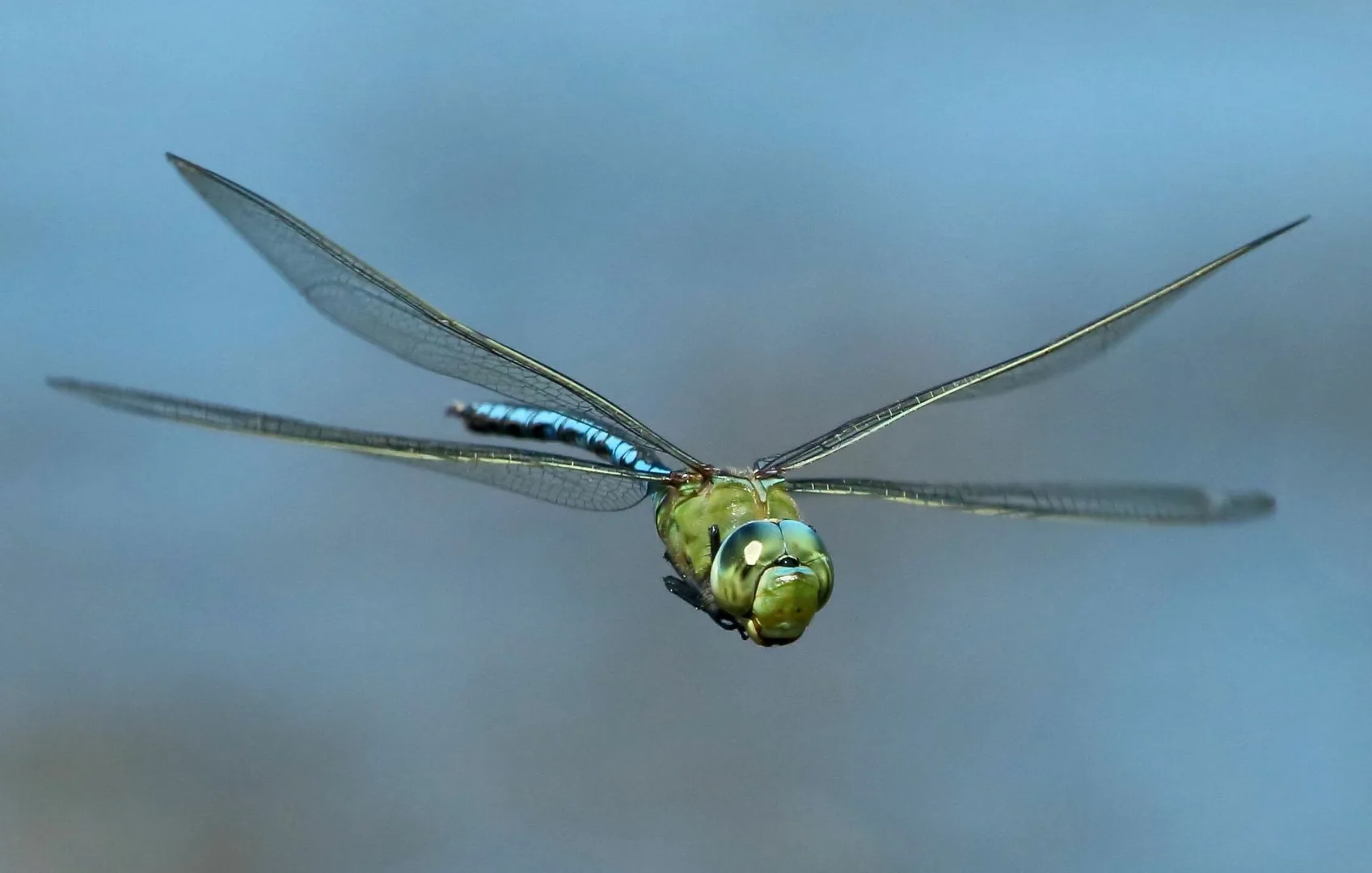
Male blue emperor Anax imperator in flight at Cedara, KwaZulu-Natal.
Field
notes
A mouthpart that fires
The emperor dragonfly, Anax imperator, starts life underwater. The young form, called a larva, is a hunter with an odd weapon. Dragonfly larvae catch prey by shooting out a labial mask, a mouthpart with movable hooks. Scientists call this kind of strike ballistic, like the tongue of a chameleon or a frog.
Too fast to dodge In lab tests, emperor larvae struck at 0.03 to 0.25 metres per second, more than 10 times faster than the water fleas they hunted could swim. The prey had no time to escape. Whether it caught them depended mainly on aim: about 40% of mistakes fell short of the target and about 60% aimed above or below it.
An earlier study of Anax larvae, the emperor’s genus, timed the mask at 25 to 40 milliseconds to extend fully. The larva is as voracious as the adult, and the Sussex Wildlife Trust says it will gorge on anything smaller than itself, tadpoles and small fish included.
Big, but about a gram
It is Britain’s bulkiest dragonfly: an adult is about 78 mm long with a wingspan of about 10.5 cm. In a study in Normandy, France, mature females averaged 1.26 g and mature males 0.97 g. The larva reaches 45 to 56 mm.
An adult may live for a couple of months or more, but the Sussex Wildlife Trust says it spends around ten times longer underwater as a larva.
King of the pond
Male emperors are very territorial. They patrol the water’s edge and chase off intruders, and the Sussex Wildlife Trust describes them clashing with other dragonflies in the air. Emperors rarely settle, even eating prey in flight. Their menu includes large butterflies and other dragonflies. Adults have biting-chewing mouthparts.
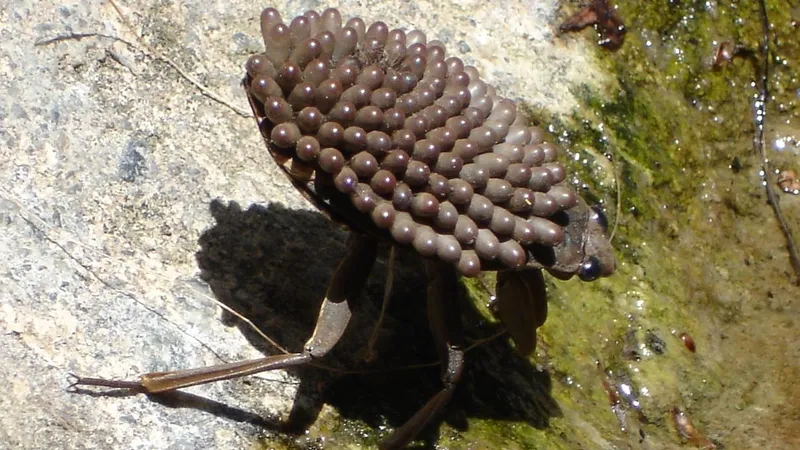
The female lays her eggs alone, in floating pondweed.
Where it lives
The emperor is widespread across the Old World, in all types of standing and slow-running fresh water. It is found throughout most of Europe and eastern Asia and is common in much of Africa. In Britain it lives in Wales and most of England, and it has been recorded in Scotland since 2003. The IUCN Red List rates it Least Concern.
Published
Traits
Intel
& FAQ
Guess
first
How big is a Emperor Dragonfly, really? Slide, lock in, and see what the sources say. Every answer is a figure from this page, quoted from where it came from.
Sources
- 01Vinko et al. (2024). Anax imperator. The IUCN Red List of Threatened Species 2024: e.T59812A208815239.
- 02Quenta Herrera et al. (2018). Temperature effects on ballistic prey capture by a dragonfly larva. Ecology and Evolution.
- 03Minot, Le Gall & Huste (2019). Biometry of the large dragonfly Anax imperator (Odonata: Aeshnidae): A study of traits from larval development to adults. European Journal of Entomology.
- 04Sharkey, Partridge & Roberts (2015). Polarization sensitivity as a visual contrast enhancer in the Emperor dragonfly larva, Anax imperator (Leach, 1815). Journal of Experimental Biology.
- 05Herzog et al. (2016). The complete mitochondrial genome of the emperor dragonfly Anax imperator LEACH, 1815 (Odonata : Aeshnidae) via NGS sequencing. Mitochondrial DNA Part B.
- 06Josten, Gorb & Büsse (2022). The mouthparts of the adult dragonfly Anax imperator (Insecta: Odonata), functional morphology and feeding kinematics. Journal of Morphology.
- 07Emperor Dragonfly. British Dragonfly Society.
- 08Duncan. Species of the day: Emperor Dragonfly. Sussex Wildlife Trust.
- 09Anax imperator - Emperor dragonfly. First Nature.
What the sources say: 47 claims checked word for word against these sources →