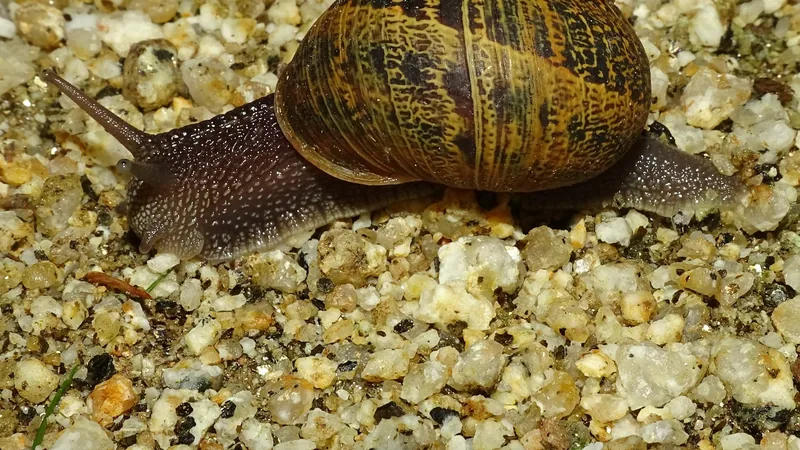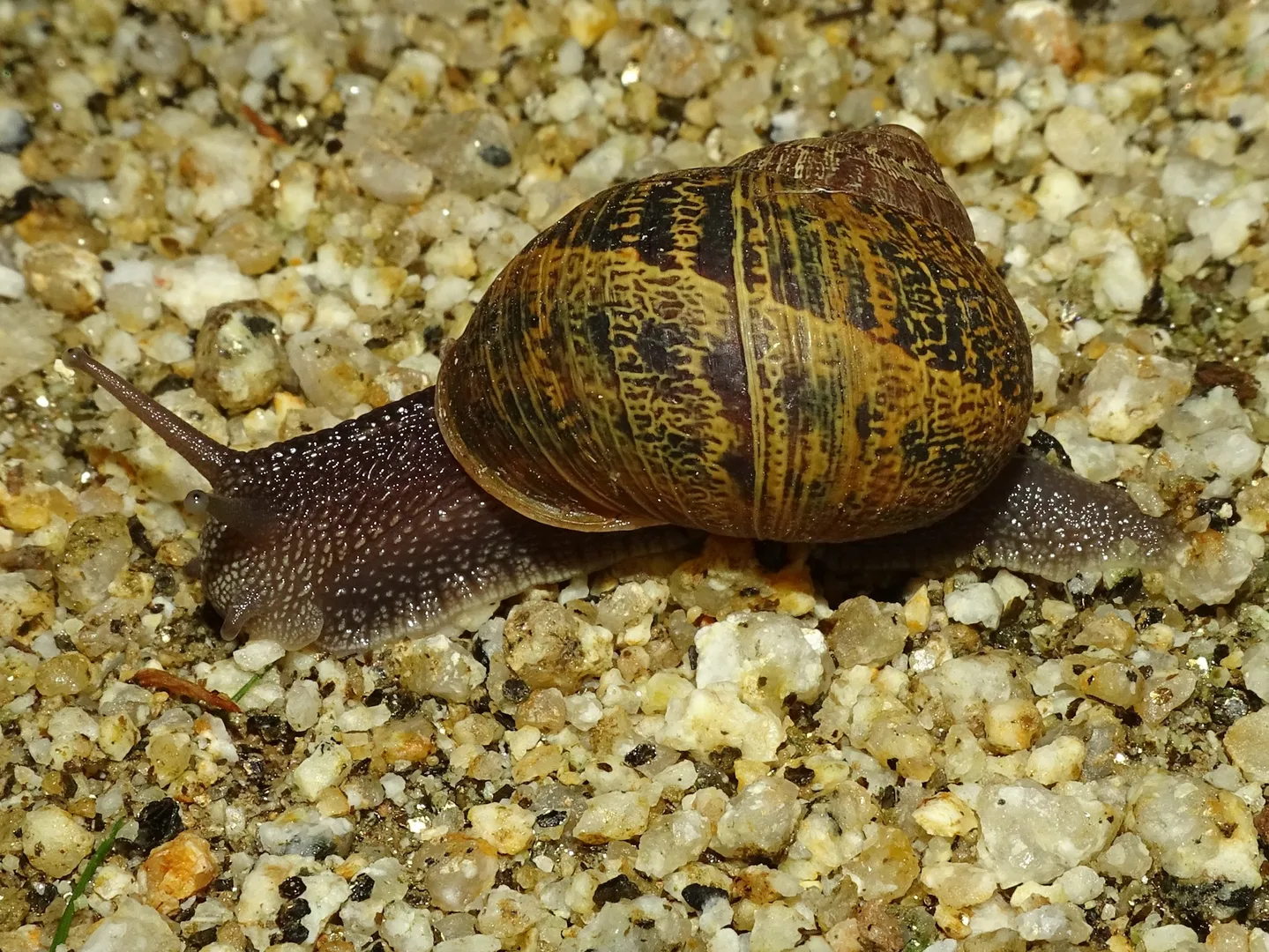
Garden Snail (Cornu aspersum), Orange County, US-CA, US
Field
notes
Three kinds of slime
The garden snail, Cornu aspersum, is a slime factory. It makes three different kinds of mucus (the sticky slime snails ooze): one shielding the animal from environmental threats, one adhesive mucus from the pedal surface of the foot, and a lubricating mucus from the foot too. The foot is a muscle that glides the snail along. It constantly secretes mucus, which later dries to form the silvery slime trail.
Epiphragm The adhesive mucus is used to create the epiphragm, the persistent glue that maintains bonds between the snail’s shell and the surface it sits on.
A year in the life
How big is a garden snail? The adult shell is 32 to 38 mm across and 29 to 33 mm tall. In a Chilean study, adults picked for roughly the same body mass averaged 4.21 grams and were thought to be under a year old. Maturity takes about two years in southern California but about 10 months in South Africa. EDDMapS says that under favorable conditions it may mature within a year, and that adults can normally live about a year.
Night shift
At night, the snail goes to work. Snails are most active at night and on cloudy or foggy days. On sunny days they seek hiding places out of the heat and bright light. They feed on a variety of living plants and on decaying plant matter, scraping with rasp-like tongues.
When the weather turns hot and dry, the snail estivates, which is hibernation during hot weather. It seals itself off with a parchment-like membrane and often clings to a tree trunk, fence or wall. In cold weather it hibernates in the topsoil instead.
Spread across the world
The garden snail is native to Britain, western Europe and the lands around the Mediterranean and Black Seas, but it has been distributed widely worldwide, on purpose and by accident. It was originally introduced for escargot dishes, meaning snails cooked to eat, and it has escaped confinement and become established as a pest. One study calls it one of the most widely spread land snails in the world. It was brought to South Africa as food in 1855, though one expert thinks it probably arrived there by accident long before, and the Pacific’s oldest recorded introduction was in New Caledonia in 1879.
The USDA and the Canadian Food Inspection Agency both considered it a plant pest in 2009, and quarantines were set up to stop the snail being imported in plant and soil material.
The IUCN Red List’s 2024 Europe assessment rates it Least Concern, with a stable population trend.
Published Updated
Traits
Intel
& FAQ
Guess
first
How big is a Garden Snail, really? Slide, lock in, and see what the sources say. Every answer is a figure from this page, quoted from where it came from.
Sources
- 01Cerullo et al. (2023). Comparative mucomic analysis of three functionally distinct Cornu aspersum Secretions. Nature Communications.
- 02Snails and Slugs. UC Statewide IPM Program, University of California.
- 03European brown snail (Cornu aspersum). EDDMapS, University of Georgia Center for Invasive Species and Ecosystem Health.
- 04Gaitán-Espitia et al. (2013). Variation in Thermal Sensitivity and Thermal Tolerances in an Invasive Species across a Climatic Gradient: Lessons from the Land Snail Cornu aspersum. PLoS ONE.
- 05Guiller et al. (2012). Tracing the Invasion of the Mediterranean Land Snail Cornu aspersum aspersum Becoming an Agricultural and Garden Pest in Areas Recently Introduced. PLoS ONE.
- 06Walther (2026). Cornu aspersum. The IUCN Red List of Threatened Species 2026: e.T156890A220141565.
- 07Cornu aspersum (European brown garden snail): Fact sheet. Canadian Food Inspection Agency.
- 08Dekle and Fasulo. Brown Garden Snail, Cornu aspersum. University of Florida IFAS Extension, EDIS IN396.
What the sources say: 48 claims checked word for word against these sources →