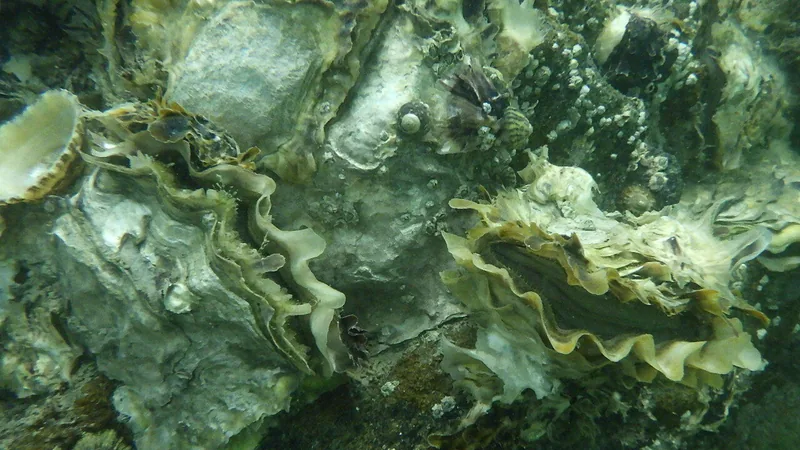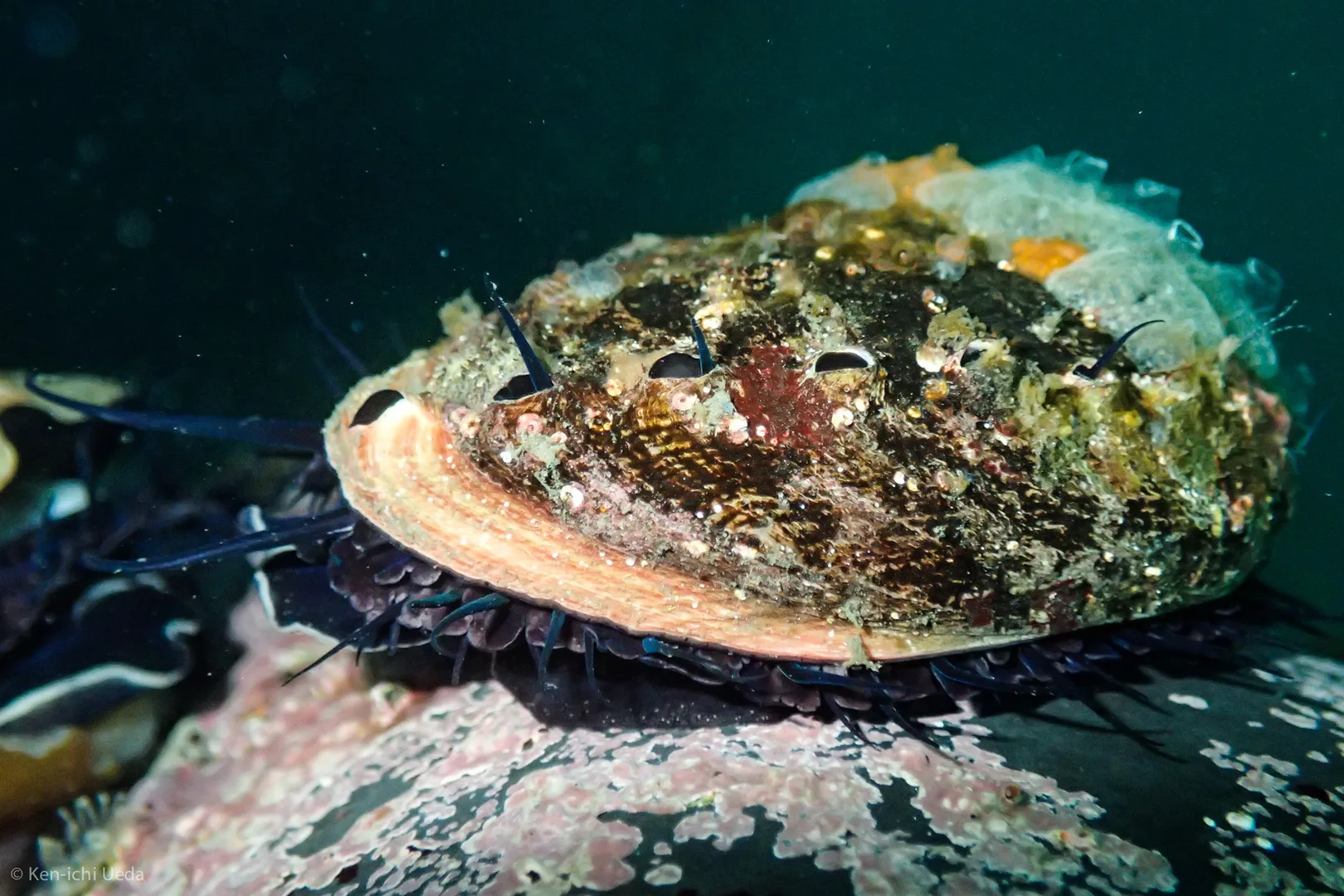
Red Abalone (Haliotis rufescens), California, US
Field
notes
The Clamp
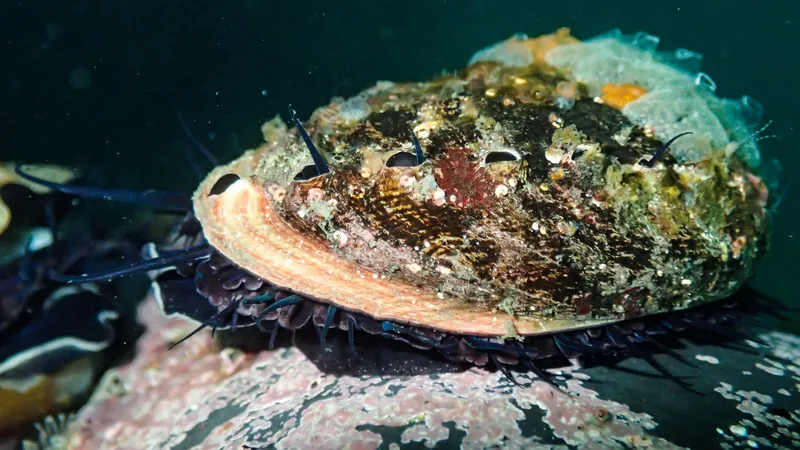
A disturbed red abalone (Haliotis rufescens) draws in its foot and mantle and clamps its shell down onto the rock. It is a gastropod, a one-shelled mollusc related to snails and sea slugs, and in that attached position the strength of its foot muscle makes it extremely difficult to detach. The massive foot works like a very powerful suction cup.
Red abalone are the largest and most common of the eight abalone species in California waters. Shell length today averages up to 20 centimeters (8 inches), and the maximum reported for an abalone that avoids harvest is 30 centimeters (12 inches). Lifespan is about 30 to 35 years. Its range runs from Sunset Bay, Oregon to Bahia Tortugas, Baja California, Mexico.
Breathing Through Holes
An abalone breathes and gets rid of waste through a row of holes on one side of its shell. Its gill chambers sit under the holes: water drawn in under the edge of the shell flows over the gills and out through them. The same holes carry out eggs and sperm. There are typically 3 to 5 holes, which fill in and are replaced by new ones as the animal ages.
Red abalone are herbivores. In Southern California adults feed mainly on giant and feather boat kelp, and in Northern California on bull kelp. A feeding abalone traps the alga beneath its body and eats it with small rasp-like teeth and a tongue that often measures a third of its total body length.
Tougher than its own ingredient The red abalone’s nacre, or mother-of-pearl, is 95% aragonite by mass. Aragonite is a hard but brittle mineral, yet nacre is 3000-fold tougher than aragonite.
Six Million Eggs
Red abalone are broadcast spawners: eggs and sperm are flushed out into the water through the shell holes. A large adult can release as many as six million eggs. When one abalone begins to spawn it usually triggers others in the group, and spawners need to be no more than 1.5 meters (5 feet) apart for spawning to succeed. The swimming larvae stay up in the water column for several days to a week before they start searching for somewhere to attach, and a chemical from coralline red algae called gamma-aminobutyric acid (GABA) stimulates them to settle and stop swimming.
In Trouble
Abalone were once abundant and supported thriving commercial and sport fisheries in California. The IUCN Red List now rates the red abalone Critically Endangered. The Aquarium of the Pacific lists overfishing, disease, populations too thin to spawn well, predation by sea otters and illegal poaching among the reasons abalone are in trouble. In December 2025 the California Fish and Game Commission voted to keep the recreational red abalone fishery closed through April 1, 2036.
Published Updated
Traits
Intel
& FAQ
Guess
first
How big is a Red Abalone, really? Slide, lock in, and see what the sources say. Every answer is a figure from this page, quoted from where it came from.
Sources
- 01Red Abalone. Aquarium of the Pacific, Online Learning Center.
- 02Haliotis rufescens. Animal Diversity Web, University of Michigan.
- 03Haliotis rufescens summary page. SeaLifeBase.
- 04Peters, Rogers-Bennett & De Shields (2021). Haliotis rufescens. The IUCN Red List of Threatened Species 2021: e.T78771583A78772573.
- 05Gilbert et al. (2008). Gradual Ordering in Red Abalone Nacre. Journal of the American Chemical Society.
- 06Stierch (2025). California extends recreational red abalone fishing closure through 2036. The Mendocino Voice (Bay City News).
What the sources say: 43 claims checked word for word against these sources →