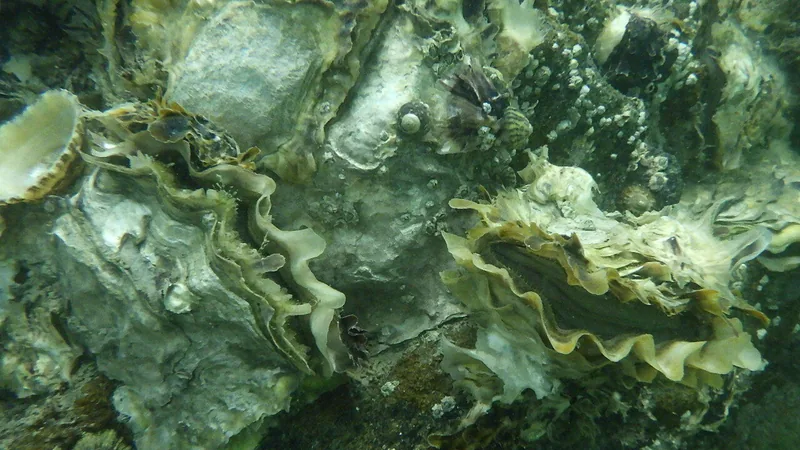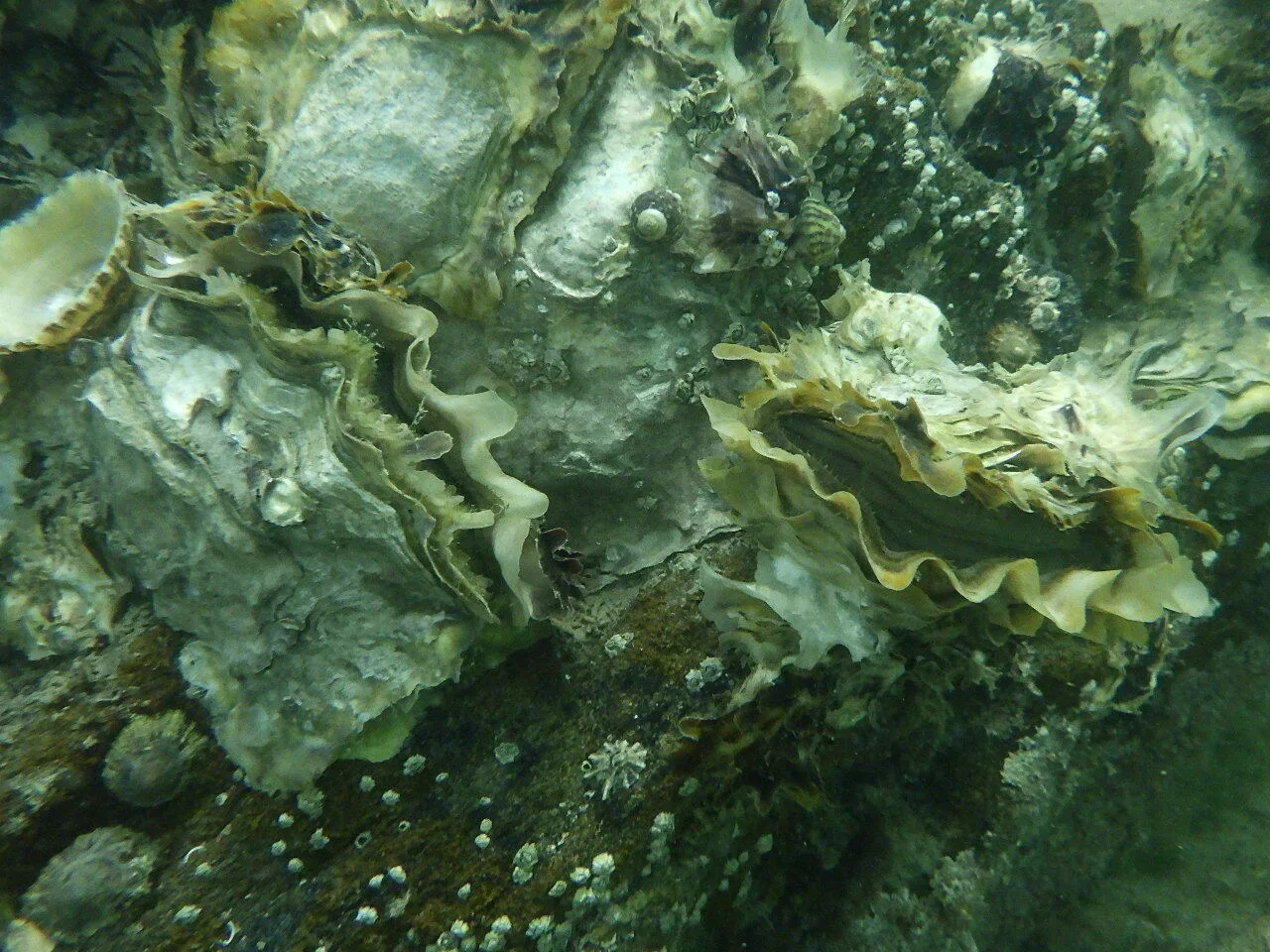
Pacific Oyster (Magallana gigas), Ille-et-Vilaine, Bretagne, France
Field
notes
An oyster that can hear a cargo ship
The Pacific oyster, Magallana gigas, stays in one place for life once it settles. That is what “sessile” means. Yet it can hear. In a lab test, oysters briefly shut their valves when they were played loud enough sounds from 10 hertz to just under 1,000 hertz. Valves are the two halves of the shell. Hertz counts sound waves per second. Their sensitivity peaked between 10 and 200 hertz.
In a 14-day test with cadmium, a metal pollutant, in the water, oysters exposed to cargo ship noise grew 2.6 times slower than oysters that heard no ship noise. They also stayed shut more during the day.
Shell clapping Male oysters release their sperm by clapping their shells together, often when the water is warm and coming in with the tide.
Male first, maybe female later
In their first year of life, Pacific oysters are male. As they get older, some develop female reproductive organs while their male organs shrink. A female can release anywhere from 50 to 200 million eggs in a spawning event.
The tiny larvae drift in the upper layers of the water. After about 20 to 22 days they settle on a shell, rock or other suitable surface, grow their own shells and can live there for the rest of their lives.
Size, weight and lifespan
NOAA says a Pacific oyster can reach 10 to 12 inches. Its shell is long, thick and rough, and sometimes sharp around the edges. One of the two valves is cupped, which is why the animal is also called the Pacific cupped oyster. The other valve is flat.
In one hearing study, five oysters with shells 70 to 75 millimeters long weighed 72 grams on average. AnAge lists a maximum of 7 years in the wild.
A water filter that went global
Oysters are filter feeders. An adult can filter up to 50 gallons of seawater a day, and that filtering improves light penetration for underwater plants. Oysters can also form reefs that give critical habitat to many species, including fish and invertebrates like the native Olympia oyster.
The species is native to the northwest Pacific, from Hong Kong east to Taiwan and north to Kamchatka, Russia. It lives in intertidal and subtidal areas, meaning both the shore zone that the tide uncovers and the water below it. The Washington State Department of Fisheries introduced it from Japan in the 1920s, and it is now a popular aquaculture species on the US West Coast. SeaLifeBase lists it as introduced across the rest of the Pacific, the Atlantic, the Indian Ocean and the Mediterranean.
Published
Traits
Intel
& FAQ
Guess
first
How big is a Pacific Oyster, really? Slide, lock in, and see what the sources say. Every answer is a figure from this page, quoted from where it came from.
Sources
- 01Pacific Oyster. NOAA Fisheries.
- 02Magallana gigas summary page. SeaLifeBase.
- 03Crassostrea gigas. AnAge: The Animal Ageing and Longevity Database.
- 04Charifi et al. (2017). The sense of hearing in the Pacific oyster, Magallana gigas. PLOS ONE.
- 05Charifi et al. (2018). Noise pollution limits metal bioaccumulation and growth rate in a filter feeder, the Pacific oyster Magallana gigas. PLOS ONE.
What the sources say: 41 claims checked word for word against these sources →