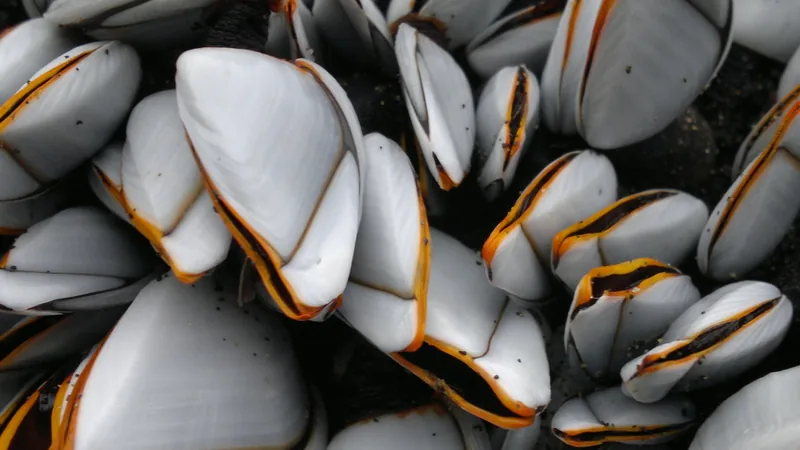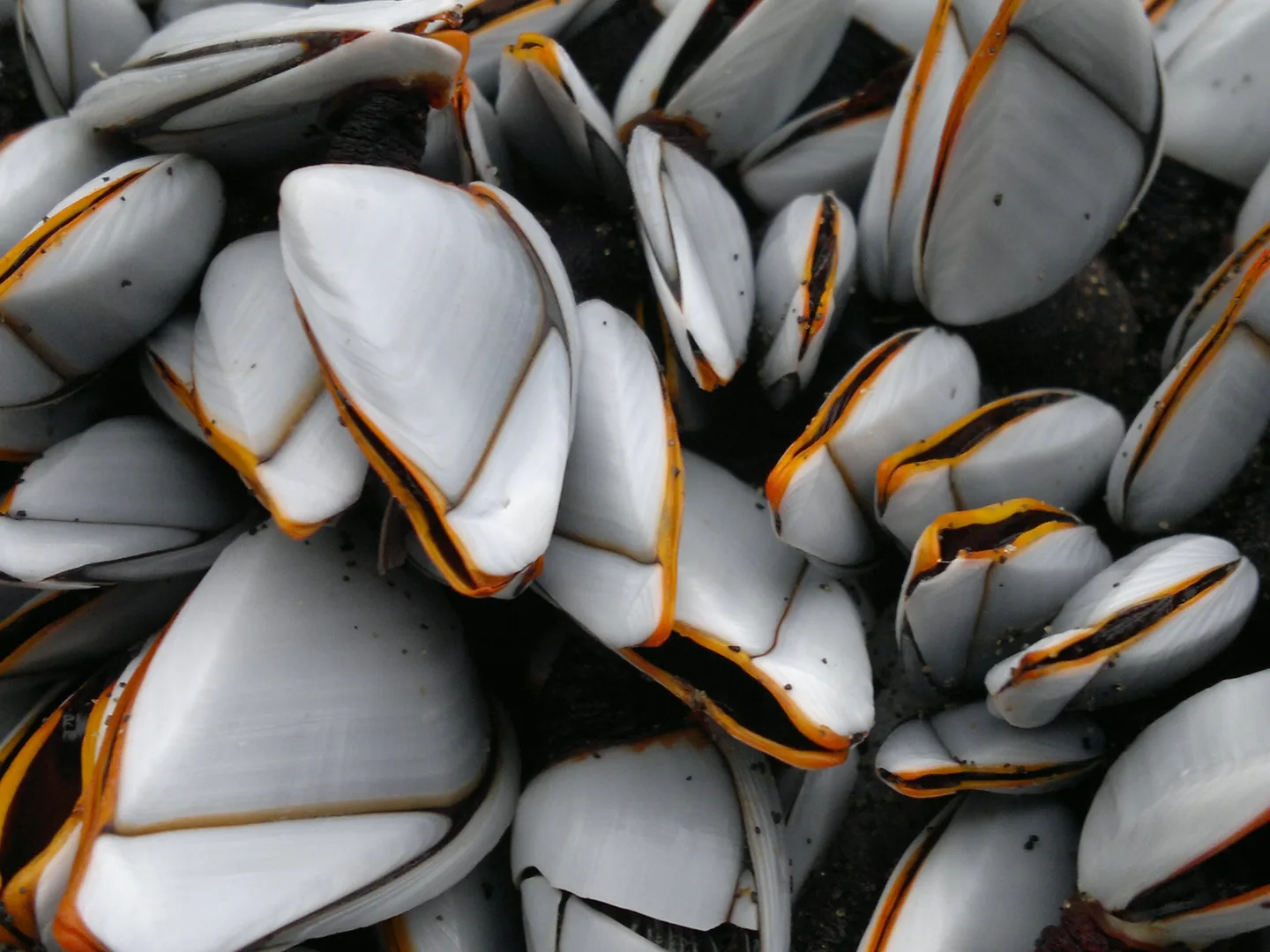
Goose barnacles in Madera
Field
notes
Glue that breaks the rules
Barnacles are the only sessile crustaceans: they glue the base of their bodies to a surface. A goose barnacle does not move unless it is torn from that surface. It makes its glue in large single-cell glands, each 70 to 180 micrometres across.
Staining tests found that two chemicals, L-3,4-dihydroxyphenylalanine and phosphoserine, are missing from the glue-making tissue. That showed barnacle glue works differently from that of every other permanently gluing marine animal studied to date. The researchers say the mechanisms that keep the glue liquid inside the body, and turn it into hard cement, appear to be unknown. This barnacle is also attached by a membranous base, while the other species examined before it have chalky baseplates.
A raft rider with a built-in clock
Lepas anatifera is a pelagic barnacle, and pelagic means open ocean. It can be found attached to driftwood, bottles, boats, buoys, macroalgal rafts, and turtles. It lives in most tropical and temperate seas around the world, and it is most abundant where the water is warmer than 18 to 20 degrees Celsius. Its heart-shaped shell, the capitulum, can grow up to 5 cm long.
That size works as a clock. Researchers in the Maldives used the capitulum length of these barnacles, along with how much of a net was covered in growth, to estimate the minimum time eight ghost nets (lost fishing nets) had drifted: between 7.5 and 101 days. Barnacles on tarballs from Brazilian beaches measured 0.122 to 2.20 cm, which suggested the tarballs had been floating for at least a month. On litter stranded on two Moroccan Mediterranean beaches, almost all of it plastic, it was one of the most common fouling species.
The goose that came from a barnacle The barnacle goose (Branta leucopsis) was once thought to start life as a goose barnacle because no one had ever seen its nest.
Frilly legs, and a few enemies
The barnacle feeds with frills on its limbs called cirri, which it pushes out from between its shell plates. It filters currents, but it is also predatory, capturing prey (shrimp, polyps, young flying fish) with the cirri. A 1959 study of this species and one other gooseneck barnacle found both to be relatively unselective omnivores that at times behave like predatory carnivores. When large prey was available, the barnacles caught and handled it well.
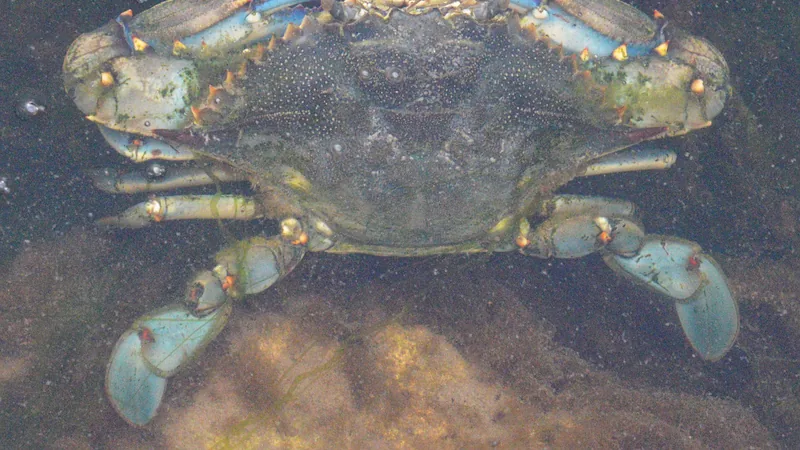
Adults are protected by a shell but may still be eaten by gastropods, starfish and crabs. Fiona pinnata, a pelagic sea slug, is a known predator. The sea slug uses its jaws to grasp the barnacle near the junction of the stalk and shell, and then uses its radula, a tongue studded with tiny teeth, to rasp. The barnacle soon gapes open, allowing the sea slug to consume the prey.
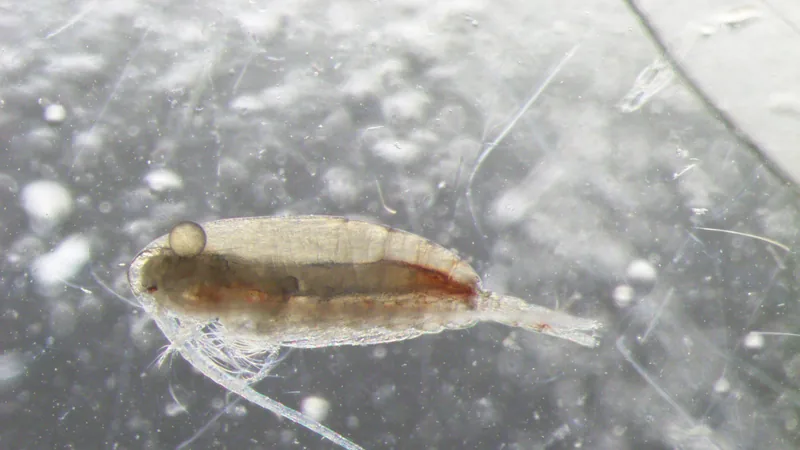
Each barnacle is a hermaphrodite, yet it still needs a partner. Cross-fertilization is required, so the barnacles cluster in turfs close enough to mate. The young hatch as free-swimming larvae that go through six stages and then turn into a cyprid, a non-feeding stage that drifts until it finds something to settle on.
Published
Traits
Intel
& FAQ
Guess
first
How big is a Goose Barnacle, really? Slide, lock in, and see what the sources say. Every answer is a figure from this page, quoted from where it came from.
Sources
- 01Lepas anatifera (duck barnacle). Animal Diversity Web, University of Michigan.
- 02Jonker et al. (2012). Unusual adhesive production system in the barnacle Lepas anatifera: An ultrastructural and histochemical investigation. Journal of Morphology.
- 03Jonker et al. (2015). The chemistry of stalked barnacle adhesive (Lepas anatifera). Interface Focus.
- 04Domínguez-Pérez et al. (2021). Proteogenomic Characterization of the Cement and Adhesive Gland of the Pelagic Gooseneck Barnacle Lepas anatifera. International Journal of Molecular Sciences.
- 05Howard & Scott (1959). Predaceous Feeding in Two Common Gooseneck Barnacles. Science.
- 06Stelfox et al. (2020). Minimum drift times infer trajectories of ghost nets found in the Maldives. Marine Pollution Bulletin.
- 07Mello et al. (2023). Tarballs on the Brazilian coast in late 2022 sustain Lepas anatifera Linnaeus, 1758 (Crustacea: Cirripedia): Occurrence and risk of petroleum hydrocarbon ingestion. Science of The Total Environment.
- 08Mghili et al. (2022). Marine macroinvertebrates fouled in marine anthropogenic litter in the Moroccan Mediterranean. Marine Pollution Bulletin.
What the sources say: 49 claims checked word for word against these sources →