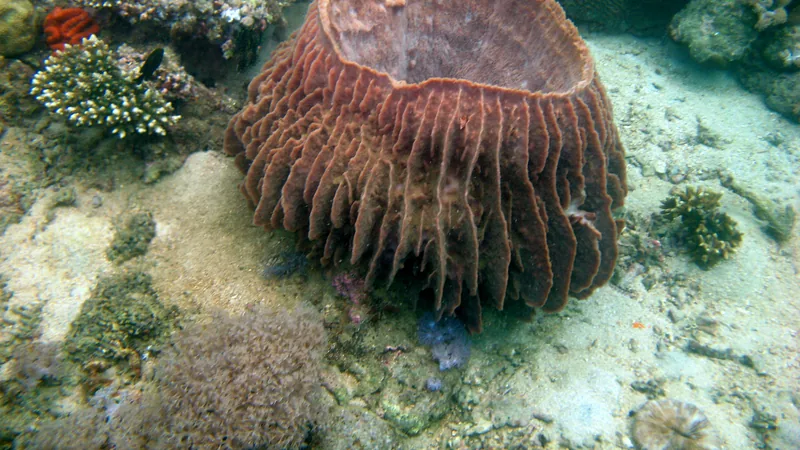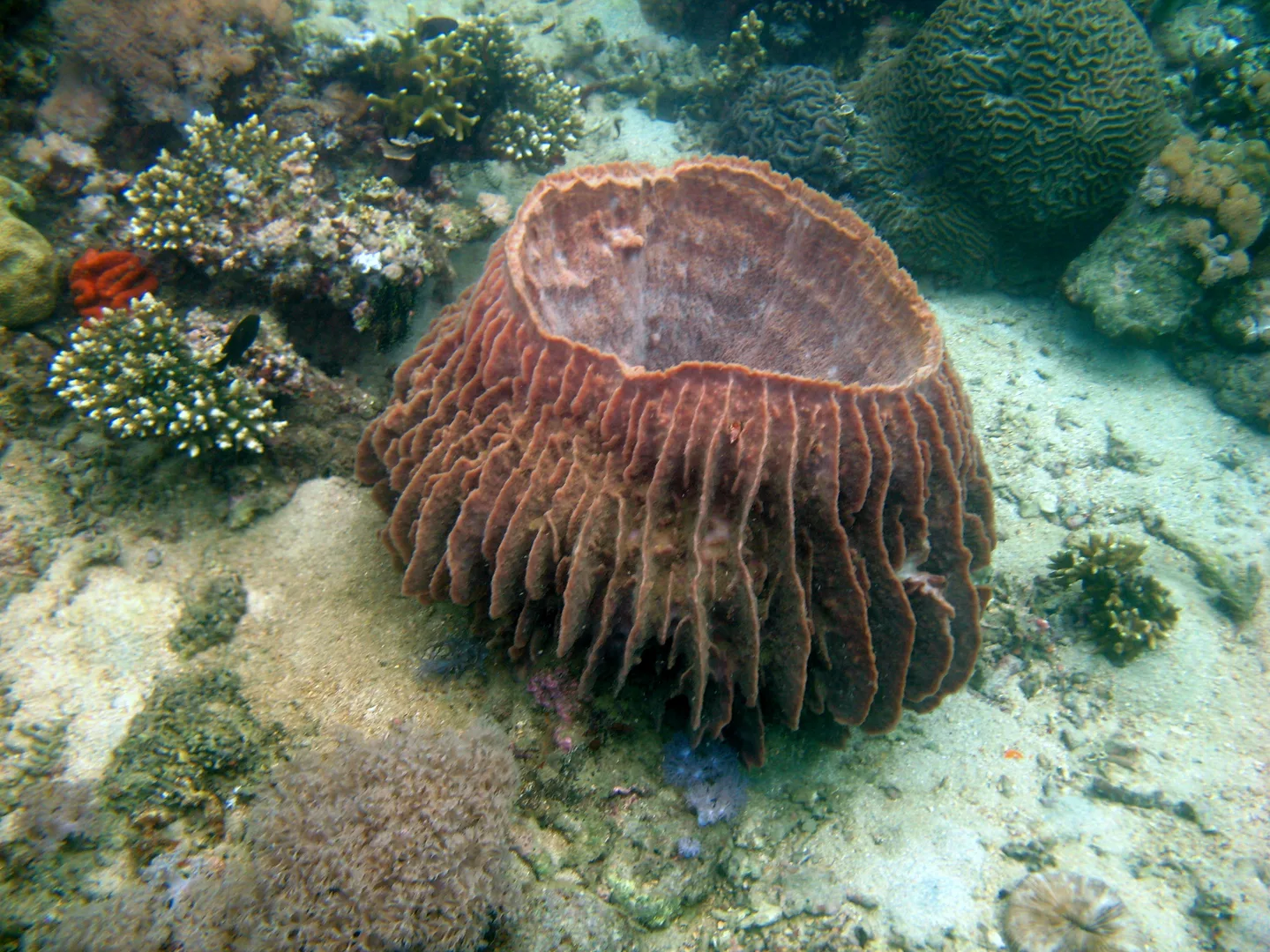
Bucket Coral, Mabini Batangas
Field
notes
The redwood of the reef
Some people call the giant barrel sponge the “redwood of the reef”, and the nickname fits. It may grow over 1 meter (about 3 feet) tall, with a mass that exceeds most other benthic invertebrates. That is science-speak for animals without backbones that live on the sea floor. In one nitrogen study, the masses calculated for the sponges ran from 7.4 to 68.2 kilograms (about 16 to 150 pounds).
Redwoods live a long time, and so does this sponge. Its age is estimated with growth models, and studies of Caribbean giant barrel sponges suggest they may be thousands of years old. Those estimates carry error, which is expected to grow with the size of the sponge.
A living pump
A sponge is an animal with no nervous system, and a giant barrel sponge stays in one spot. It feeds by pumping seawater through its body. Water enters through tiny pores and passes through chambers lined with cells called choanocytes, which have whip-like tails that help drive the water and filter out food. Then it leaves through a hole at the top called the osculum. One sponge may filter up to 50,000 times its own volume of water every day, catching food particles about the size of bacteria.
Its color, anywhere from salmon pink to purple, comes from cyanobacteria that live inside it as symbionts, meaning partners.
Armor for an animal that cannot run
Stuck in one spot, the sponge protects itself from fish mainly with chemical defenses. In the Florida Keys it is also defended with spicules, microscopic glass-like rods.
Bleached and bitten Across 10 hours of video, parrotfish took 45 bites from normally colored giant barrel sponges and 527 bites from four bleached ones.
Timed by the moon
Giant barrel sponges spawn together: neighbors release eggs and sperm in one synchronized event. In one study, spawning came on the ninth night after a full moon. In one event that was observed, eggs and sperm were released for about an hour. The sponges live on tropical Atlantic reefs, with the highest concentrations off Florida, Central America and the Caribbean. On Conch Reef off Key Largo, Florida, densities in 2006 ranged from 0.134 to 0.277 sponges per square meter, and a 2011 study called it the dominant habitat-forming organism on many Caribbean coral reefs. The IUCN Red List has not evaluated it.
Published
Traits
Intel
& FAQ
Guess
first
How big is a Giant Barrel Sponge, really? Slide, lock in, and see what the sources say. Every answer is a figure from this page, quoted from where it came from.
Sources
- 01Xestospongia muta (giant barrel sponge). Animal Diversity Web, University of Michigan.
- 02Fiore, Baker & Lesser (2013). Nitrogen Biogeochemistry in the Caribbean Sponge, Xestospongia muta: A Source or Sink of Dissolved Inorganic Nitrogen? PLoS ONE.
- 03Dunlap & Pawlik (1998). Spongivory by Parrotfish in Florida Mangrove and Reef Habitats. Marine Ecology.
- 04McMurray, Henkel & Pawlik (2010). Demographics of increasing populations of the giant barrel sponge Xestospongia muta in the Florida Keys. Ecology.
- 05McMurray et al. (2011). Bleaching of the giant barrel sponge Xestospongia muta in the Florida Keys. Limnology and Oceanography.
- 06McGrath et al. (2018). Growth and longevity in giant barrel sponges: Redwoods of the reef or Pines in the Indo-Pacific? Scientific Reports.
What the sources say: 44 claims checked word for word against these sources →