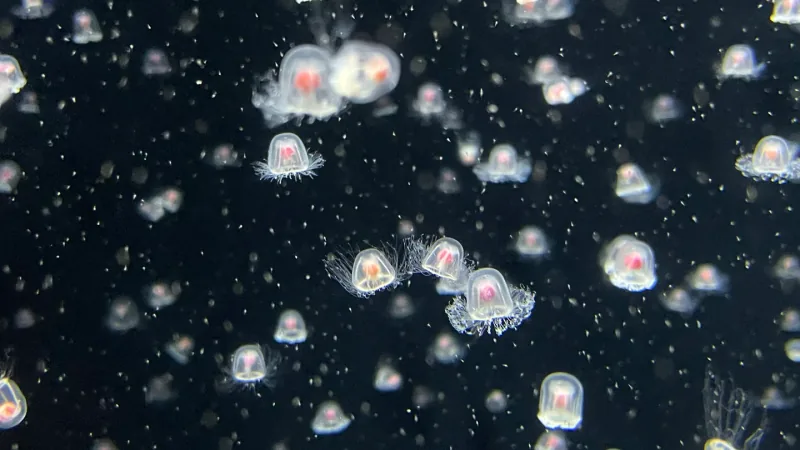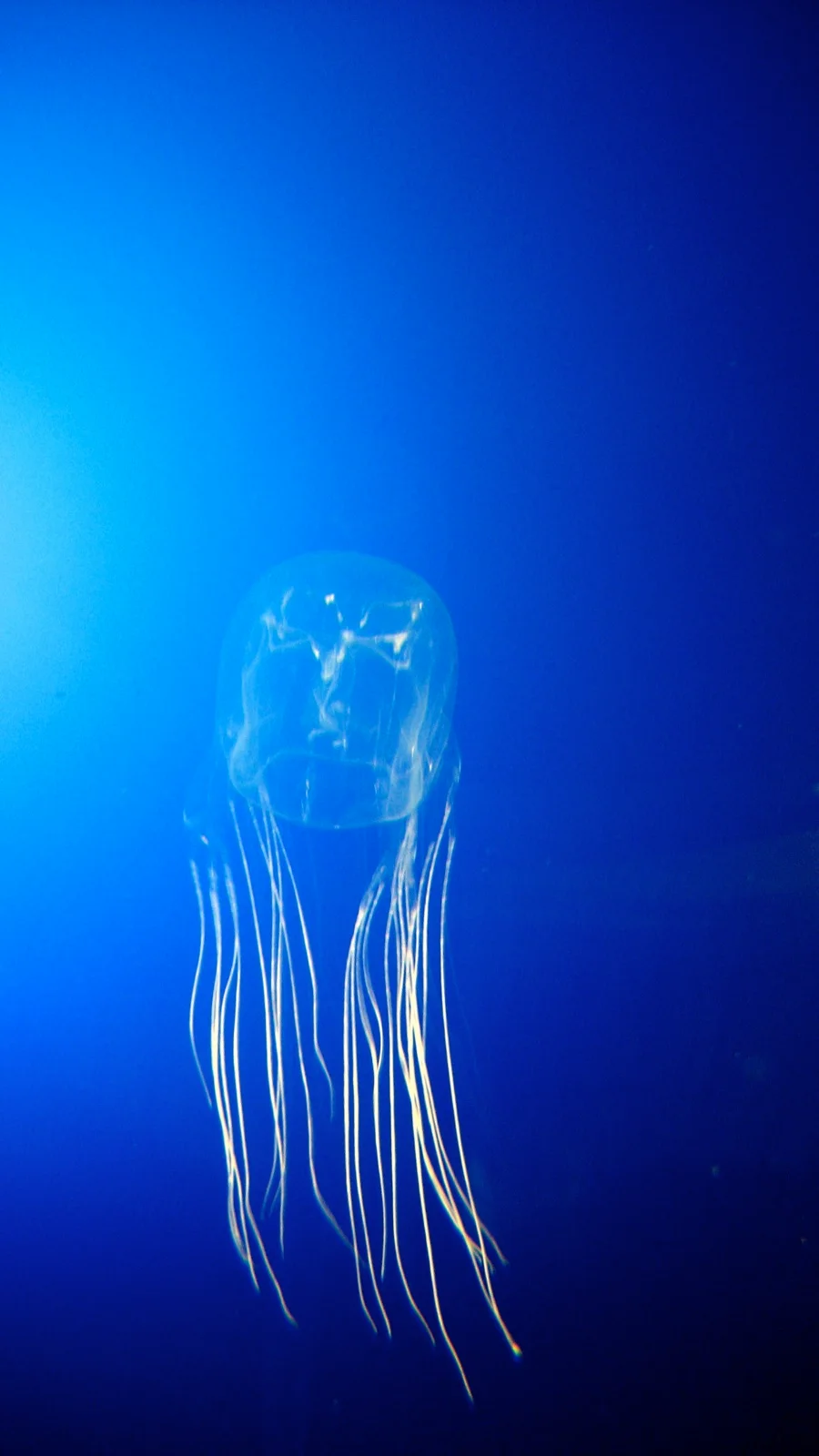
A captive box jellyfish of the genus Chironex at the Port of Nagoya Public Aquarium, Japan.
Field
notes
A Transparent Predator with Up to Sixty Tentacles
Chironex fleckeri, the box jellyfish, is nearly invisible in the water off Northern Australia and Southeast Asia, where it hunts through shallow coastal waters, estuaries and mangrove channels. Its box-shaped bell usually measures 16 to 24 cm across, though some grow to 35 cm, and up to 60 tentacles hang from its four corners, trailing as far as 3 metres (10 feet). A full-grown adult can weigh up to 2 kilograms, and researchers who sequenced its venom call it the largest and most dangerous cubozoan jellyfish to humans.
Unlike the drifting jellyfish most people picture, box jellyfish are active swimmers. They can move at up to 4 knots, though by day they typically travel at 1 knot or less. Adults feed mainly on small fish and prawns, and until they’re fully grown they feed primarily on shrimp. Box jellyfish also grow fast and live short lives: at the growth rates measured off Queensland, wild medusae, the free-swimming adult form, reach sexual maturity at about 45 to 50 days old, and the oldest one researchers aged was roughly 78 days. Each spring, box jellyfish gather in rivers to spawn, then die shortly after.
Twenty-Four Eyes and No Brain
A box jellyfish has no brain, yet it carries 24 eyes. They’re clustered into four eye-bearing sensory structures called rhopalia. Its eyes’ photoreceptors tell light from dark, it’s drawn toward light and it tends to avoid darker shapes, and in the laboratory medusae swam away from dark objects. Its only known predator is the green turtle, whose skin is too thick for the venom to penetrate.
A Sting That Can Stop a Heart in Minutes
Each tentacle carries millions of microscopic stinging cells. Triggered, each one explosively releases a harpoon-like tubule that injects venom into its victim.
A Molecular Wrecking Ball A venom protein punches pores about 12 nanometres wide clean through human red blood cells, and potassium pours out through the holes.
In lab tests on human blood, that potassium surge began within 5 minutes of exposure, with the cells breaking down by 20 minutes; researchers found this hyperkalemia, a dangerous spike in blood potassium, to be the likely trigger for the cardiovascular collapse that follows a severe sting. Chironex fleckeri is described in medical literature as the most lethal jellyfish worldwide, and death can occur in as little as 2 to 10 minutes. As of 2012 it had accounted for more than 60 recorded deaths, most of them children and young adults.
Published Updated
Traits
Intel
& FAQ
Guess
first
How big is a Box Jellyfish, really? Slide, lock in, and see what the sources say. Every answer is a figure from this page, quoted from where it came from.
Sources
- 01Chironex fleckeri (box jellyfish). Animal Diversity Web, University of Michigan.
- 02Brinkman et al. (2015). Transcriptome and venom proteome of the box jellyfish Chironex fleckeri. BMC Genomics.
- 03Yanagihara & Shohet (2012). Cubozoan Venom-Induced Cardiovascular Collapse Is Caused by Hyperkalemia and Prevented by Zinc Gluconate in Mice. PLoS ONE.
- 04Gordon & Seymour (2012). Growth, Development and Temporal Variation in the Onset of Six Chironex fleckeri Medusae Seasons: A Contribution to Understanding Jellyfish Ecology. PLoS ONE.
- 05DeLoughery (2022). There's something in the water: an overview of jellyfish, their stings, and treatment. International Maritime Health.
- 06Hamner, Jones & Hamner (1995). Swimming, feeding, circulation and vision in the Australian box jellyfish, Chironex fleckeri (Cnidaria:Cubozoa). Marine and Freshwater Research.
What the sources say: 47 claims checked word for word against these sources →