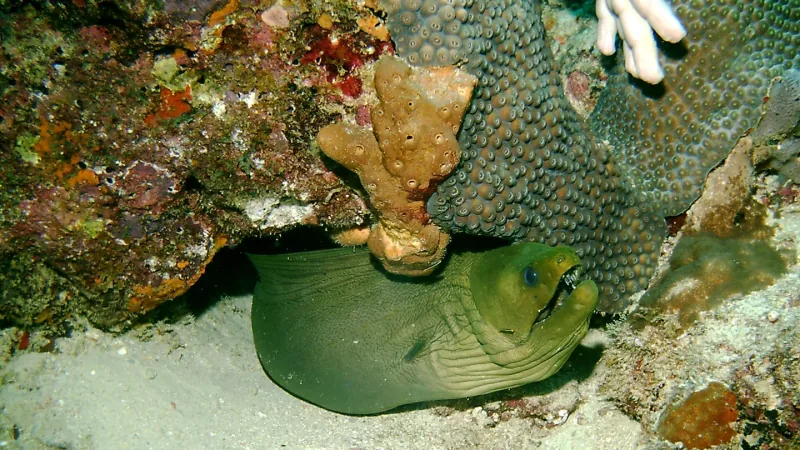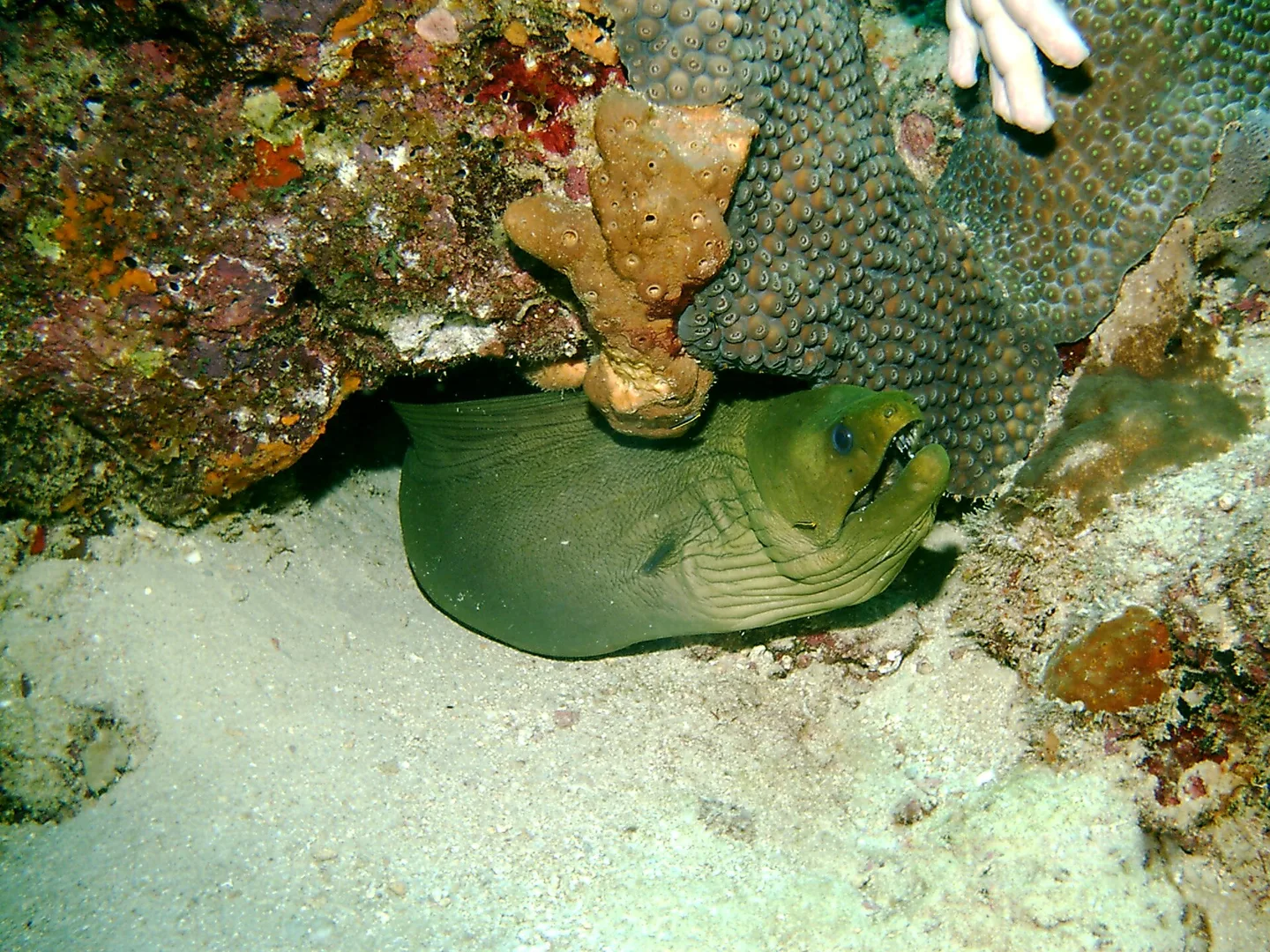
A green moray at a cleaning station in Morrocoy National Park, Venezuela, July 2004.
Field
notes
The Reef’s Yellow-Slicked Predator
Common in the warm waters of the Caribbean, the green moray eel (Gymnothorax funebris) is one of the largest morays. Its maximum reported size is 8 feet (2.5 m) and 65 pounds (29 kg), though the average maximum is likely closer to 6 feet and 30 pounds. Its life expectancy is 10 to 40 years, longer in human care.
It isn’t even really green. Strip away the slime and its scaleless skin is a plain dark grey or brown. A yellow mucus covers the whole body and protects it from parasites and bacteria, and that yellow, mixed with the dark skin, gives the eel the green hue it is named for.
A Second Set of Jaws Waiting in the Throat
Most bony fish gulp in a burst of water that carries a meal back to a second set of jaws already waiting in the throat. Moray eels are weak at building that kind of suction. A study of a different moray, Muraena retifera, showed how that species gets around the problem: its throat jaws launch forward into the mouth, seize the struggling prey, and haul it back down into the esophagus. It was the first described case of a backboned animal using a second set of jaws to both restrain and transport prey, made possible by elongated muscles working the jaws and reduced gill-arch structures beside them.
Grabbed too big a meal? When a green moray meets a fish too large to swallow whole, it wraps itself around its prey in a knot for leverage, then tears the fish into smaller pieces that are easier to swallow.
Hunting by Smell
Green morays hunt at night, relying largely on their sense of smell to find fish, crabs, shrimps and cephalopods such as squid, working in and out of the many tight crevices and holes of coral reefs where prey hide. By day they hide away in rock crevices and small caves. Their mouths constantly open and close, pumping water over the gills for breathing. Cleaner shrimp and gobies eat parasites, bacteria and dead skin off an eel’s body and out of its mouth, and green morays have been seen visiting wrasse cleaning stations.
From Mangrove Bay to Reef
Some green morays start out in mangrove bays. Researchers who tagged sixteen eels along the mangrove fringe of bays in the US Virgin Islands and tracked them for up to 11 months found they kept to the same general parts of their bays, and all but one stayed in the same bay. Then several of the larger eels left for good, heading out to coral reef habitats offshore. Each final move happened during a single night, at a mean speed of 3.4 km/h. It was the first documented habitat shift with growth in any moray eel.
The species ranges through the western Atlantic from New Jersey and Bermuda down to Brazil, from 1 to 50 meters deep but usually 5 to 30, and is listed as Least Concern. Its large size and aggressiveness make its bites particularly dangerous, and eating a large green moray can cause ciguatera poisoning, from a toxin that builds up in large predatory reef species.
Published Updated
Traits
Intel
& FAQ
Guess
first
How big is a Green Moray Eel, really? Slide, lock in, and see what the sources say. Every answer is a figure from this page, quoted from where it came from.
Sources
- 01Gymnothorax funebris (Morena verde). Animal Diversity Web, University of Michigan.
- 02Gymnothorax funebris (Green Moray). Florida Museum of Natural History.
- 03Gymnothorax funebris, Green moray. FishBase.
- 04Green Moray Eel. Virginia Aquarium & Marine Science Center.
- 05Mehta & Wainwright (2007). Raptorial jaws in the throat help moray eels swallow large prey. Nature.
- 06Kendall et al. (2021). Green morays (Gymnothorax funebris) have sedentary ways in mangrove bays, but also ontogenetic forays to reef enclaves. Environmental Biology of Fishes.
- 07Smith & McCosker (2015). Gymnothorax funebris. The IUCN Red List of Threatened Species 2015: e.T195731A2409410.
What the sources say: 56 claims checked word for word against these sources →