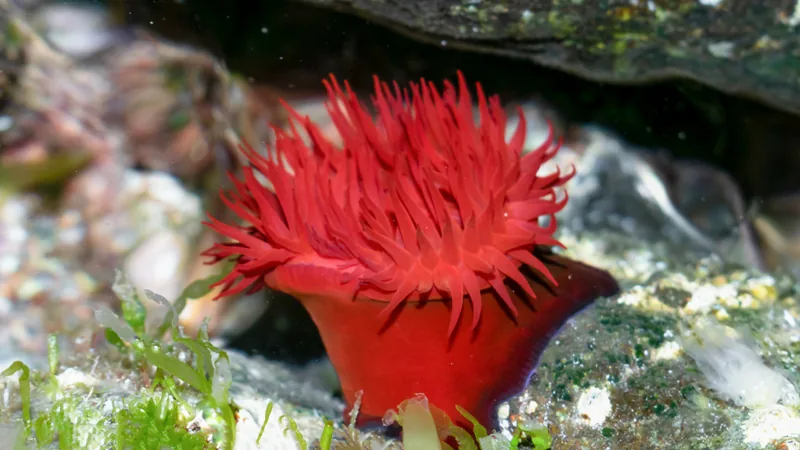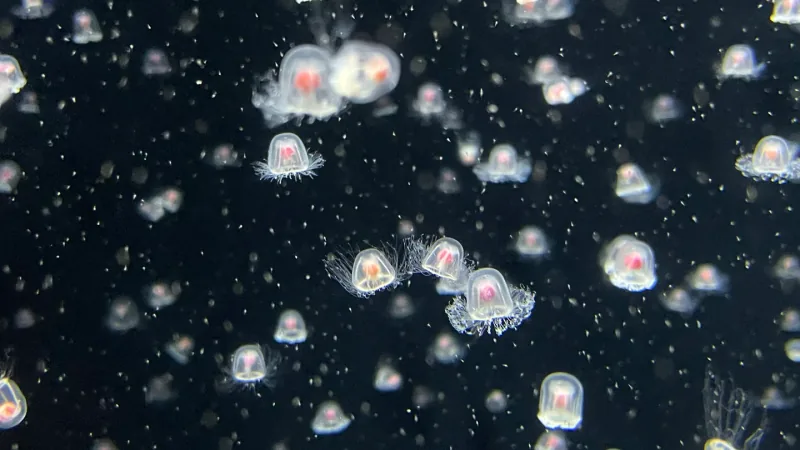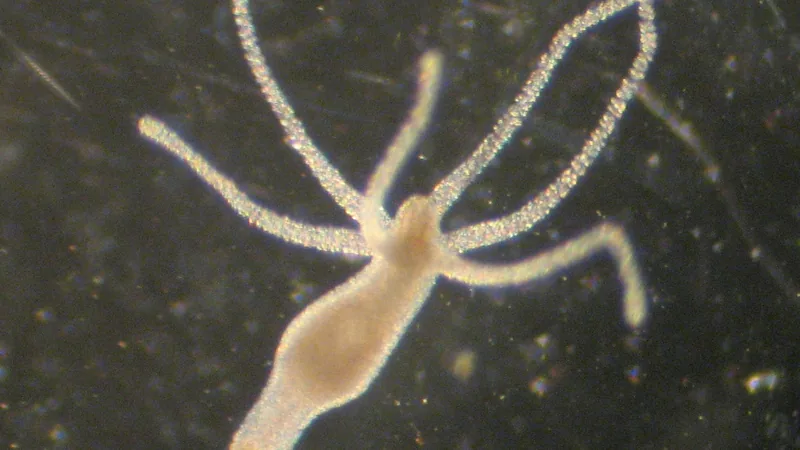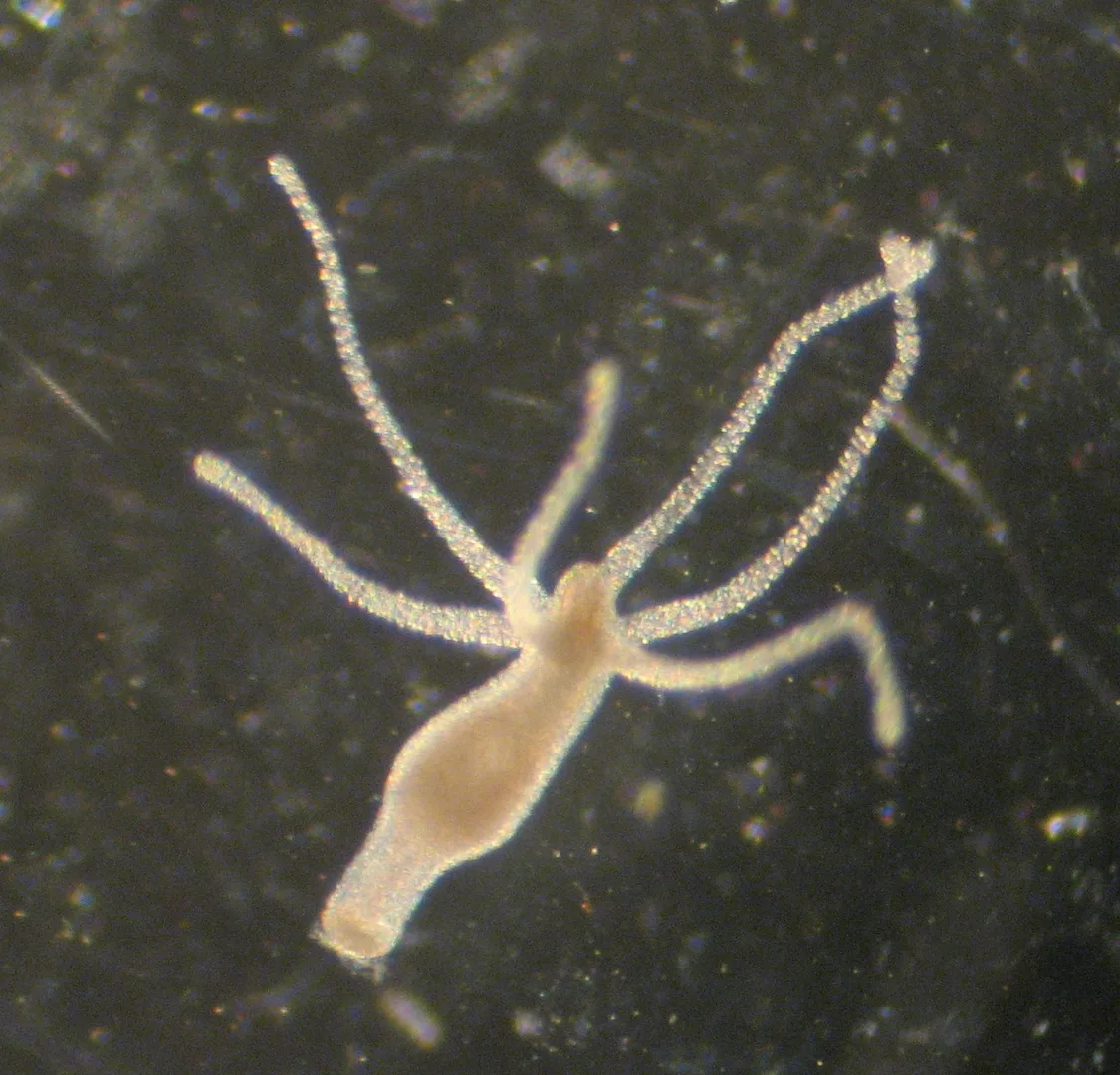
Hydra vulgaris, a hydrozoan cnidarian.
Field
notes
Tiny tube, loaded tentacles
Hydra is a freshwater polyp, an animal with a tube-shaped body. It measures between 2 and 10 mm in length, though the body can reach up to 30 mm. Its head is ringed by tentacles. It belongs to the phylum Cnidaria, the group that also holds jellyfish, sea anemones and corals. Researchers have collected Hydra strains from around the world.
The tentacles are packed with cnidocytes, cells that hold stinging parts and are rich in neurotoxic substances that paralyse prey. Hydra feeds on small animals such as copepods and other zooplankton, which are tiny creatures that drift in water. Once the tentacles have caught a meal, it is moved to the hypostome, the mouth opening.
A death rate that stays flat
For a long time, scientists thought that every animal that breeds repeatedly would see its death rate rise and its fertility fall with age after maturity. A 2015 study put that to the test on 2,256 Hydra from two closely related species. Spread across 12 groups in two labs, they had extremely low, constant rates of mortality.
Forever young, in a dish In a lab in Rostock, Germany, researchers cared for about 1,800 polyps over almost ten years, each in its own small glass dish at a constant 18 degrees Celsius, fed three times a week. Their yearly chance of dying stayed at a low 0.6 percent. For humans, it reaches levels as high as 50 percent at advanced ages.
The lab is a kind place, though. In the wild, Hydra’s average life span is counted in weeks rather than years, because of high extrinsic mortality, which is the death rate from outside causes.
Rebuilt every four weeks
The researchers say features such as a high proportion of stem cells and rapid cell turnover may make that flat death rate possible. Its stem cells can develop into any part of the body. Hydra replaces all of its cells within four weeks, and it regularly expels cells that mutations have changed. It can completely replace body parts that are damaged or lost, and it can fully regenerate if its body is almost completely destroyed.
It reproduces mostly without a partner, by budding, which makes genetically identical clones. Warmth boosts budding. By the end of one lab test, an average of 45 polyps were budding at 25 degrees Celsius, against 4 at 15 degrees.
Published
Traits
Intel
& FAQ
Guess
first
How big is a Hydra, really? Slide, lock in, and see what the sources say. Every answer is a figure from this page, quoted from where it came from.
Sources
- 01Auclair et al. (2024). Ecotoxicity of a Representative Urban Mixture of Rare Earth Elements to Hydra vulgaris. Toxics.
- 02Klymenko & Lutz (2026). From Hydra to Humans: Head Activator in Neurogenesis and Neurorepair. Cells.
- 03Destry, Cochran & Macias-Muñoz (2025). The effect of temperature on asexual reproduction in Hydra vulgaris. microPublication Biology.
- 04Schaible et al. (2015). Constant mortality and fertility over age in Hydra. Proceedings of the National Academy of Sciences.
- 05Forever young. Max Planck Institute for Demographic Research, press release.
- 06Martı́nez (1998). Mortality Patterns Suggest Lack of Senescence in Hydra. Experimental Gerontology.
- 07Sahm et al. (2024). Hydra has mammal-like mutation rates facilitating fast adaptation despite its nonaging phenotype. Genome Research.
- 08Schenkelaars et al. (2020). The polymorphism of Hydra microsatellite sequences provides strain-specific signatures. PLOS ONE.
- 09Dupre & Yuste (2017). Non-overlapping Neural Networks in Hydra vulgaris. Current Biology.
What the sources say: 47 claims checked word for word against these sources →