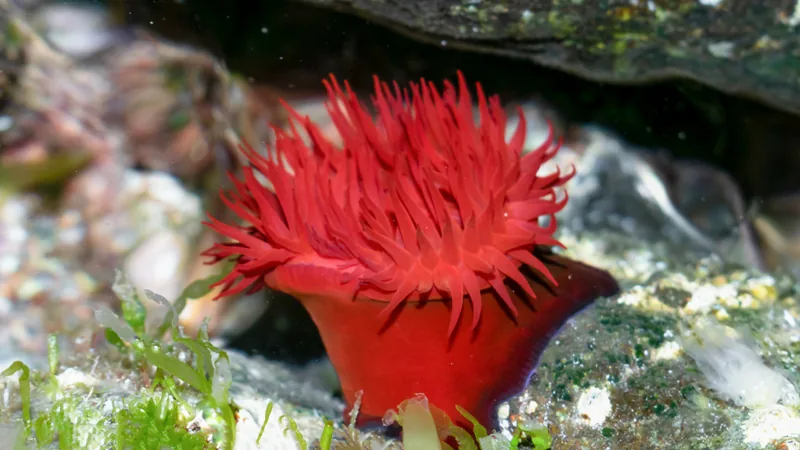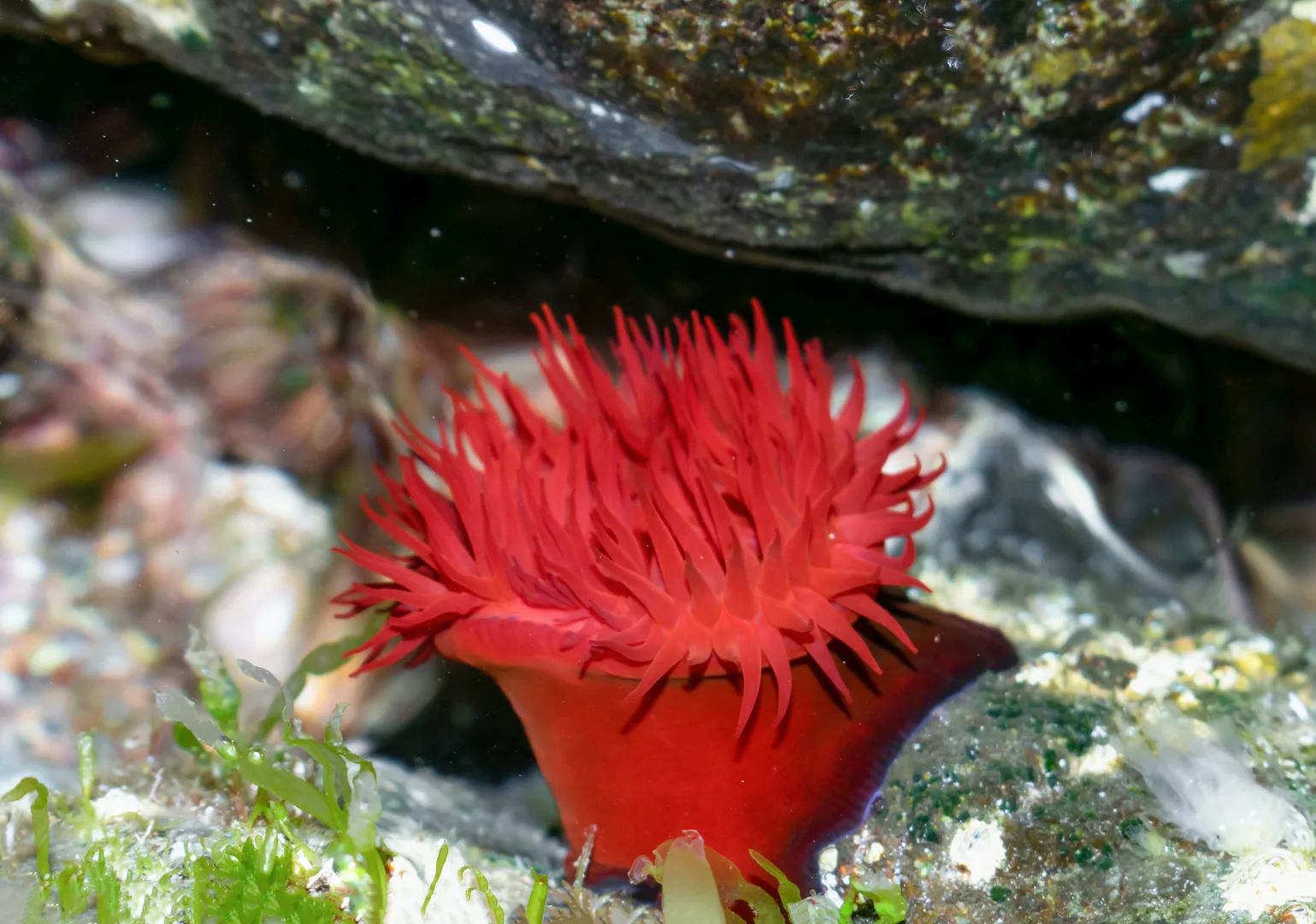
Actinia equina, Mokrane Island, Honaïne, Tlemcen Province.
Field
notes
The anemone that fights its neighbors
A beadlet anemone sits on a rock and looks calm. It is not. Actinia equina is aggressive toward the anemones next to it, and a fight starts when the tentacles of two neighbors touch. The aggressor stings the victim with nematocysts, the stinging cells, carried in its acrorhagi: bright blue, wart-like spots that are often found near the top of the body column. The victim either crawls away or drops off the rock.
Toxin dose Researchers purified three equinatoxins from this anemone. The dose that killed half of the mice tested was 23, 35 and 83 micrograms per kilogram for equinatoxins I, II and III, injected into a vein.
A small body with a lot of tentacles
The base is up to 5 cm across and is usually wider than tall. Up to 192 tentacles sit in 6 circles, and they pull back in when the animal is disturbed. Color runs from red to brown, green and orange, and rust-red is the most common.
Animal Diversity Web gives a dry weight of 0.01 to 0.84 g. The average is 0.42 g. That is the weight with the water taken out, because an anemone in the water is mostly water it has absorbed.
Life between the tides
The beadlet anemone lives all around the coasts of Britain and Ireland. Its range runs across western Europe and the Mediterranean, from the Arctic to the west coast of Africa, almost to the equator. It clings to hard surfaces from the upper to the lower shore and rarely goes subtidal, to about 20 m deep. It handles high temperatures and desiccation (drying out).
Out of the water it is always retracted and looks like a little red blob. It eats almost anything it can catch, and its toxins paralyze the prey and inhibit its ability to escape.
It has three main defenses: inflating its body column, detaching from the rock in a bid to escape predation, and releasing stinging cells with toxins. The grey sea slug still eats it, and somehow does not digest the most toxic stinging cells.
Not the strawberry anemone
A lookalike, the strawberry anemone (Actinia fragacea), is plumper and red to reddish brown with greenish spots. Animal Diversity Web adds that genetic studies suggest the differently colored beadlets may be separate species.
Published Updated
Traits
Intel
& FAQ
Guess
first
How big is a Beadlet Anemone, really? Slide, lock in, and see what the sources say. Every answer is a figure from this page, quoted from where it came from.
Sources
- 01Actinia equina (beadlet anemone). Animal Diversity Web, University of Michigan.
- 02Beadlet anemone (Actinia equina). MarLIN, the Marine Life Information Network.
- 03Maček & Lebez (1988). Isolation and characterization of three lethal and hemolytic toxins from the sea anemone Actinia equina L. Toxicon.
- 04Maček et al. (1994). Mechanism of action of equinatoxin II, a cytolysin from the sea anemone Actinia equina L. belonging to the family of actinoporins. Toxicology.
What the sources say: 35 claims checked word for word against these sources →