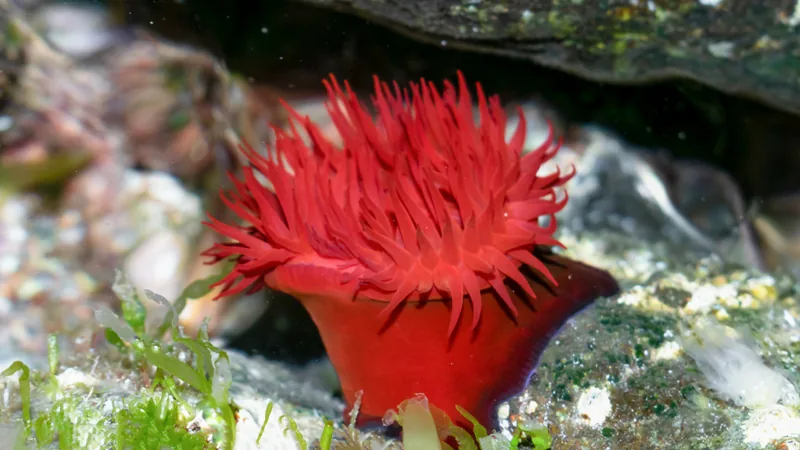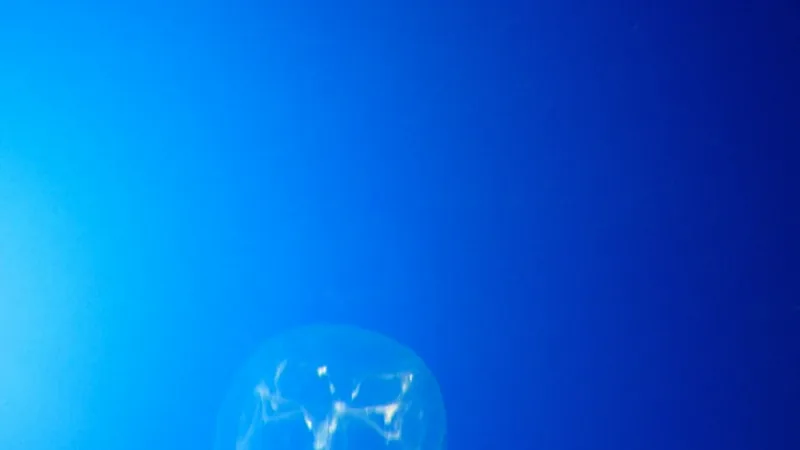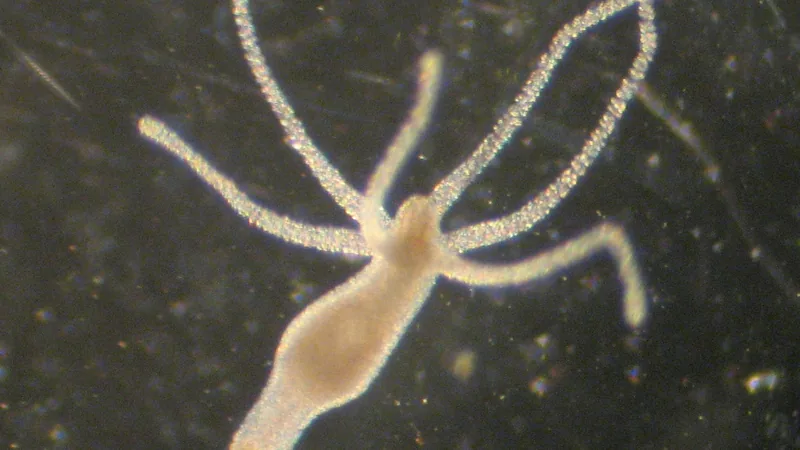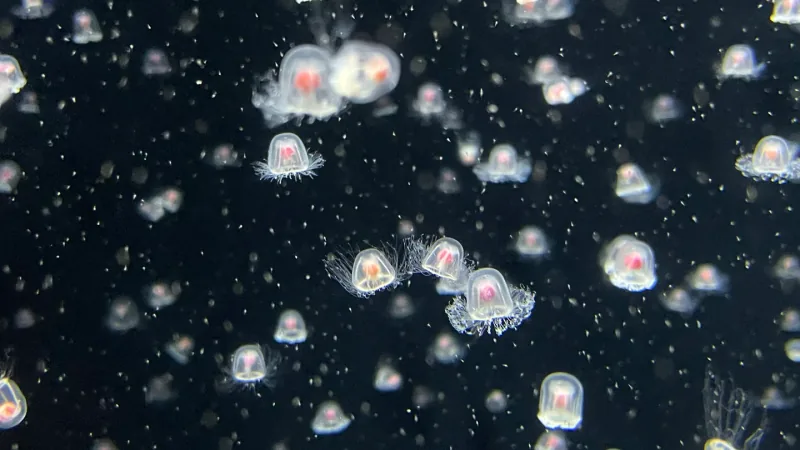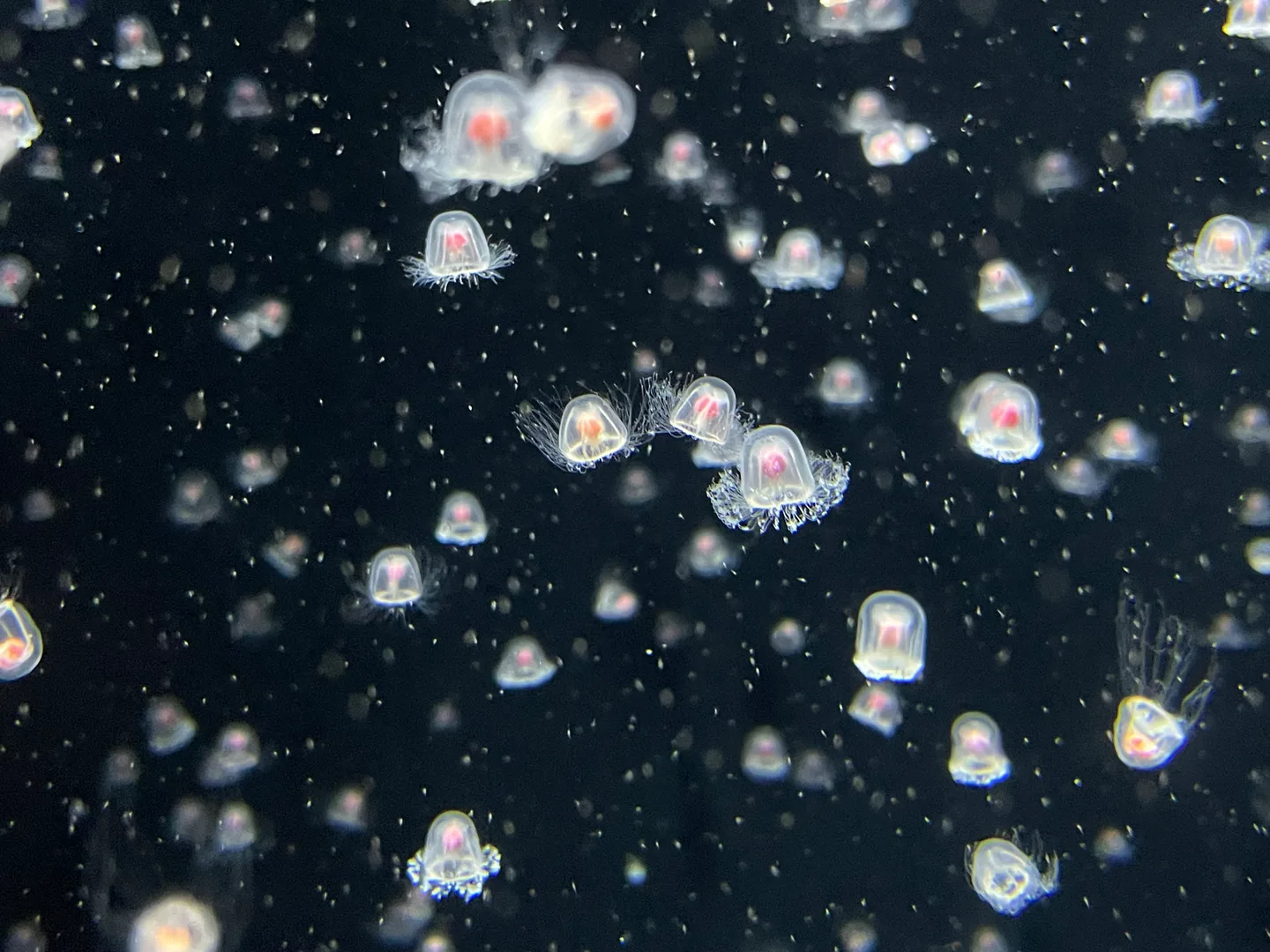
Captive Turritopsis medusae at Kamo Aquarium, Tsuruoka, Japan, filed on Commons as T. nutricula
Field
notes
Two Bodies, One Animal
Unlike almost all animals, including most jellyfish, some cnidarian species can turn a medusa back into a polyp. Turritopsis dohrnii is the one the press christened the “immortal jellyfish.”
It has two body forms. The polyp is a branching colony that sticks to rocks, docks, pilings and ships’ hulls. The colony buds off medusae, the jellyfish form, which drift as plankton. An adult medusa is up to 2.7 millimetres tall and 3.3 millimetres wide. The species eats zooplankton, tiny animals adrift in the sea.
Medusae have separate sexes. Their eggs and sperm join to make larvae called planulae, which settle and grow into new polyps.
It was first described from Naples, Italy, and its polyps are common on rocks in the Western Mediterranean and the Adriatic.
The Rewind Button
Life cycle reversal A senescent (old), weakened or damaged medusa can transform into a cluster of poorly differentiated cells called the cyst stage, and the cyst then metamorphoses back into a polyp.
Starved medusae do the same, and a Smithsonian species database says the restart makes each individual “potentially immortal.” The switch involves transdifferentiation, in which specialised cells are reprogrammed into other cell types.
A 2019 study compared the three stages and found DNA repair genes more active in the cyst than in the polyp or the medusa. The authors say that may be part of how the reset works.
Immortal, With Fine Print
“Immortal” is shorthand. A 2022 genome paper calls T. dohrnii immortal because the chance of a sexually mature medusa rejuvenating goes up to 100%, with no apparent limit on the number of cycles for one individual.
Another 2022 genome paper counted just two species of hydrozoan jellyfish, T. dohrnii and a second, unidentified Turritopsis, that had shown repeated reversal in the laboratory. The unidentified one went through as many as 10 reversals in response to severe damage with needles.
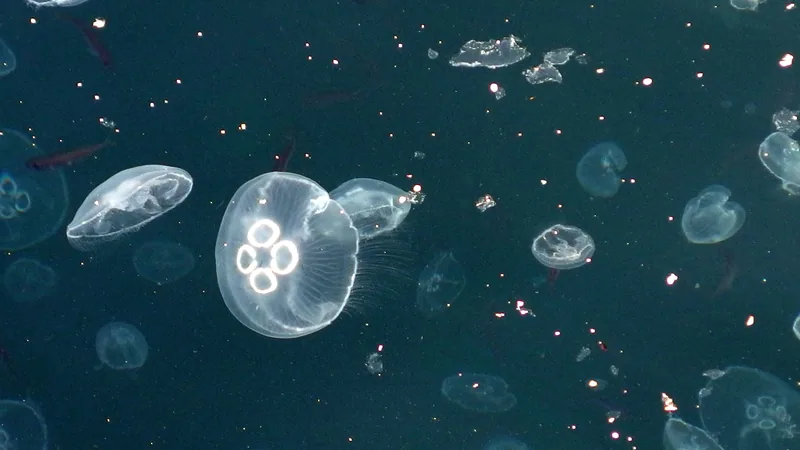
Names are messy too. Medusae in this genus have been widely labelled T. nutricula around the world, and its look-alike species can only be identified by DNA.
A Quiet Hitchhiker
A genetic study found the same species in Florida, Panama and Japan as in Spain and Italy, and called it a human-mediated introduction. Its authors say Turritopsis medusae that revert when starved or damaged can easily survive long trips in cargo ships and ballast water.
Published Updated
Traits
Intel
& FAQ
Guess
first
How big is a Immortal Jellyfish, really? Slide, lock in, and see what the sources say. Every answer is a figure from this page, quoted from where it came from.
Sources
- 01Hasegawa et al. (2022). Genome assembly and transcriptomic analyses of the repeatedly rejuvenating jellyfish Turritopsis dohrnii. DNA Research.
- 02Pascual-Torner et al. (2022). Comparative genomics of mortal and immortal cnidarians unveils novel keys behind rejuvenation. Proceedings of the National Academy of Sciences.
- 03Matsumoto, Piraino & Miglietta (2019). Transcriptome Characterization of Reverse Development in Turritopsis dohrnii (Hydrozoa, Cnidaria). G3 Genes|Genomes|Genetics.
- 04Miglietta & Lessios (2008). A silent invasion. Biological Invasions.
- 05Turritopsis dohrnii. NEMESIS, Smithsonian Environmental Research Center.
What the sources say: 41 claims checked word for word against these sources →