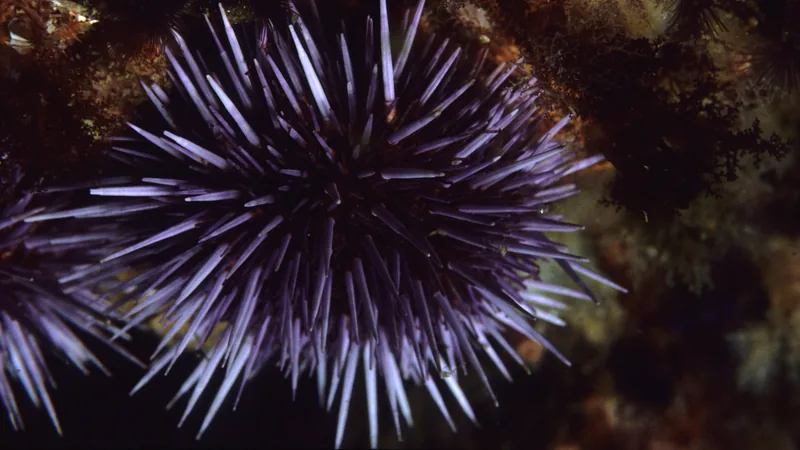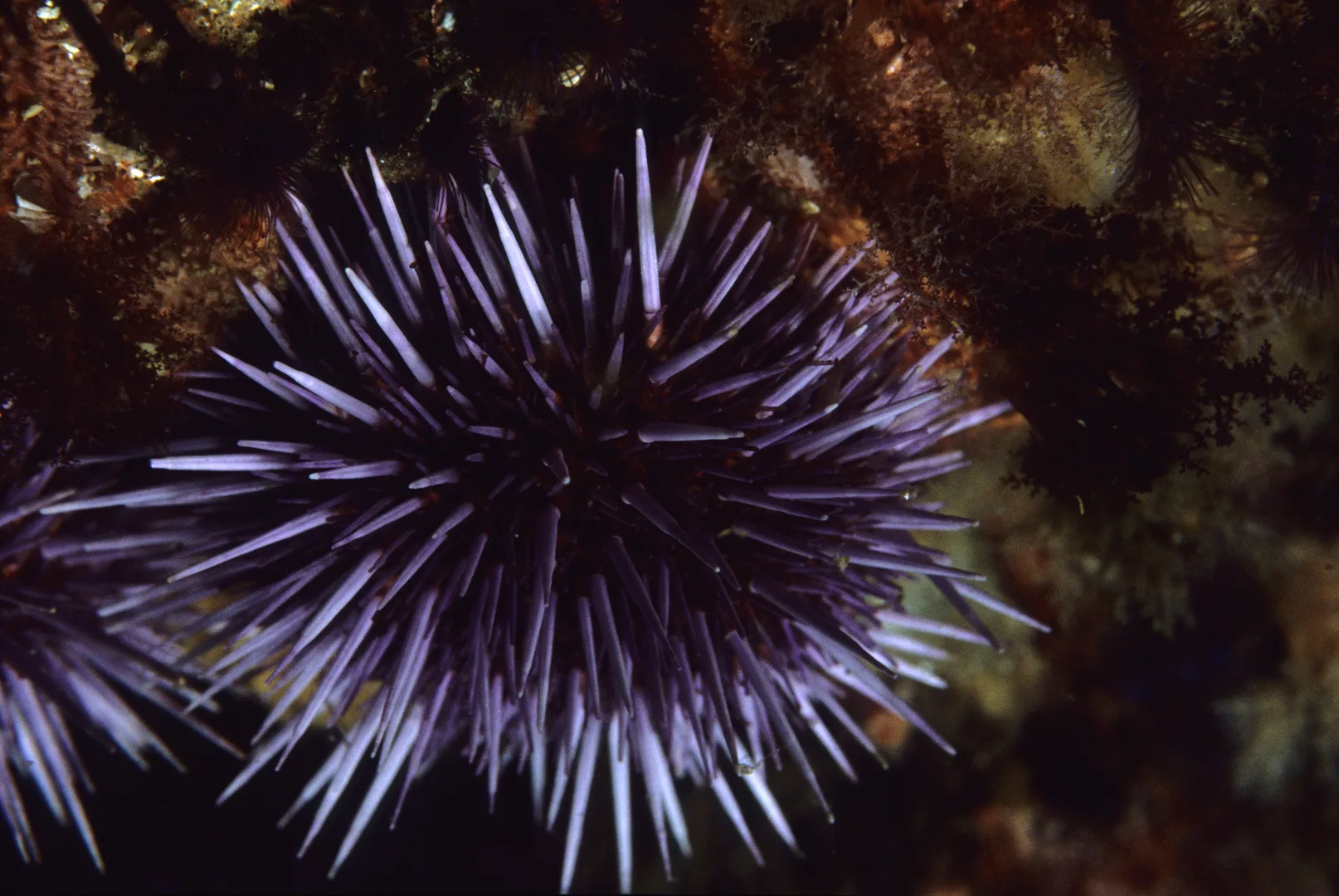
On a reef off the California coast.
Field
notes
A pincushion with a chisel for a mouth
The purple sea urchin is a round, spiny animal. Its body shell is called a test, and it can grow up to 10 cm (4 in) across. California Sea Grant gives a typical size of 5 to 10 cm wide and 4 cm tall. Young urchins are mostly pale green, and their spines darken to purple as they mature.
Its mouth sits underneath. It holds five sharp teeth arranged in a circle, a set called Aristotle’s lantern. The urchin scrapes algae off rock with them. It can also use them to dig a hollow in rock for protection. Sometimes an urchin grows too big to leave its hollow and is stuck there.
Pincers on long stalks, called pedicellariae, help it defend itself from attackers and keep barnacles and sponges from settling on its body.
From Alaska to Baja
Strongylocentrotus purpuratus lives along the Pacific coast from Alaska to Baja California, Mexico. It likes rocky shores and kelp beds, from the intertidal zone as deep as 160 m (525 ft). Kelp is its favourite food. It will also eat dead fish, barnacles and sponges.
Warm water is a problem. At temperatures above 22.8°C (73°F), more of them die.
Urchin barrens Purple urchins have two feeding modes. When drifting kelp is plentiful, they sit and catch it. When the supply drops, they switch to active foraging and form dense feeding fronts that can remove a kelp forest completely. What is left is called an urchin barren. Once the food is gone, the urchins’ gonads shrink, and they can linger in this “zombie” state for decades.
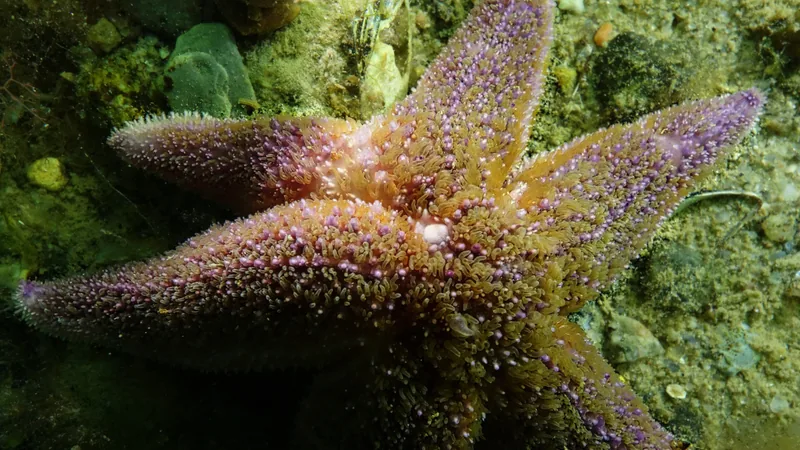
Sea otters and sunflower stars eat urchins, and fewer of both have let urchin numbers jump. California Sea Grant reports that some areas, such as northern California, have enough urchins to suppress kelp.
A very long life
The Oregon Coast Aquarium gives an average lifespan of 20 years and says some may live as long as 70. A 2016 aging study, citing earlier work, puts the maximum life expectancy in the wild at more than 50 years.
In that study, old urchins regrew snipped-off spines and tube feet as quickly as young ones. Tube feet help the urchin move, breathe and sense its surroundings.
A lab favourite
Scientists sequenced this urchin’s genome in 2006. It holds more than 814 million letters of DNA and 23,300 genes. The urchin and humans share an ancestor that lived over 540 million years ago. The head of the US genome institute said then that urchins share substantially more genes and biological pathways with humans than expected.
Published
Traits
Intel
& FAQ
Guess
first
How big is a Purple Sea Urchin, really? Slide, lock in, and see what the sources say. Every answer is a figure from this page, quoted from where it came from.
Sources
- 01Purple Sea Urchin. Aquarium of the Pacific.
- 02Purple Urchin. Oregon Coast Aquarium.
- 03Purple Sea Urchin. California Sea Grant, California Seafood Profiles.
- 04Strongylocentrotus purpuratus. SeaLifeBase.
- 05California Purple Sea Urchin Genome Sequenced by International Team. Caltech.
- 06Bodnar & Coffman (2016). Maintenance of somatic tissue regeneration with age in short‐ and long‐lived species of sea urchins. Aging Cell.
What the sources say: 39 claims checked word for word against these sources →