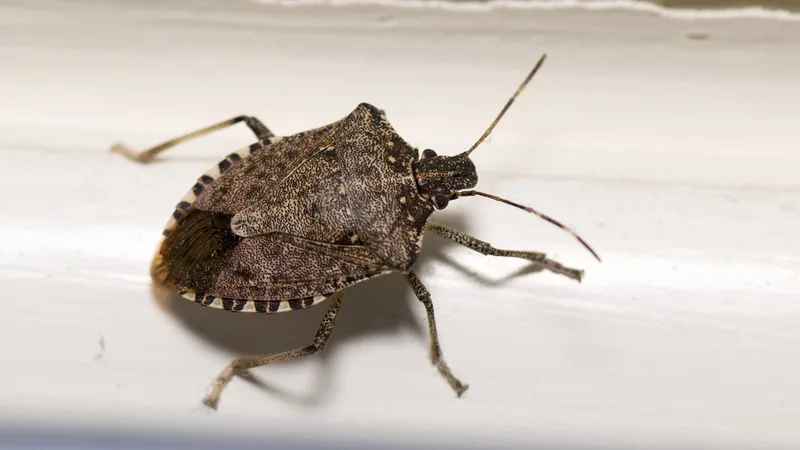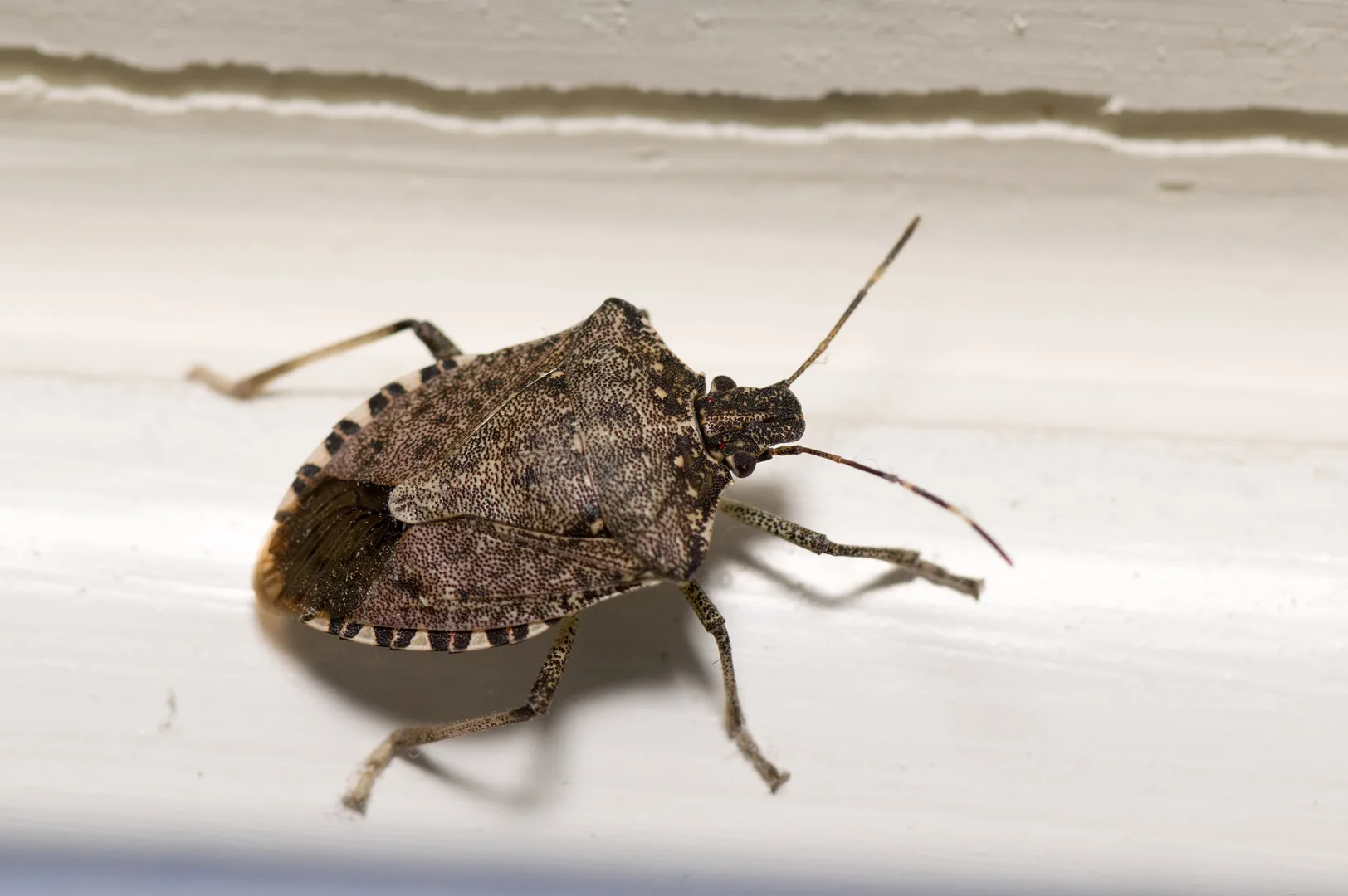
Brown marmorated stink bug on a window sill.
Field
notes
A Smell With a Job
The “stink bug” in its name refers to its scent glands. They sit on top of the abdomen, the rear body section, and under the thorax, the middle section. The defensive chemicals they make can act as an airborne allergen. Sensitive people can get allergic reactions in the nose and eyes. If the bug is crushed against bare skin, it can cause a skin rash where it touched. That seems to affect only a small percentage of people.
An adult is about 17 millimetres long. It is brown and shield-shaped, almost as wide as it is long. Animal Diversity Web lists a wild lifespan of 8 to 10 months.
A Scent Call That Draws a Crowd
Males make an aggregation pheromone, a chemical signal that gathers bugs in one place. In field trials, its two main ingredients attracted females, males and nymphs, the young bugs. Mixtures that held related chemicals alongside those two attracted them too, and the researchers say relatively inexpensive mixtures can be used in monitoring and control.
In Pennsylvania, adults begin to search for overwintering sites from September through October. Penn State Extension says that on warm fall days they are drawn to the outside of houses in search of sheltered spots for winter, and can enter in large numbers.
Long-Haul Flyer In 22-hour tests on a flight mill, a lab device that measures flight, the average male flew 2,442 metres and the average female 2,083 metres. Most bugs (89%) flew under 5 kilometres in the test, though some flew much further, with a maximum of 117 kilometres.
A Straw for Fruit
Its mouthparts are straw-like and made for sucking. It feeds on a wide range of plants, including apples, peaches, beans, corn, tomatoes and soybeans. On apples, its feeding leaves a distortion called “cat facing”, which makes the fruit unmarketable as a fresh product. In 2010, bug numbers in the mid-Atlantic United States reached outbreak levels, and feeding severely damaged tree fruit.
An Accidental Traveller From East Asia
Its native range is China, Japan, Korea and Taiwan. It was accidentally introduced into eastern Pennsylvania and first collected in Allentown in 1998, although it probably arrived several years earlier. A Penn State Extension fact sheet revised in December 2017 said it had spread throughout most of eastern and western North America.
A 2018 review listed introductions into the United States, Canada, multiple European countries and Chile. Europe’s first report came in 2008, near Zurich, Switzerland.
Published
Traits
Intel
& FAQ
Guess
first
How big is a Brown Marmorated Stink Bug, really? Slide, lock in, and see what the sources say. Every answer is a figure from this page, quoted from where it came from.
Sources
- 01Brown marmorated stink bug. Penn State Extension.
- 02Halyomorpha halys (brown marmorated stink bug). Animal Diversity Web, University of Michigan.
- 03Leskey & Nielsen (2018). Impact of the Invasive Brown Marmorated Stink Bug in North America and Europe: History, Biology, Ecology, and Management. Annual Review of Entomology.
- 04Lee & Leskey (2015). Flight behavior of foraging and overwintering brown marmorated stink bug, Halyomorpha halys (Hemiptera: Pentatomidae). Bulletin of Entomological Research.
- 05Khrimian et al. (2014). Discovery of the Aggregation Pheromone of the Brown Marmorated Stink Bug ( Halyomorpha halys ) through the Creation of Stereoisomeric Libraries of 1-Bisabolen-3-ols. Journal of Natural Products.
- 06Zhu et al. (2012). Potential Geographic Distribution of Brown Marmorated Stink Bug Invasion (Halyomorpha halys). PLoS ONE.
- 07Lee et al. (2013). Review of the Biology, Ecology, and Management of Halyomorpha halys (Hemiptera: Pentatomidae) in China, Japan, and the Republic of Korea. Environmental Entomology.
What the sources say: 45 claims checked word for word against these sources →