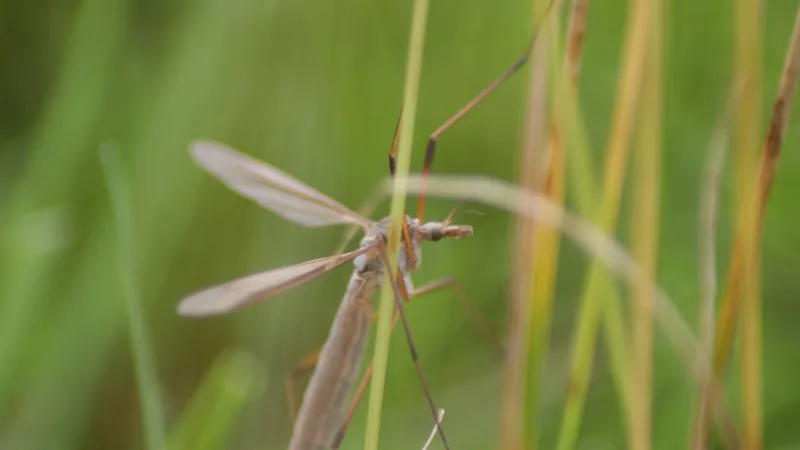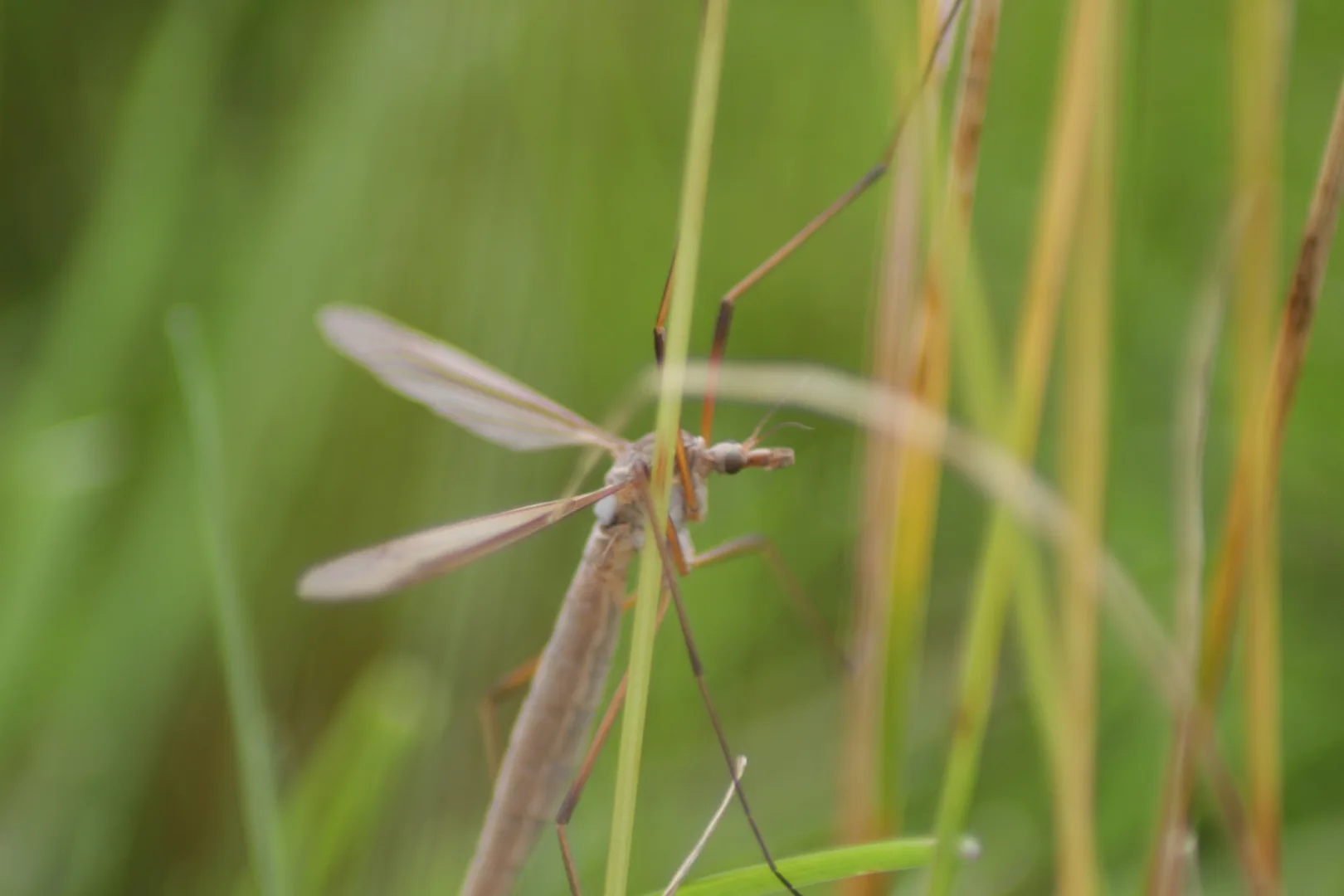
European crane fly (Tipula paludosa)
Field
notes
A grub in a leather coat
The larvae of the European crane fly develop a tough skin, which is where their common name, leatherjackets, comes from. A leatherjacket is a small, gray-brown, wormlike grub about 1 inch long. By day it mostly stays underground. When the night is damp and warm, it comes up to eat the above-ground parts of many plants.
In fall the grubs feed on the root crowns of clover and grass. They also feed on beet, potato, corn, other garden vegetables, ornamentals and nursery trees, and young plants suffer most.
One year, one generation
Adults emerge from the soil of lawns and pastures from late August to mid-September. An adult could pass for an oversized mosquito, with a body of about 1 inch before you add the legs. Within 24 hours of emerging, females have mated and laid their eggs in the grass, and the first grubs hatch from September to mid-October.
The grubs spend the winter as leatherjackets and keep feeding as spring warms. Feeding stops about mid-May. In July and August they lie in a nonfeeding stage just below the soil surface. Pupae are the stage where a grub rebuilds itself into a fly. They wriggle to the surface and the adult crane flies emerge. The species has one generation a year.
Leatherjacket crowd In 1966, a pasture near New Westminster, British Columbia, averaged 110 larvae per square foot in April and May, which works out to 4.5 million per acre.
Daddy longlegs cannot bite
In Britain, large craneflies are called daddy longlegs. The Welsh Wildlife Trust says the idea that they are venomous is a myth. Craneflies cannot bite, it adds, and the rumour probably comes from mixing them up with certain spiders. That page covers the crane fly family, not this species alone.
Adults of this species do not feed, says the Pacific Northwest Insect Management Handbook: they mate quickly and lay eggs for 2 to 14 days. Cornell’s pest management programme calls them relatively short-lived. The Welsh page adds that a crane fly’s very long legs easily fall off if handled.
A European native abroad
Tipula paludosa is native to northern Europe, and a 2006 study called it the major insect pest of grassland in northwest Europe. In North America it was first found in 1955 on Cape Breton Island, Nova Scotia, and in 1965 near Vancouver, British Columbia. A 1980 to 1981 outbreak around Seattle, Washington, wiped out lawns, fairways and golf greens. It was detected in New York State for the first time in 2004.
Published Updated
Traits
Intel
& FAQ
Guess
first
How big is a European Crane Fly, really? Slide, lock in, and see what the sources say. Every answer is a figure from this page, quoted from where it came from.
Sources
- 01European Crane Fly. Ornamentals Northwest Archives, Washington State University Extension (hosted by Oregon State University).
- 02Daddy longlegs. Welsh Wildlife Trust.
- 03European crane fly (Tipula paludosa). Pacific Northwest Insect Management Handbook, Oregon State University.
- 04European Crane Flies (Tipula paludosa and Tipula oleracea). Cornell Integrated Pest Management.
- 05Oestergaard et al. (2006). Biological control of Tipula paludosa (Diptera: Nematocera) using entomopathogenic nematodes (Steinernema spp.) and Bacillus thuringiensis subsp. israelensis.
- 06Peck, Olmstead & Morales (2008). Application timing and efficacy of alternatives for the insecticidal control of Tipula paludosa Meigen (Diptera: Tipulidae), a new invasive pest of turf in the northeastern United States. Pest Management Science.
- 07Tipula paludosa Meigen, 1830. Integrated Taxonomic Information System (ITIS).
What the sources say: 45 claims checked word for word against these sources →