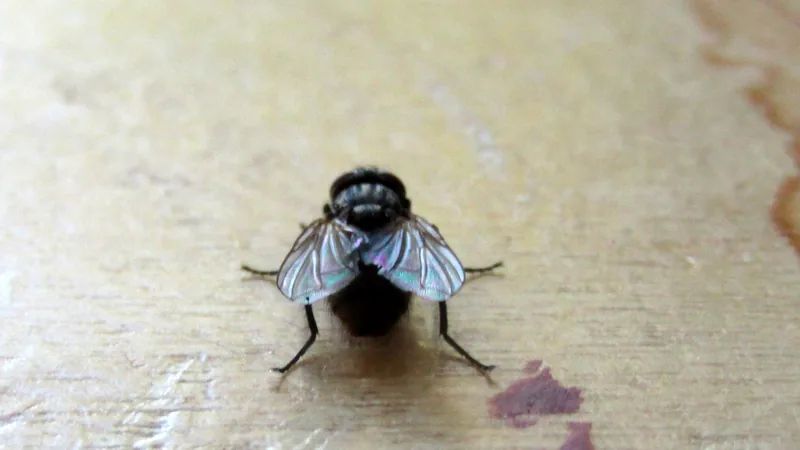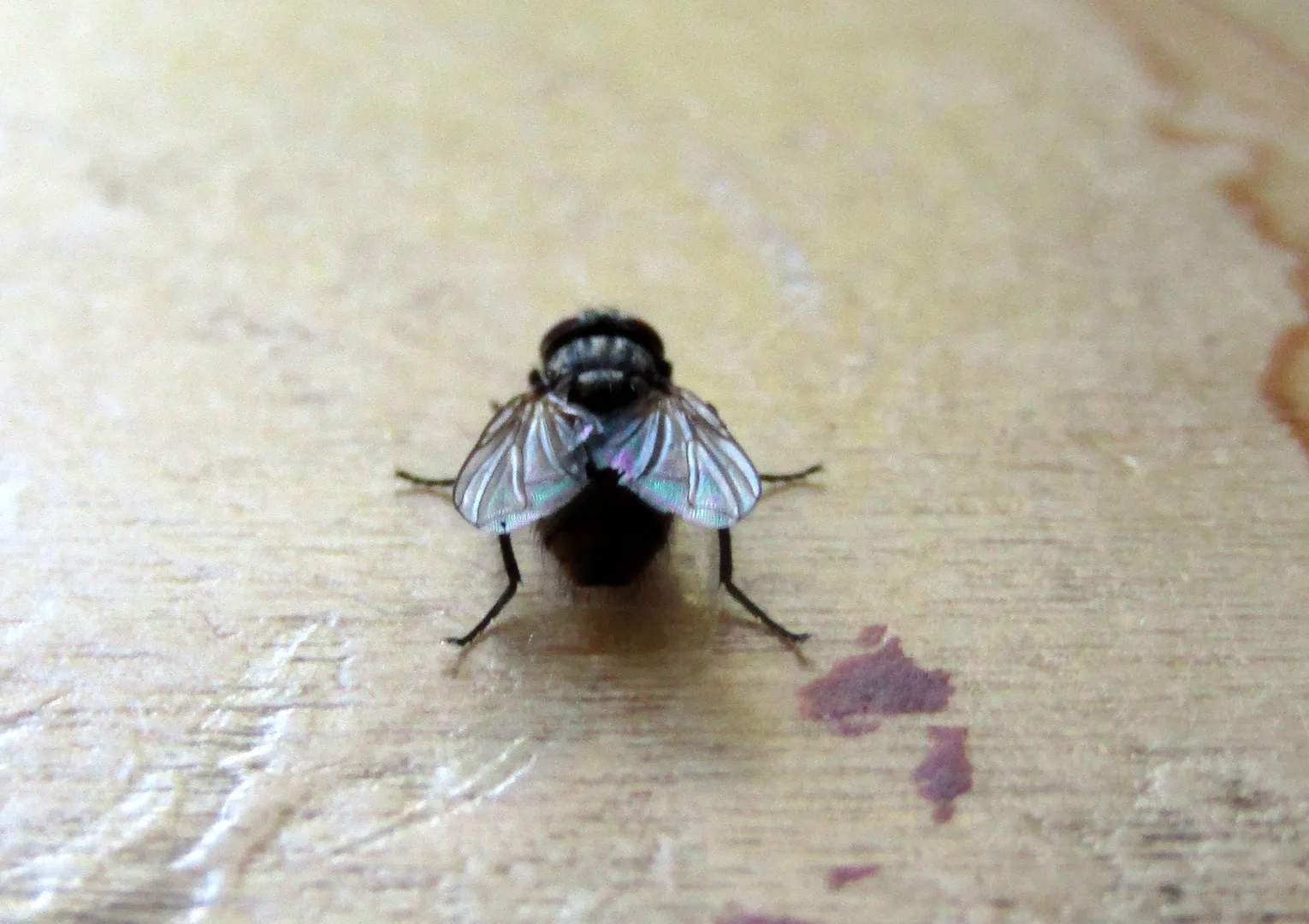
A housefly in Trimingham, Norfolk, England.
Field
notes
Tastes With Its Feet
A housefly tastes with its feet. Taste hairs, many of them on its feet, do the sampling. That is why houseflies tend to crawl on food.
Then comes the odd part. Houseflies can only take in food as a liquid, through sponge-like mouthparts. They cannot ingest particles larger than 0.045 mm. To deal with harder food, a fly puts saliva and stomach contents from its crop (a storage pouch) onto it, which makes it easier to digest. Straw-coloured spots on food may show where a fly regurgitated, or brought food back up. Dark spots are its droppings.
Small, Fast and Everywhere
An adult is 4 to 8 mm long, and 6.35 mm on average, with a wingspan of 13 to 15 mm and an average mass of 0.012 g. Females are slightly larger than males. Like all flies, it has one pair of wings. The second pair is reduced to halteres, which are used for balance.
Animal Diversity Web says houseflies can fly in bursts up to 15 miles per hour, and gives a typical lifespan in the wild of 15 to 25 days.
Houseflies are found almost anywhere, especially where people live. They are believed to have come from temperate parts of the Eastern Hemisphere, and now have a worldwide range. Genome researchers say they are always found in association with humans and human activities.
Built for Dirty Places
A female lays about 500 eggs in her life, in 5 to 6 batches. Maggots develop best in dung heaps, garbage cans and road kill. A housefly can complete its life cycle in as little as 7 to 10 days, so as many as 10 to 12 generations may occur in one summer.
The house fly genome holds 146 P450 genes, which suggests enhanced detoxification, compared with 86 in the fruit fly. It also has 771 putative immune-related genes, with substantial increases in copy number and diversity over the fruit fly’s immune system, consistent with life in a pathogen-rich environment. Insecticides have been used on houseflies for a century, and the species evolved resistance to them quickly.
Disease Carrier Adult houseflies are mechanical vectors of more than 100 devastating diseases. Their mobility and regular contact with dung, carcasses and garbage all contribute to their role in transmitting them. Their feces can spread typhoid fever, diarrhea and cholera. Houseflies do not bite.
Published
Traits
Intel
& FAQ
Guess
first
How big is a Housefly, really? Slide, lock in, and see what the sources say. Every answer is a figure from this page, quoted from where it came from.
Sources
- 01Musca domestica. Animal Diversity Web, University of Michigan Museum of Zoology.
- 02Scott et al. (2014). Genome of the house fly, Musca domestica L., a global vector of diseases with adaptations to a septic environment. Genome Biology.
- 03Williamson et al. (1996). Identification of mutations in the housefly para-type sodium channel gene associated with knockdown resistance (kdr) to pyrethroid insecticides. Molecular and General Genetics MGG.
What the sources say: 51 claims checked word for word against these sources →