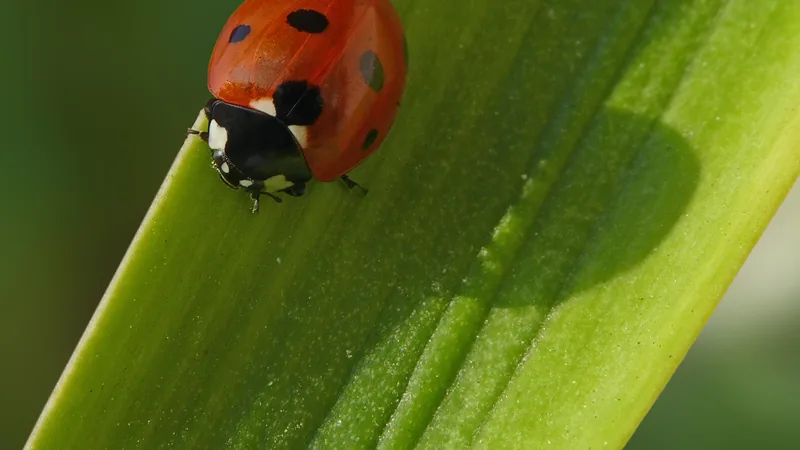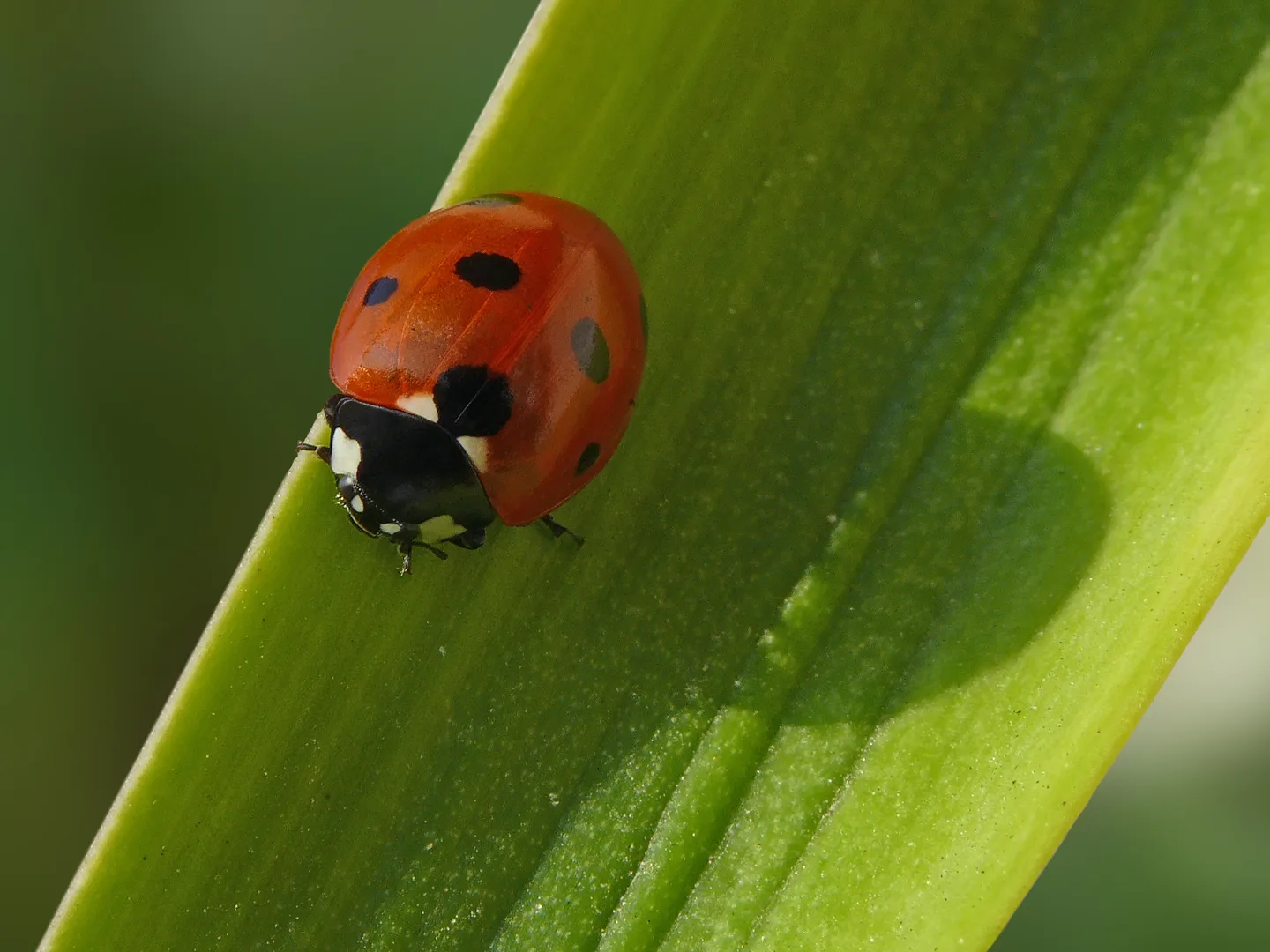
The seven-spot ladybird ( Coccinella septempunctata ).
Field
notes
Red and black, with a poison bleed
The seven-spot ladybird, Coccinella septempunctata, is about 6.5 to 7.8 mm long. It usually has seven black spots on orange-red wing covers, though the count can run from 0 to 9. Ladybird beetles are commonly called ladybugs or lady beetles.
The red and black colours are a warning. When threatened or attacked, the beetle leaks toxic chemicals from a gland between two leg segments, the femur and the tibia. They are highly toxic to many beetle predators, such as birds and small mammals.
Honest advertising Researchers raised seven-spot ladybird larvae on a low or a high aphid diet. The well-fed beetles carried more of the defensive alkaloid precoccinelline. The more carotenoid pigment in a beetle’s wing covers, the more precoccinelline it carried.
An aphid hunter
Adults and larvae both eat aphids, small insects that feed on plant sap. The larva looks like a tiny alligator, grows up to 8 mm and passes through four stages, called instars, as it moults. As in other lady beetles, young larvae usually pierce prey and suck out the contents. Older larvae and adults chew and can eat the whole insect.
It tracks aphids partly by smell. Aphids release an alarm pheromone, a warning scent, that attracts the beetle. Soybean plants under aphid attack release more methyl salicylate, and traps baited with it were highly attractive to adults in field tests.
Aphids try to escape by dropping. In a series of laboratory and field-cage tests on alfalfa, less than 7% of pea aphids dropped with no predator present. With a seven-spot ladybird there, nearly 60% dropped. The beetle itself grips with adhesive hairs on its feet, soft and rich in the elastic protein resilin at the tips and stiff at the bases.
When aphids run short, adults can eat pollen, and larvae can eat other ladybird larvae. In the growing season a female lives about two months and lays about 200 to 300 eggs. The species spends winter mostly as adults, sheltering in groups of around 10 to 15, and groups of over 200 have been recorded. An adult that survives the winter generally lives 1 to 2 years.
From Eurasia to North America
The species is native to Europe and Asia. US releases for aphid control between 1951 and 1971 were not thought to have created a wild population. One turned up in 1973 in Hackensack Meadowlands, New Jersey, and it was thought to have come from an accidental release. It went on to become one of the most common and widespread ladybirds in North America.
In crop fields in eastern South Dakota, one native ladybird was on average 20 to 32 times scarcer in the years after this species became established than before, depending on the crop. Animal Diversity Web calls it an invasive species.
Published
Traits
Intel
& FAQ
Guess
first
How big is a Seven-Spot Ladybird, really? Slide, lock in, and see what the sources say. Every answer is a figure from this page, quoted from where it came from.
Sources
- 01Coccinella septempunctata, sevenspotted lady beetle. Animal Diversity Web, University of Michigan Museum of Zoology.
- 02Sevenspotted Lady Beetle, Coccinella septempunctata. UC Statewide Integrated Pest Management Program, University of California.
- 03Ladybugs or Ladybird Beetles. University of Maryland Extension.
- 04Blount et al. (2012). How the ladybird got its spots: effects of resource limitation on the honesty of aposematic signals. Functional Ecology.
- 05Losey & Denno (1998). The escape response of pea aphids to foliar-foraging predators: factors affecting dropping behaviour. Ecological Entomology.
- 06Elliott, Kieckhefer & Kauffman (1996). Effects of an invading coccinellid on native coccinellids in an agricultural landscape. Oecologia.
- 07Zhu & Park (2005). Methyl Salicylate, a Soybean Aphid-Induced Plant Volatile Attractive to the Predator Coccinella septempunctata. Journal of Chemical Ecology.
- 08Peisker, Michels & Gorb (2013). Evidence for a material gradient in the adhesive tarsal setae of the ladybird beetle Coccinella septempunctata. Nature Communications.
What the sources say: 44 claims checked word for word against these sources →