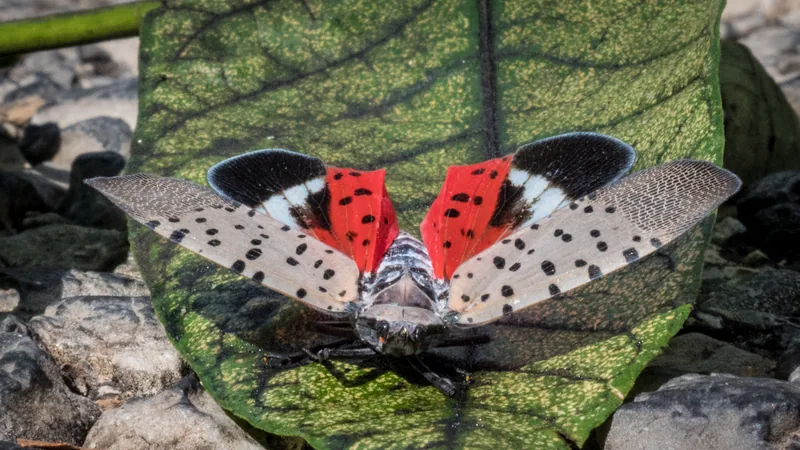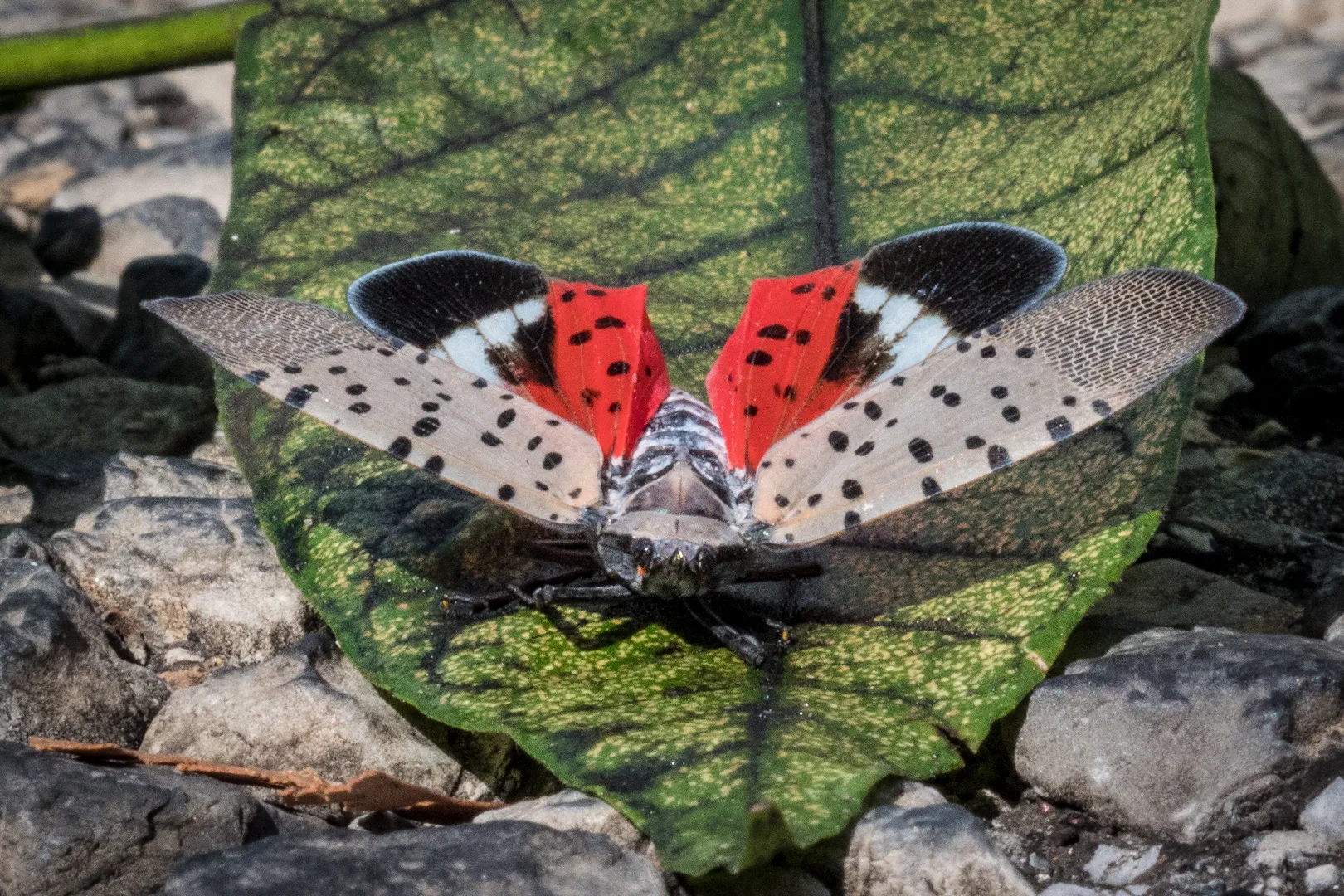
Adult spotted lanternfly with its hindwings open
Field
notes
A Planthopper That Borrows Its Poison
The spotted lanternfly, Lycorma delicatula, is neither a fly nor a moth. The Pennsylvania Department of Agriculture calls it an invasive planthopper. Animal Diversity Web warns that adults can be confused for moths. It feeds with piercing-sucking mouthparts that work like a tiny straw.
Its best trick is chemical. Third-stage nymphs are black with white spots, but fourth-stage nymphs, the final nymph stage, are red with white spots. Adults hide back wings that are bright red near the body and show only in flight. A 2018 study linked the switch to red with the insect narrowing its diet mainly to the tree of heaven, an invasive tree defended by chemicals called quassinoids. The lanternflies keep one of them, ailanthone, in their bodies. Bright colours on a distasteful animal warn predators off, a strategy called aposematism.
Borrowed warning In taste trials, birds shunned lanternflies gathered from tree of heaven but not ones gathered from other host plants.
Small Body, Big Jumps
Adult females are 24 to 27 mm long and males are 21 to 22 mm, according to Animal Diversity Web. In a lab study in which nymphs were reared on tree of heaven, newly moulted adult males averaged 0.120 g and females 0.175 g.
The nymphs are acrobats. High-speed video of nymphs jumping in a lab showed take-off speeds of 2.7 to 3.4 metres per second and accelerations of 800 to 1,000 metres per second squared, from fast hind-leg extensions. They spun in mid-air at 5 to 45 turns per second, yet landed successfully in 58.9 percent of trials.
A second study dropped nymphs and filmed them landing. Nymphs land at varying angles, then flip upright as they bounce, using body rotations, foot adhesion and leg motions. The authors say they take advantage of near-total energy loss on impact.
One Generation a Year
Animal Diversity Web lists the species as univoltine, meaning one generation a year. Females lay eggs from August to early November, and the eggs overwinter. In a Pennsylvania study from 2016 to 2017, egg masses held up to 192 eggs, though 91.8 percent held under 50. Eggs hatched between 2 May and 5 June, and the adult stage ran from 24 July to 15 November, 114 days. Adults spent about two months feeding, then laid eggs in early October.
An Invader That Hitches a Ride
The lanternfly is native to China, Taiwan, India and Vietnam, and in 2020 Animal Diversity Web listed it as invasive in Korea, Japan and the United States. It was first discovered in Berks County, Pennsylvania, in 2014. California’s agriculture department says it can walk, jump or fly short distances, but its long-distance spread is helped by people who move infested items. It lays eggs on almost any surface, including vehicles and outdoor equipment.
Penn State reported in 2022 that it feeds on more than 100 plant species. Recent research suggests it rarely kills them, and it is not known to bite or sting. Its sugary waste, called honeydew, feeds sooty mold. Nature also pushes back: in a 2019 study, two native fungi caused a local outbreak of lanternflies in the eastern United States to collapse.
Published Updated
Traits
Intel
& FAQ
Guess
first
How big is a Spotted Lanternfly, really? Slide, lock in, and see what the sources say. Every answer is a figure from this page, quoted from where it came from.
Sources
- 01Lycorma delicatula. Animal Diversity Web, University of Michigan Museum of Zoology.
- 02Song et al. (2018). Defense sequestration associated with narrowing of diet and ontogenetic change to aposematic colours in the spotted lanternfly. Scientific Reports.
- 03Li et al. (2023). Putting a new spin on insect jumping performance using 3D modeling and computer simulations of spotted lanternfly nymphs. Journal of Experimental Biology.
- 04Kane et al. (2021). Many ways to land upright: novel righting strategies allow spotted lanternfly nymphs to land on diverse substrates. Journal of The Royal Society Interface.
- 05Kreitman et al. (2023). The impact of host plant species on instar duration and body weight of nymphal Lycorma delicatula. Frontiers in Insect Science.
- 06Liu (2019). Oviposition Substrate Selection, Egg Mass Characteristics, Host Preference, and Life History of the Spotted Lanternfly (Hemiptera: Fulgoridae) in North America. Environmental Entomology.
- 07Clifton et al. (2019). A pair of native fungal pathogens drives decline of a new invasive herbivore. Proceedings of the National Academy of Sciences.
- 08Spotted lanternfly lore: Penn State experts clear up falsehoods about pest. Penn State College of Agricultural Sciences.
- 09Spotted Lanternfly. Pennsylvania Department of Agriculture.
- 10Spotted Lanternfly. California Department of Food and Agriculture.
What the sources say: 66 claims checked word for word against these sources →