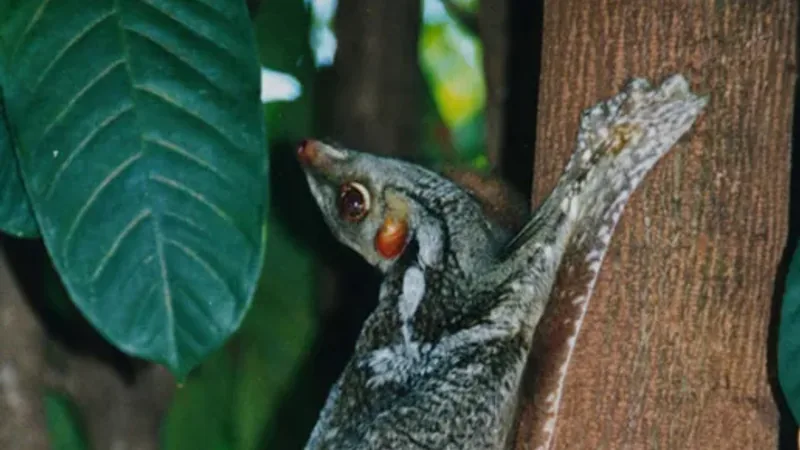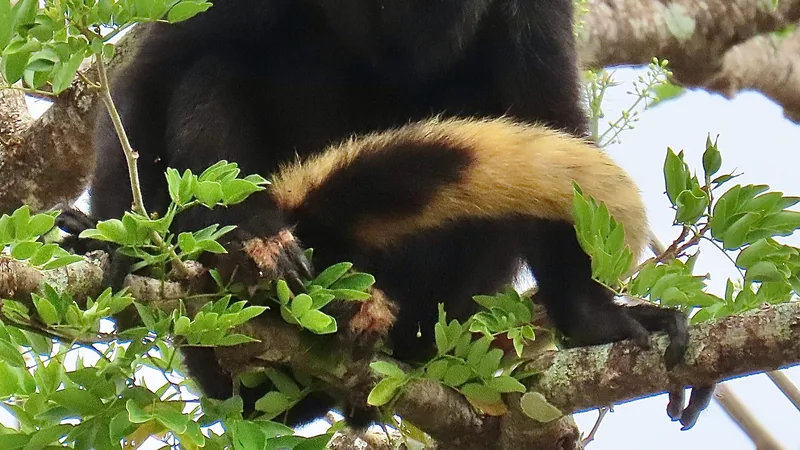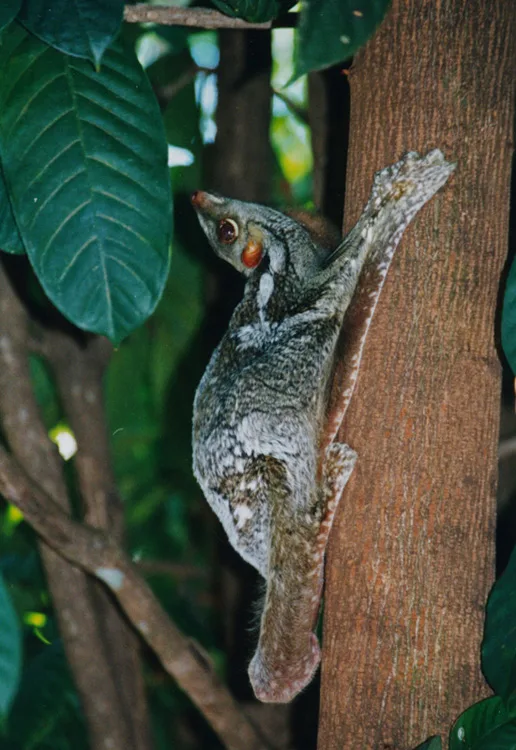
A Sunda colugo (Galeopterus variegatus) clinging to a tree trunk.
Field
notes
Clinging to a rainforest trunk in Southeast Asia, a Sunda colugo (Galeopterus variegatus) is hard to spot. Bold patches of color in its fur look like lichen, camouflage against predators. An adult weighs 0.9 to 2 kilograms and measures 33 to 42 centimetres long, plus a 17.5 to 27-centimetre tail.
Its other name, “flying lemur,” doesn’t hold up: a colugo is not a lemur, and it cannot fly. It belongs to Dermoptera, a mammal order counted among the closest living relatives of primates.
A Membrane From Neck to Tail
A sheet of furred skin called a patagium runs from the colugo’s neck, along its limbs, out to its fingers, toes and tail. When the animal glides, it can spread to about 70 centimetres, with help from an extensor muscle in the flank. Climbing a trunk looks awkward: it stretches out its front legs, then brings up its back legs in a hopping motion. To escape predators it glides away, covering up to 100 metres with little loss in height.
A 2008 study that fitted free-ranging colugos with accelerometers found they actively control each glide. The animals push off harder for longer glides, and landing forces fall quickly as glides lengthen from the shortest, then level off, suggesting they reorient the aerodynamic forces before landing to slow down.
Gliding Is Not the Cheap Way Across A 2011 study found gliding is not the energy-saving shortcut it looks like. Colugos climb a short way to launch a glide, and the energy cost of that climb makes a glide pricier per metre than crossing that same ground through the canopy would be.
A Diet of Soft Plant Parts
Sunda colugos are strict herbivores, feeding on soft plant parts: young leaves, buds, fruit, flowers, nectar and sap. Their comb-shaped lower incisors, with up to 20 prongs per tooth, are thought to help them scrape sap from trees or strain fruit and flowers, among 34 carnivore-like teeth.
Passengers in a Furry Parachute
Females give birth to a single pup after a gestation of about 60 days; twins happen rarely. The newborn is tiny and underdeveloped, weighing around 35 grams. Its mother can fold her patagium into a pouch to protect and warm it; out of the pouch, it clings to her underside, even while she glides from tree to tree. Pups are weaned at six months and reach adulthood at about three years.
Holding On in a Shrinking Canopy
Sunda colugos are endemic to Indochina and Sundaland, the region covering the Malay Peninsula and its surrounding islands. They are strictly arboreal, living out their lives in the rainforest canopy, though they are also found in highlands and adapt to disturbed forest edges and plantations. Little is known about their lifespan, but the oldest known captive member of the colugo family Cynocephalidae reached 17.5 years.
Humans are among the colugo’s few known predators, and if threatened, a colugo freezes or climbs higher into the trees. Habitat loss to logging and the conversion of native forest into farmland has cut colugo numbers, yet the IUCN’s 2008 assessment, the latest, rates the species Least Concern.
Published Updated
Traits
Intel
& FAQ
Guess
first
How big is a Sunda Colugo, really? Slide, lock in, and see what the sources say. Every answer is a figure from this page, quoted from where it came from.
Sources
- 01Galeopterus variegates (Sunda flying lemur). Animal Diversity Web, University of Michigan.
- 02Boeadi & Steinmetz (2008). Galeopterus variegatus. The IUCN Red List of Threatened Species 2008: e.T41502A10479343.
- 03Byrnes, Lim & Spence (2008). Take-off and landing kinetics of a free-ranging gliding mammal, the Malayan colugo (Galeopterus variegatus). Proceedings of the Royal Society B: Biological Sciences.
- 04Byrnes et al. (2011). Gliding saves time but not energy in Malayan colugos. Journal of Experimental Biology.
What the sources say: 58 claims checked word for word against these sources →