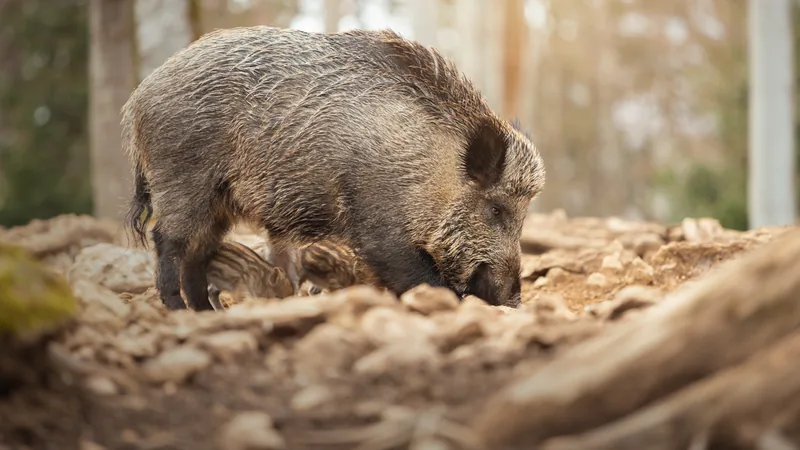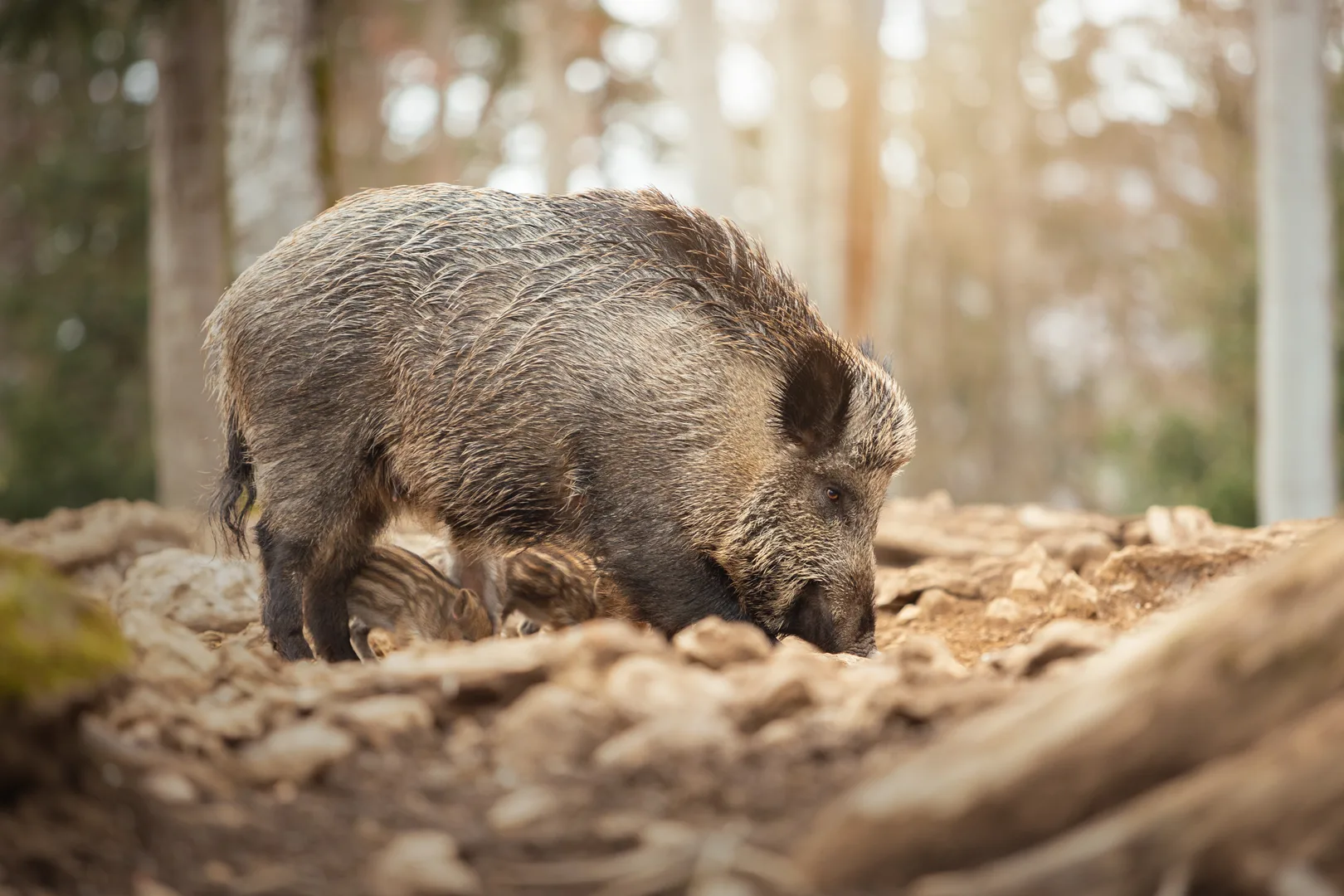
Female wild boar with piglets in Šumava National Park, Czechia
Field
notes
Nose to the ground
A wild boar’s long, flattened snout gives it a heightened sense of smell, and as it forages it keeps that snout near the ground. The habit has a cost: a boar with its nose down may find it harder to smell danger.
Boars are omnivores, so they eat plants and animals. Most of the menu is plant matter such as crops, fruit, nuts and roots. They have also been known to eat bird eggs, carrion (dead animals), small rodents, insects and worms. Feral swine, also called wild pigs or boar, use their keen sense of smell and their digging to prey on reptile eggs buried in sand or soil.
Canines on show
Adult wild boars measure 153 to 240 cm in total length and weigh 66 to 272 kg. Females tend to be smaller than males of the same age. A boar can stand as tall as 0.9 m at its bulky shoulders. Its upper canine teeth typically measure 5 to 10 cm and are usually visible even when the mouth is closed. The thick, coarse coat runs from black to brownish-red to white.
In the wild, hunting pressure greatly affects their mortality. A study that followed 376 marked wild boars in Poland’s Kampinos National Park from 1963 to 1973 found an average life of 21 months for males and 24 months for females, and the oldest male reached 9 years. The longevity record is 27 years, set in captivity by an individual of the subspecies Sus scrofa riukiuanus.
Striped babies At birth, piglets generally have yellowish-brown stripes down their backs. The stripes let them stay concealed in undergrowth and in their nest, and they fade into an even color within about 4 months.
Life in a sounder
Wild boars tend to live in groups called sounders. A sounder is made up of 6 to 20 closely related females, but may hold over 100 animals. Males leave their mothers at 1 to 2 years old and generally join a sounder only during mating season.
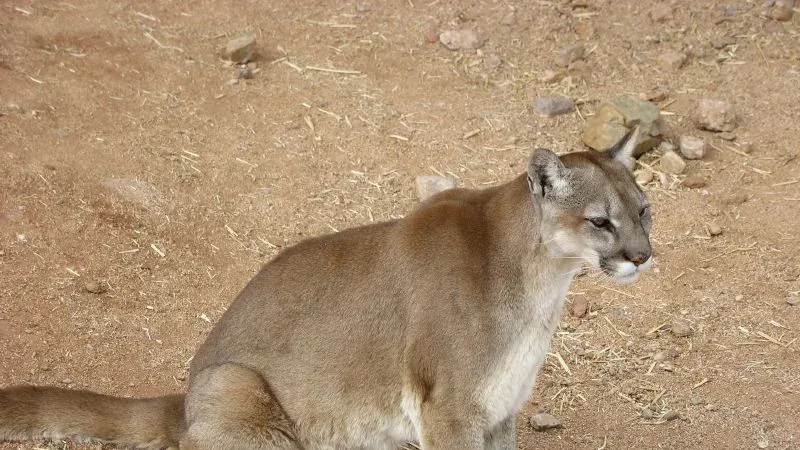
A sow’s gestation period lasts 108 to 120 days, and a litter averages 5 to 6 piglets. When the group travels, the mothers keep the young in the middle, with adults in the lead and at the rear. Humans are the main predator. Young boars are targeted by coyotes and bobcats, while juveniles and adults may fall prey to American black bears and cougars.
Everywhere but Antarctica
Wild boars originated in Europe and Asia, and they live on every continent except Antarctica. They may live in savanna, forest, farmland, shrubland and swamp. They need a nearby water source and dense vegetation for cover. The IUCN Red List rates the species Least Concern.
Wild boars can be destructive to farmland and natural ecosystems. In the United States, feral swine are descended from escaped or released domestic pigs, Eurasian boar and their hybrids. They were introduced in the 1500s, and in 2020 the USDA put their population at about 6 million. They have played a role in the decline of nearly 300 native plants and animals.
Published Updated
Traits
Intel
& FAQ
Guess
first
How big is a Wild Boar, really? Slide, lock in, and see what the sources say. Every answer is a figure from this page, quoted from where it came from.
Sources
- 01Sus scrofa (wild boar). Animal Diversity Web, University of Michigan.
- 02AnAge entry for Sus scrofa. AnAge: The Animal Ageing and Longevity Database, Human Ageing Genomic Resources.
- 03Feral Swine: Impacts on Threatened and Endangered Species. USDA Animal and Plant Health Inspection Service.
- 04Eurasian Boar. New York State Department of Environmental Conservation.
- 05Sain (2019). Hogs Gone Wild. National Wildlife, National Wildlife Federation.
- 06Scandura et al. (2025). Sus scrofa. The IUCN Red List of Threatened Species 2025: e.T41775A215861797.
- 07Mataković, Beljan & Landekić (2023). Wild Animal Attacks on Humans in Croatia. South-east European forestry.
- 08Jezierski (1977). Longevity and mortality rate in a population of wild boar. Acta Theriologica.
What the sources say: 56 claims checked word for word against these sources →