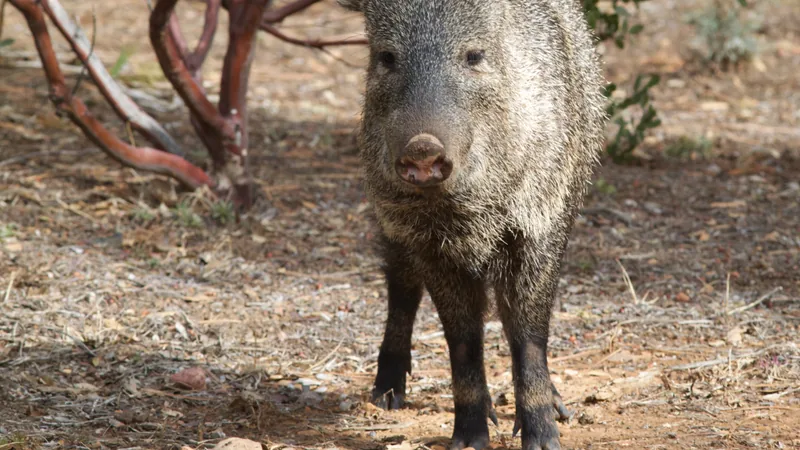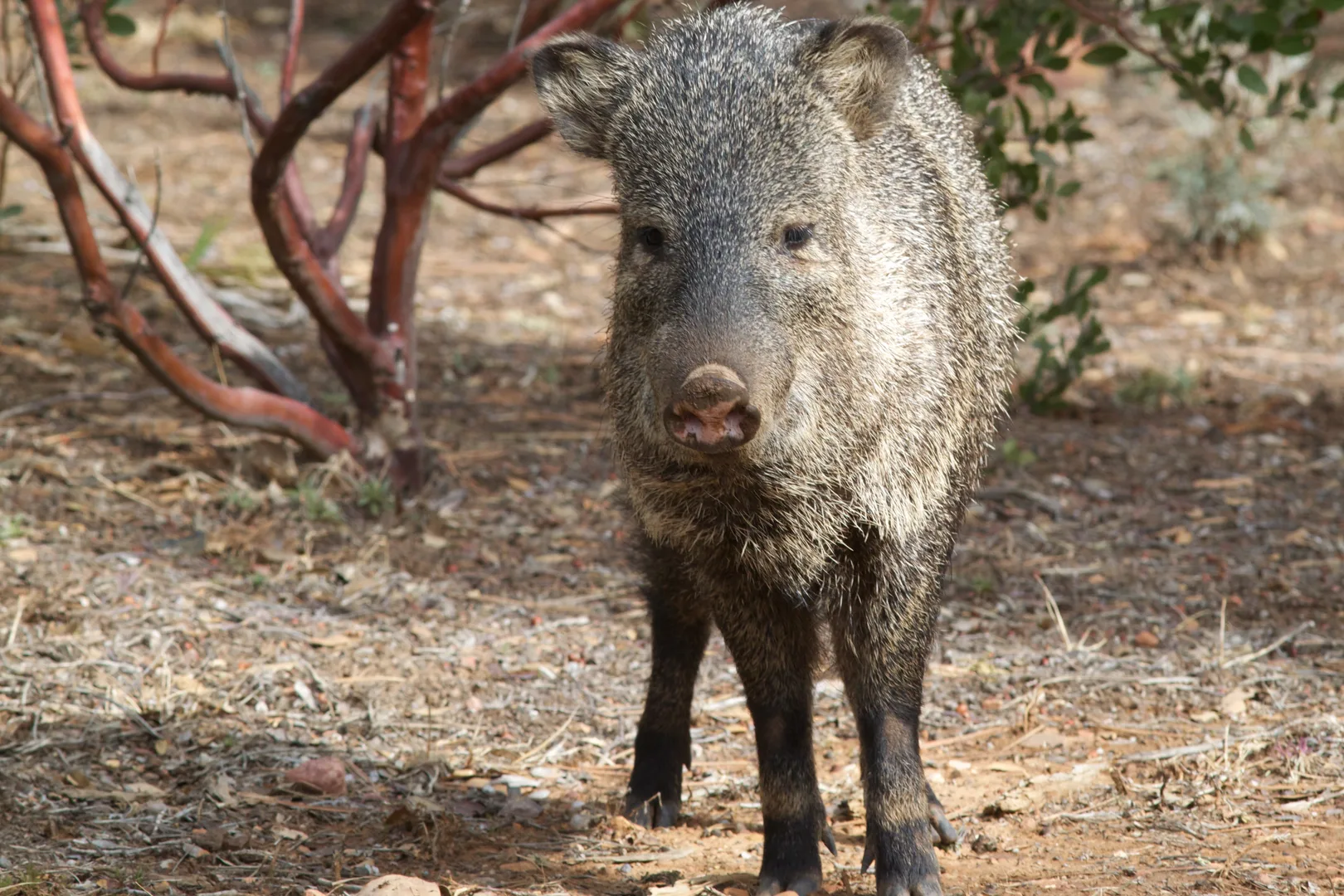
Javelina in a neighbourhood, Arizona
Field
notes
Teeth That Sharpen Themselves
The collared peccary (Dicotyles tajacu) carries a built-in weapon rack. Its upper and lower canine teeth, the pointed ones at the corners of the mouth, are straight and self-sharpening. Few herbivores, and few carnivores, have canines as large and sharp as a peccary’s, and they serve little purpose in eating. They are mainly for defence and threats: when provoked, a peccary clacks its teeth together in rapid up-and-down motions, and it can open its mouth to show them off. Many older sources file it as Pecari tajacu, but a 2020 review of the naming history found that Dicotyles is the valid genus for the collared peccary and Pecari its junior synonym.
Scent signature A collared peccary has large scent glands on its back, just ahead of the tail, and uses their liquid to mark territory.
Its eyesight is poor, but its sense of smell is highly developed.
A Pig? Don’t Say That
It is perhaps better known as the javelina, but do not call it a pig. It is only distantly related to true swine, which share a common ancestor with peccaries believed to have lived some 40 million years ago. Its hind foot has only three toes.
Adults stand 30 to 50 cm at the shoulder and are 84 to 106 cm long. Adults weigh 15 to 28 kg, and some in Arizona and Peru have been recorded at 40 to 42 kg. It is the smallest peccary species, but it can reach 35 kilometres per hour.
Desert Diner, Rainforest Fruit Fan
Collared peccaries live from Arizona, New Mexico and Texas through Central America and east of the Andes down to northern Argentina. Their habitats include deserts, grasslands and rainforests.
In Texas, a 1981 diet study found that cacti made up 74.7 percent of what they ate. Succulent plants, cacti included, can supply up to 88 percent of a Texas javelina’s water. In tropical forests they eat mostly fruit, from over 128 species. They also eat insects.
Run First, Bluff Second
Herds of about 5 to 15 animals roam semi-arid country. When a jaguar or puma shows up, they usually flee, but herds have been seen standing their ground or making bluff-charges (rushes that stop short of contact). When alarmed, they huff and stomp their feet.
One captive animal was still alive at 31.5 years. In the wild, Texas javelinas generally live five to 10 years. The IUCN Red List rates the species Least Concern.
Published Updated
Traits
Intel
& FAQ
Guess
first
How big is a Collared Peccary, really? Slide, lock in, and see what the sources say. Every answer is a figure from this page, quoted from where it came from.
Sources
- 01Gongora et al. (2011). Pecari tajacu. The IUCN Red List of Threatened Species 2011: e.T41777A10562361.
- 02Acosta et al. (2020). Unraveling the nomenclatural puzzle of the collared and white-lipped peccaries (Mammalia, Cetartiodactyla, Tayassuidae). Zootaxa.
- 03Pecari tajacu (collared peccary). Animal Diversity Web, University of Michigan.
- 04Peccary. San Diego Zoo Wildlife Alliance.
- 05The Javelina in Texas. Texas Parks and Wildlife Department.
- 06AnAge entry for Pecari tajacu. AnAge: The Animal Ageing and Longevity Database, Human Ageing Genomic Resources.
What the sources say: 53 claims checked word for word against these sources →