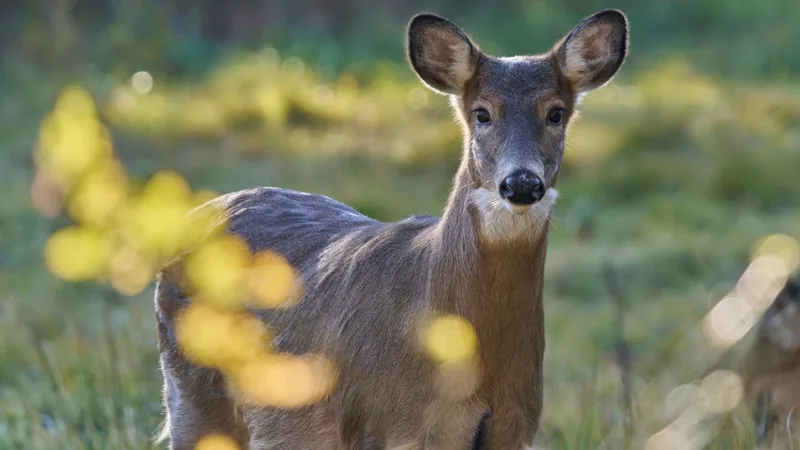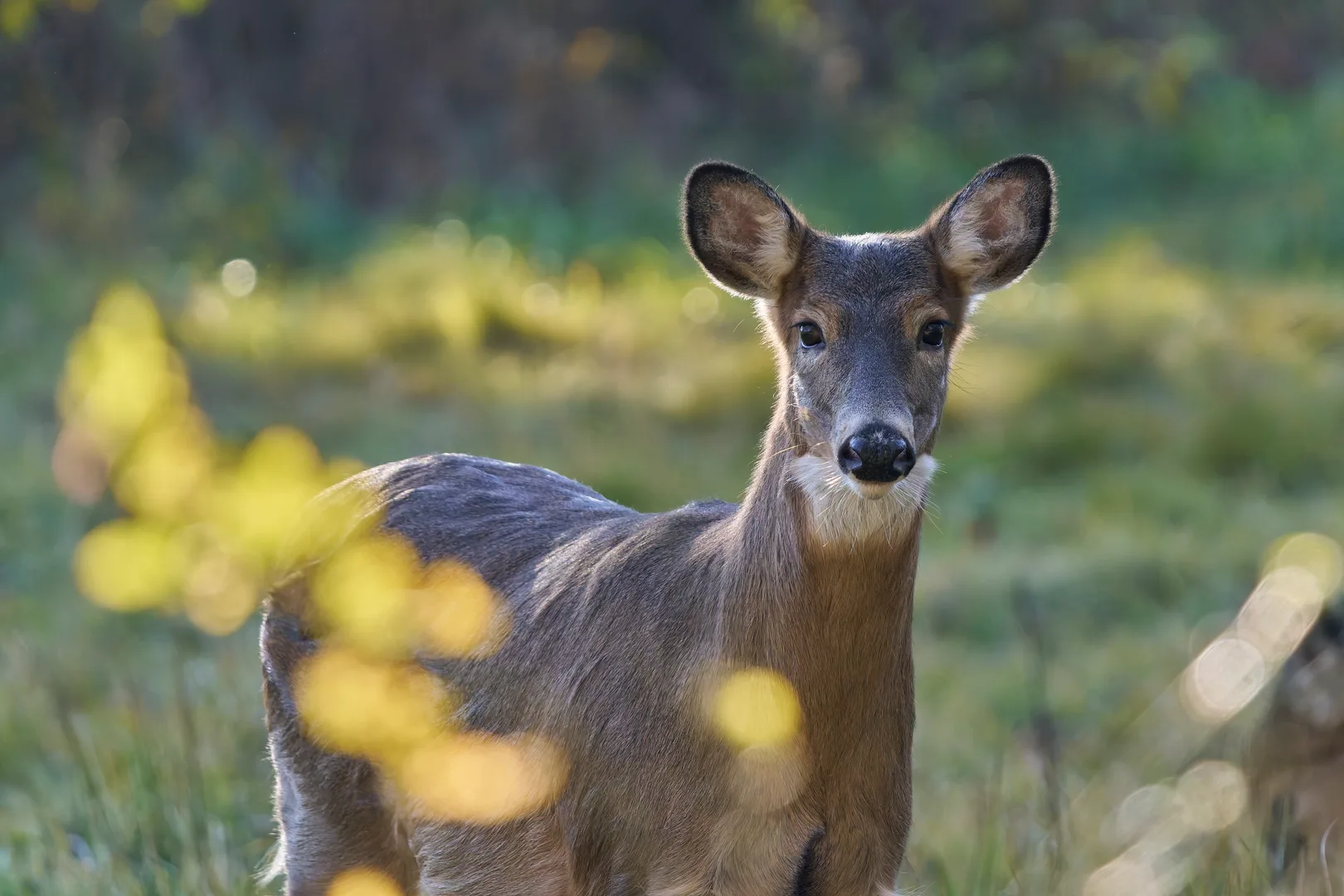
White-tailed Deer. Cedar Hill Cemetery.
Field
notes
The fawn that holds it in
A newborn white-tailed deer weighs 1.5 to 2.5 kg. Its reddish-brown coat is dappled with white spots, which give it excellent camouflage against detection by predators in the summer. Its mother leaves it in dense vegetation while she feeds. The fawn lies flat with its neck outstretched and holds in its feces and urine until she returns. Then she eats whatever the fawn passes, to deny predators any sign of it.
Early fawn losses tend to be high. In Maine, about 130 fawns are born for every 100 does, but only 65 to 90 of them usually survive their first five months.
The white flag
Adults stand 80 to 100 cm at the shoulder and weigh 57 to 137 kg, and bucks are bigger than does. Their long legs let them leap, bound, turn and run at up to 40 miles per hour. They also swim well. Wide-set eyes help them pick out subtle movement, and large ears rotate toward suspicious sounds. They depend mainly on smell to detect danger.
The tail alarm When a deer raises its white tail, it flashes a danger signal to other deer nearby.
Antlers, coats and stored fat
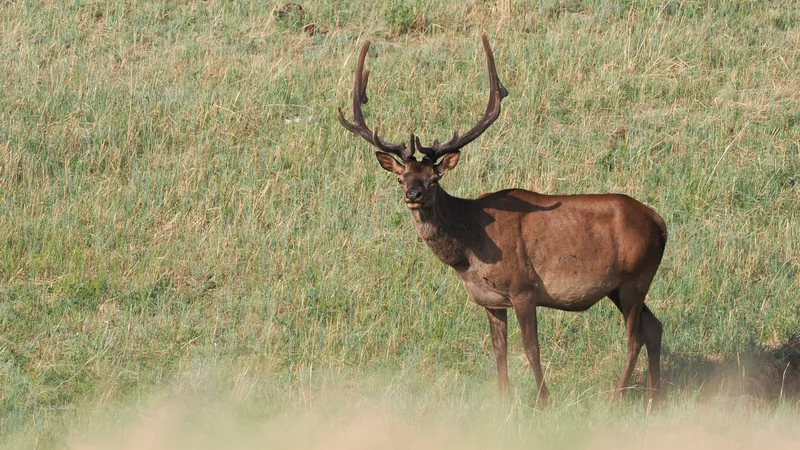
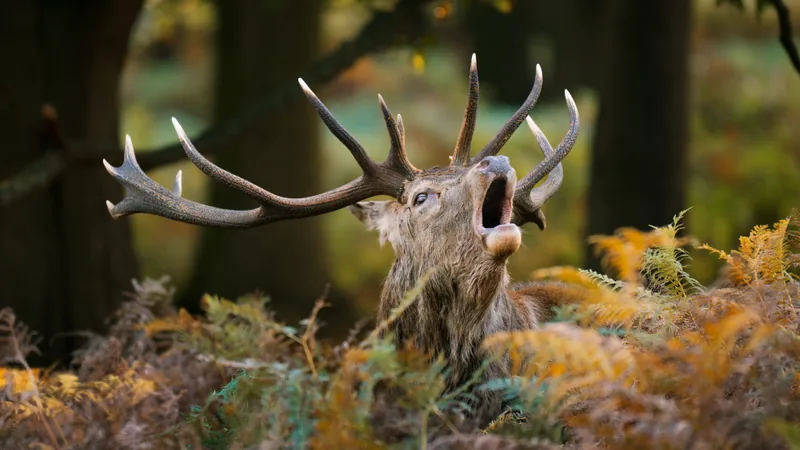
Bucks grow new antlers every year. Antlers are made of bone, and they start to grow in April wrapped in velvet, a network of skin tissue and blood vessels. The velvet is shed in late August or September, and the hard antlers drop off between late December and early March.
A deer also grows two coats a year. A short reddish one keeps it cool in summer. In September it molts into a winter coat with a woolly layer underneath and long hollow guard hairs on top, which the deer can raise to thicken the coat against winter winds. In autumn it also packs fat under the skin, between the muscles and inside the hollow bones of its legs. That fat can be 10 to 25% of its body weight by late fall.
From Maine to Bolivia
The range covers most of southern Canada and the mainland United States except two or three western states, then reaches through Central America to Bolivia. Deer live in the big woods of northern Maine, the swamps of Florida, farmland, and the cactus and thornbrush deserts of southern Texas and Mexico.
They eat grasses, ferns, mushrooms, leaves, fruits, acorns, grains, and twigs and buds of woody plants, and they take more twigs and buds when better food is short. A deer can live to 20 years, though few in the wild last that long.
Published
Traits
Intel
& FAQ
Guess
first
How big is a White-Tailed Deer, really? Slide, lock in, and see what the sources say. Every answer is a figure from this page, quoted from where it came from.
Sources
- 01Dewey (2003). Odocoileus virginianus (white-tailed deer). Animal Diversity Web, University of Michigan.
- 02White-tailed Deer. Maine Department of Inland Fisheries and Wildlife.
- 03Gallina & Lopez Arevalo (2016). Odocoileus virginianus. The IUCN Red List of Threatened Species 2016: e.T42394A22162580.
- 04Hubbard & Nielsen (2009). White-Tailed Deer Attacking Humans During the Fawning Season: A Unique Human-Wildlife Conflict on a University Campus. Human–Wildlife Interactions.
What the sources say: 50 claims checked word for word against these sources →