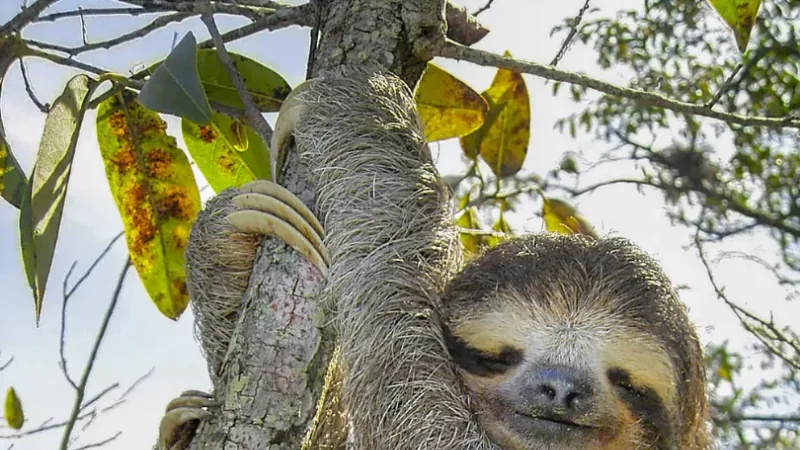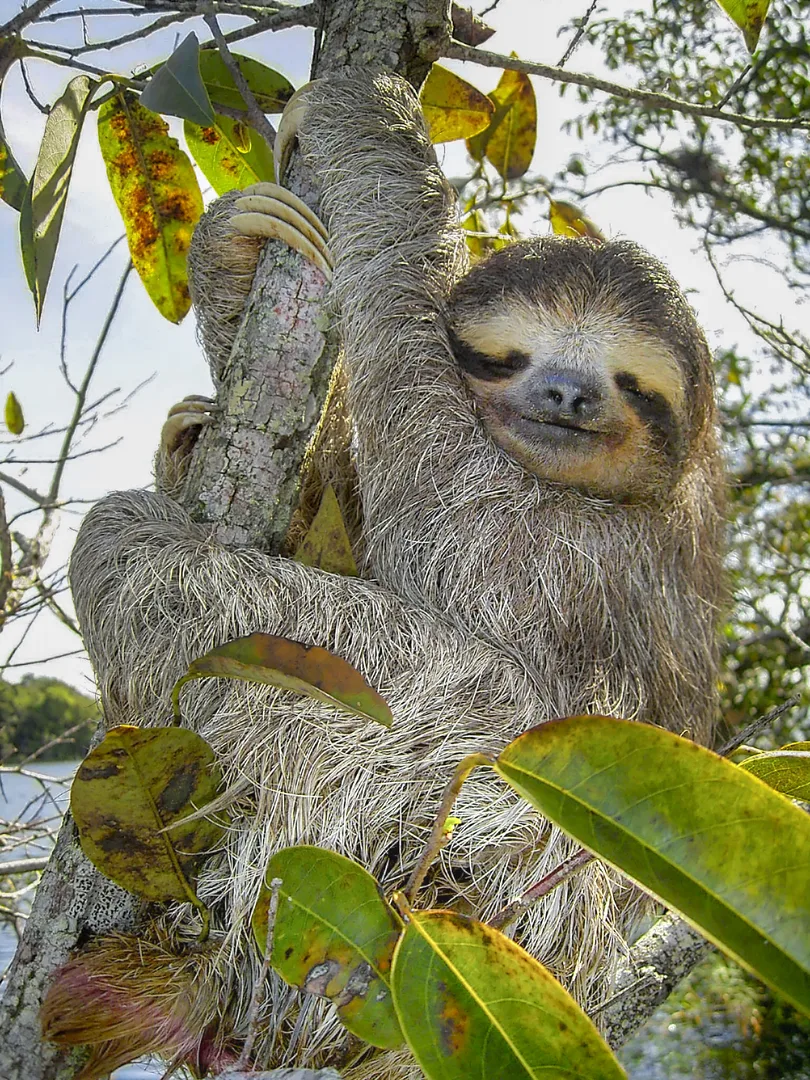
Pale-throated three-toed sloth in Anavilhanas National Park, Amazonas, Brazil
Field
notes
Life in Slow Motion
The pale-throated three-toed sloth (Bradypus tridactylus) is found in the forests of Venezuela, Guyana, Suriname, French Guiana and northern Brazil. Adults average about 4.25 kg, and three-toed sloths in general grow 1.5 to 2.5 feet (46 to 76 cm) long. Three-toed sloths live high in the rainforest canopy and feed on the twigs, buds and leaves of Cecropia trees. They need relatively little food and run a lower metabolic rate than other mammals of similar size, and at night a sloth’s body temperature drops to save energy. No detailed study of its lifespan exists, but it has been estimated to live up to 40 years in the wild. The Red List rated it Least Concern in 2022, though its population is decreasing.
A Fur Coat Full of Neighbors
Sloths carry a complex community of organisms in their hair, including moths and algae, and green algae living in the hair can give a sloth an overall greenish look that camouflages it in the canopy. In 1977, Wulf Koch, curator of an algae collection at Germany’s University of Göttingen, isolated one of those algae from the hairs of a pale-throated sloth in Brazil’s Amazon. It was filed under the name Trichophilus welckeri. In 2024, scientists re-examined its shape and DNA and found it belonged in a different genus. They described it as a new species and named it Prasiolopsis wulf-kochii, after him.
Ground Rules
Climbing down to defecate on the ground puts a sloth at risk from predators, and scientists have proposed at least five explanations for why sloths do it. One is a partnership with fur moths: the sloth covers its droppings to benefit moth larvae that develop inside them. That model was built on the brown-throated three-toed sloth (Bradypus variegatus), a close relative, and a 2021 review found it contradicted by the scientific literature. The pale-throated sloth may not even follow the same script.
Business from the branches Bradypus tridactylus sometimes relieves itself straight from the canopy, and the review’s author suggests it may be on its way to a more fully tree-bound life.
It is usually a loner: during a wildlife rescue along French Guiana’s Sinnamary River, over 73 percent of the pale-throated sloths captured were solitary. Three-toed sloths defend themselves from predators like jaguars with long arms, sharp claws and sharp teeth. On the rare occasions one comes down to the ground, it drags itself along by its hands. It can stand on its feet but cannot walk on them. In water, though, it is an excellent swimmer.
Published Updated
Traits
Intel
& FAQ
Guess
first
How big is a Three-Toed Sloth, really? Slide, lock in, and see what the sources say. Every answer is a figure from this page, quoted from where it came from.
Sources
- 01Bradypus tridactylus. Animal Diversity Web, University of Michigan.
- 02Bradypus tridactylus. AnAge: The Animal Ageing and Longevity Database.
- 03Pool et al. (2022). Bradypus tridactylus. The IUCN Red List of Threatened Species 2022: e.T3037A210442660.
- 04De Moura Filho, Huggins & Lines (1983). Sleep and waking in the three-toed sloth, Bradypus tridactylus. Comparative Biochemistry and Physiology Part A: Physiology.
- 05Taube et al. (1999). Distribution of Two Sympatric Species of Sloths (Choloepus didactylus and Bradypus tridactylus) along the Sinnamary River, French Guiana. Biotropica.
- 06Taube et al. (2001). Reproductive biology and postnatal development in sloths, Bradypus and Choloepus: review with original data from the field (French Guiana) and from captivity. Mammal Review.
- 07Darienko & Pröschold (2024). Prasiolopsis wulf-kochii (Prasiolales, Trebouxiophyceae), a New Species Occurring in Hairs of the Sloth Bradypus tridactylus. Plants.
- 08Monge Nájera (2021). Why sloths defecate on the ground: rejection of the mutualistic model. UNED Research Journal.
- 09Barros, Sampaio & Schneider (2003). Phylogenetic analysis of 16S mitochondrial DNA data in sloths and anteaters. Genetics and Molecular Biology.
What the sources say: 46 claims checked word for word against these sources →