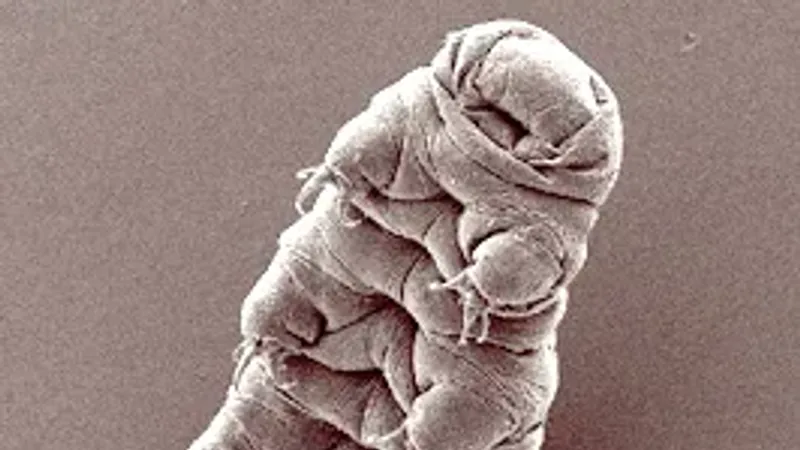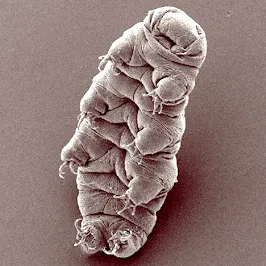
Tardigrades (commonly known as waterbears or moss piglets)
Field
notes
Not the Tardigrade You Think It Is
Tardigrades, also called water bears or moss piglets, have four body segments that each carry two legs. Across the phylum, tardigrades typically run about 0.1 to 1 millimeter long, and in one lab study active H. exemplaris measured about 164 micrometers. A commercially sold strain kept in many laboratories throughout the world was assumed to be Hypsibius dujardini. When researchers redescribed the real H. dujardini from DNA markers and detailed anatomy in 2018, that lab strain turned out to represent “in fact, a new species”: Hypsibius exemplaris, the animal on this page.
Shutting Down to Survive
Land-dwelling tardigrades need a thin film of water to stay active. Without it, H. exemplaris contracts into a compact ball called a tun, the shape tardigrades form to reduce their body surface area and rate of evaporation. In one study, tuns dried for six days measured about 101 micrometers, and the cells and mitochondria inside had shrunk too.
Unlike its relative Ramazzottius varieornatus, which tolerates rapid desiccation, H. exemplaris enters that dormant state only “after extensive pre-exposure to drying conditions.” A 2017 genome study dried it slowly, at 85% relative humidity for 48 hours, and counted a batch as successfully dormant when more than 90% of the animals recovered after rehydration.
Disordered proteins found only in tardigrades play an essential role in the shutdown. In the lab, one of this species’ proteins, CAHS-8, formed long fibres and finally a gel as it grew more concentrated, and soluble proteins caught in the gel’s cavities kept their functional form.
Radiation, Up to a Thousand Times Over
Tardigrades can survive doses of ionizing radiation up to about 1,000 times the lethal dose for humans. H. exemplaris isn’t immune: gamma rays still damage its DNA. What’s different is the comeback: the damage is repaired.
Its own genes come to the rescue Irradiation rapidly switches on many DNA-repair genes in H. exemplaris, pushing some repair transcripts to among the most abundant in the animal.
At least one of those genes is important to radiation tolerance in the living animal. A second defense may sit in the nucleus. Dsup, a damage-suppressor protein first found in R. varieornatus, has a counterpart in H. exemplaris. In lab tests that version also binds to nucleosomes in chromatin, the structure DNA is packaged into, and protects DNA from hydroxyl radicals, which ionizing radiation generates in cells.
Built for the Lab
Lab colonies of H. exemplaris are fed the green alga Chlorella vulgaris. The species has a generation time under two weeks at room temperature, stocks can be frozen and revived, and its body and embryos are optically clear. Its genome has been sequenced, and researchers have built techniques for it that include microinjection and RNA interference. A 2018 review describes it as an emerging model system, used to study how animal form evolves and how biological materials survive extreme environments.
Published Updated
Traits
Intel
& FAQ
Sources
- 01Gąsiorek et al. (2018). An integrative redescription of Hypsibius dujardini (Doyère, 1840), the nominal taxon for Hypsibioidea (Tardigrada: Eutardigrada). Zootaxa.
- 02Chavez et al. (2019). The tardigrade damage suppressor protein binds to nucleosomes and protects DNA from hydroxyl radicals. eLife.
- 03Yoshida et al. (2017). Comparative genomics of the tardigrades Hypsibius dujardini and Ramazzottius varieornatus. PLOS Biology.
- 04Richaud et al. (2020). Ultrastructural analysis of the dehydrated tardigrade Hypsibius exemplaris unveils an anhydrobiotic-specific architecture. Scientific Reports.
- 05Clark-Hachtel et al. (2024). The tardigrade Hypsibius exemplaris dramatically upregulates DNA repair pathway genes in response to ionizing radiation. Current Biology.
- 06Malki et al. (2021). Intrinsically Disordered Tardigrade Proteins Self-Assemble into Fibrous Gels in Response to Environmental Stress. Angewandte Chemie International Edition.
- 07Goldstein (2018). The Emergence of the Tardigrade Hypsibius exemplaris as a Model System. Cold Spring Harbor Protocols.
What the sources say: 54 claims checked word for word against these sources →