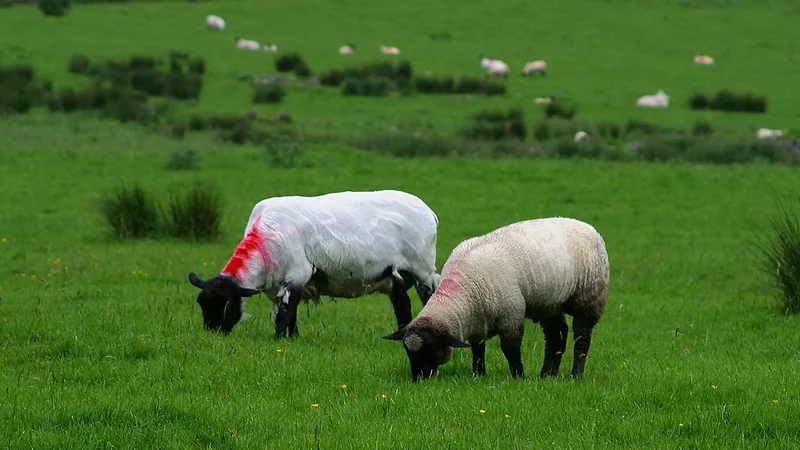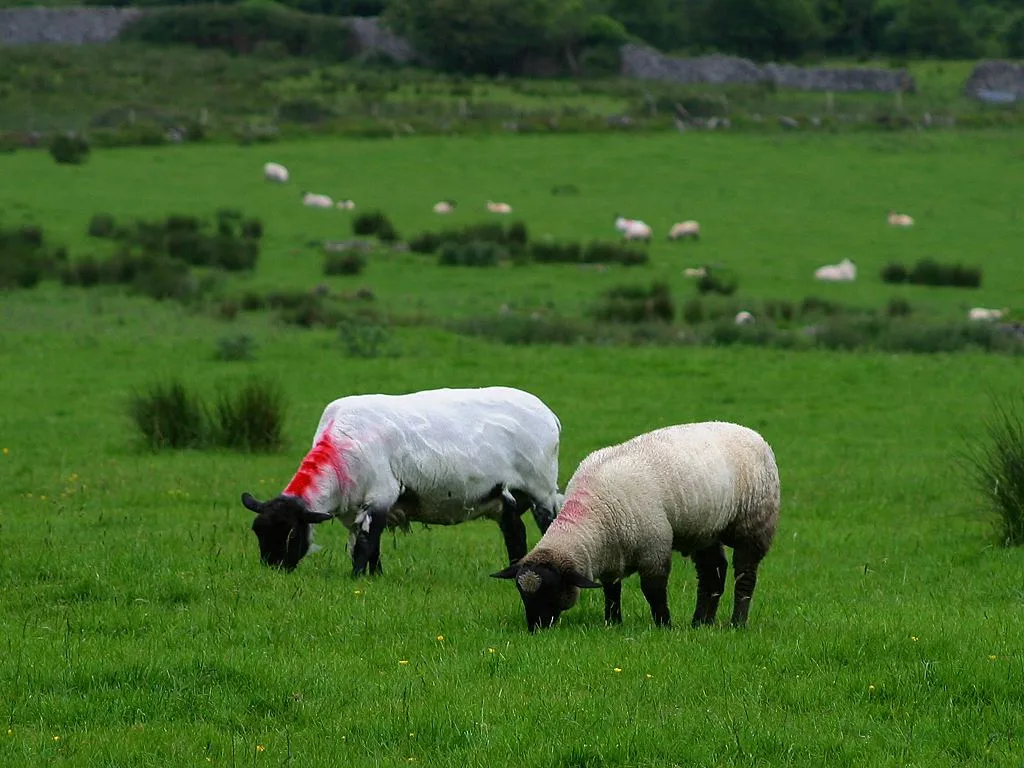
A seven-month-old Suffolk ram lamb standing in long grass.
Field
notes
Built to Grow Fast
A mature Suffolk ram weighs 113 to 159 kg (250 to 350 lb); a ewe weighs 81 to 113 kg (180 to 250 lb). The breed standard calls for a head and legs free of wool and covered in fine black hair, set against a clean white fleece, with long, bell-shaped ears that droop and tip slightly forward.
The breed association calls the Suffolk a superior producer of lean meat due to rapid early growth and heavy muscling. That growth can top a pound (about 0.45 kg) a day, and lambs can be market-ready as early as three to four months old. Commercial shepherds prize Suffolk genetics to improve the weights and carcass quality of their lamb crops. In the US, the most important lambs for the industry are crossbreds sired by Suffolk rams, which pass on their growth and carcass traits.
A Memory for Faces Sheep recognize one another by their faces, using specialized brain systems in the temporal and frontal lobes, with a bigger role for the right side of the brain. In a 2001 study, individual sheep remembered the faces of 50 other sheep for over two years.
An English Cross
The Suffolk, an original English breed, came from crossing Southdown rams with Norfolk Horn ewes. The Norfolk Horn was a wild, hardy breed from the sparse, windy uplands of Suffolk, Norfolk and Cambridgeshire, where it adapted to traveling great distances for food and became very muscular. The Southdown gave today’s Suffolk its meatiness and wool quality, and the cross reduced most of the criticisms sheepmen had of both parent breeds. The Suffolk was a recognized breed by 1810, and the English Suffolk Society was founded in 1886 to register it.
The first Suffolks reached the United States in 1888, when G. B. Streeter of Chazy, New York, brought over prize breeding animals that had belonged to Joseph Smith of Hasketon, England. The breed did not reach the American West until 1919, when the English Suffolk Sheep Society donated three ewes and two rams to the University of Idaho.
Life in the Flock
Domestic sheep in general feed mainly on grasses at pasture and can be fed a wide variety of hays and oats. The first domestic sheep lived mainly in the Middle East and Central Asia, and sheep have since been introduced everywhere.
Sheep have a highly developed flocking instinct. Large groups, up to 1,000 sheep or more, move over an area together rather than as individuals, and no leaders start the grazing, or even the running away. That instinct is part of their value to farmers, as a single shepherd can control a large flock. Separate a sheep from the others and it becomes considerably stressed, often calling out and pawing at the ground. One captive sheep lived 22.8 years, the maximum lifespan AnAge records for the species.
Published Updated
Traits
Intel
& FAQ
Guess
first
How big is a Suffolk Sheep, really? Slide, lock in, and see what the sources say. Every answer is a figure from this page, quoted from where it came from.
Sources
- 01Breed Information. United Suffolk Sheep Association.
- 02Suffolk Sheep. Oklahoma State University, Department of Animal and Food Sciences, Breeds of Livestock.
- 03Ovis aries (mouflon). Animal Diversity Web, University of Michigan.
- 04Ovis aries. AnAge: The Animal Ageing and Longevity Database, Human Ageing Genomic Resources.
- 05Kendrick et al. (2001). Sheep don't forget a face. Nature.
What the sources say: 39 claims checked word for word against these sources →