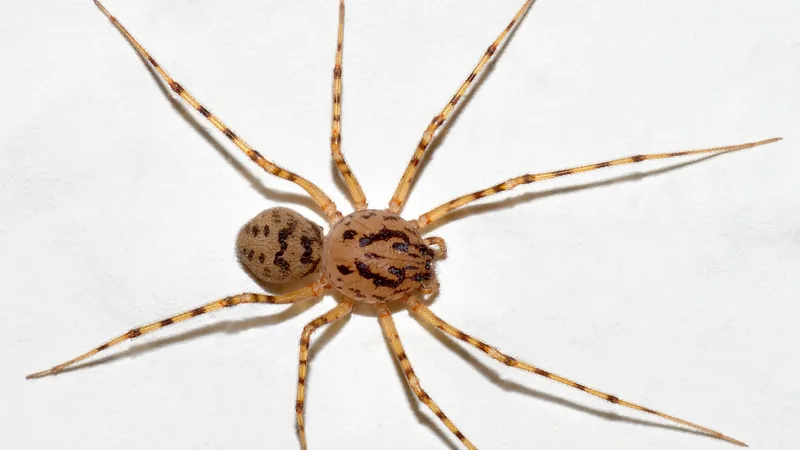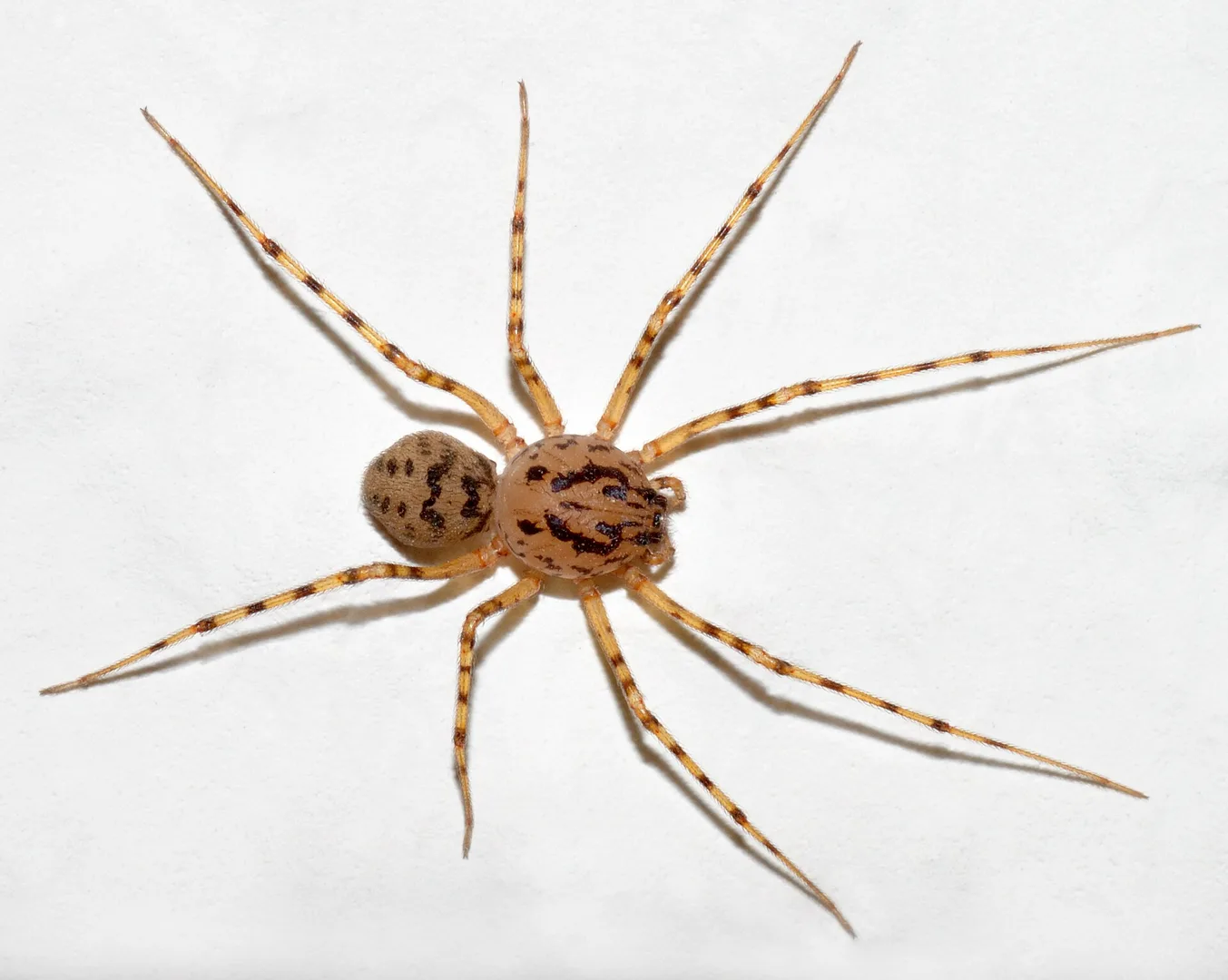
A 5.3 mm (0.21 inch) long Scytodes thoracica, seen from above.
Field
notes
Small Spider, Oversized Glands
The Spitting Spider (Scytodes thoracica) is tiny: males typically run 3.5 to 4 millimeters long, and females grow slightly bigger, at 4 to 5.5 millimeters. Its domed cephalothorax, the fused head-and-chest section, holds disproportionately large venom glands, each divided into a smaller front chamber that stores venom and a larger back one that holds a sticky mucilage. The two mix and are fired through the spider’s fused chelicerae, fangs that cannot move separately from each other. In the wild a female can live 2 to 4 years and a male 1.5 to 2, and they usually die of hunger, exhaustion, or predation.
Zigzag Spray, Timed in Milliseconds
Spitting spiders see poorly, so they hunt by touch, tapping a target with their raised front legs until it sits centered between them. Then they fire. High-speed video has clocked the ejection at up to 28.8 meters a second, while the fangs oscillate side to side up to 1,700 times a second and the spider lifts its chelicerae, laying the spray down as 5 to 17 overlapping bands. A full burst typically takes under 30 milliseconds.
The spit contracts In the two-tenths of a second after ejection, its silk shortens by 40 to 60 percent. Aimed at the two wires of a force sensor, the contracting spit pulled with a peak force of 0.05 to 0.3 millinewtons.
Spit First, Bite Second
The spray is a mixture of silk, glue and venom. The scientists who filmed it suggest the prey is held physically, by the silk contracting and the glue sticking, rather than by the venom; an earlier study found the spit had no toxic effect on prey when applied externally. The spider then quickly closes in and tangles its catch further in the drying glue with its first two pairs of legs. Once the glue is dry it bites, injecting venom that liquefies the prey’s tissues, which it later sucks up. Spitting spiders are slow movers on their long, thin legs, so they use the same spray defensively against predators instead of trying to flee.
Researchers have solved the three-dimensional structures of three of its venom peptides, each built around a cystine knot, a motif common to many venom peptides, but could not identify what they target. Injected into crickets and blowflies at the doses tested, the peptides caused no paralysis or death.
A House Guest on Four Continents
It is common in the eastern United States and also found in Britain, Sweden and other European countries, and specimens have turned up in Japan and Argentina. It is unclear which populations are native and which were introduced. Outdoors it lives in temperate forest; indoors it is most often found in dark corners, cellars, cupboards and closets of houses, where it eats moths, flies, other spiders and household bugs, many of them significantly larger than itself. In Britain it often eats mosquitoes. Many homeowners pay for pest control to get rid of it.
Published Updated
Traits
Intel
& FAQ
Guess
first
How big is a Spitting Spider, really? Slide, lock in, and see what the sources say. Every answer is a figure from this page, quoted from where it came from.
Sources
- 01Scytodes thoracica. Animal Diversity Web, University of Michigan.
- 02Suter & Stratton (2009). Spitting Performance Parameters and Their Biomechanical Implications in the Spitting Spider, Scytodes thoracica. Journal of Insect Science.
- 03Ariki et al. (2016). Characterization of Three Venom Peptides from the Spitting Spider Scytodes thoracica. PLOS ONE.
What the sources say: 49 claims checked word for word against these sources →