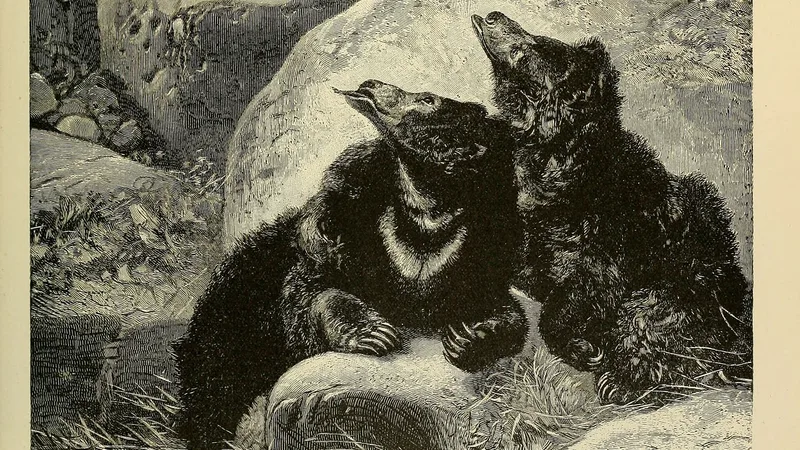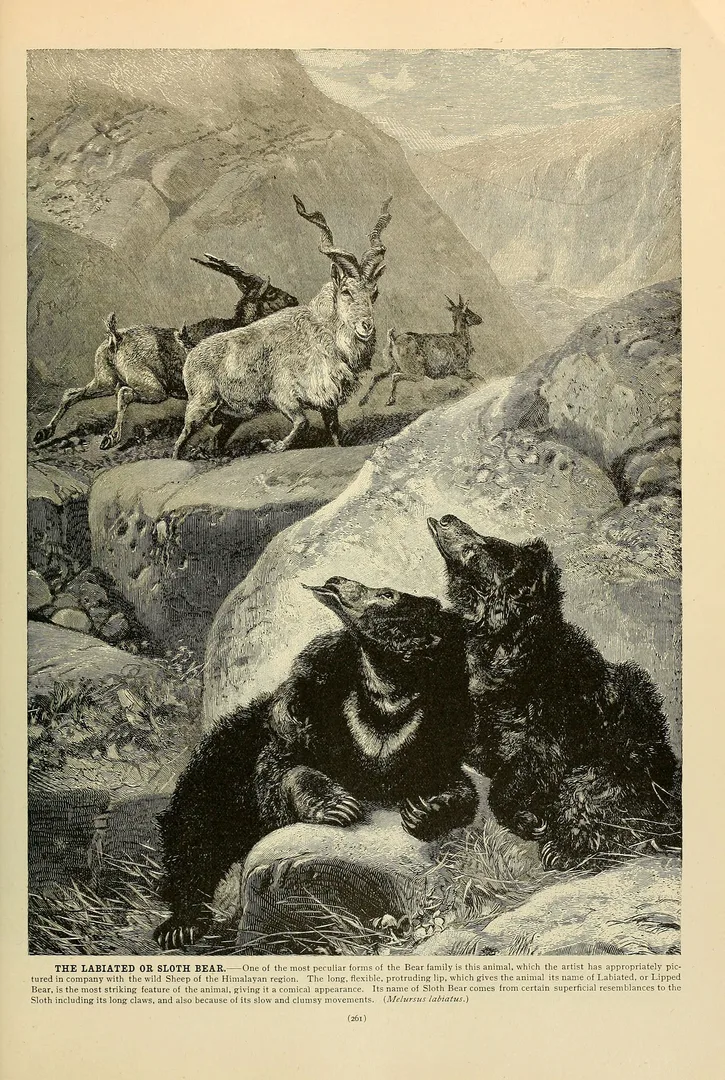
Two captive sloth bears on concrete steps
Field
notes
A Bear Built Like a Vacuum Cleaner
The sloth bear (Melursus ursinus) grows 1.4 to 1.9 meters (4.5 to 6.2 feet) long and stands 0.6 to 0.9 meters at the shoulder. Females weigh 50 to 95 kilograms and males 70 to 145 kilograms, and the oldest on record, a wild-born female in captivity, lived to 33.3 years. It roams the dry and moist forests and some tall grasslands of India, Sri Lanka and southern Nepal, often sleeping in caves and near rivers when they’re available.
What makes it unusual is a gap where teeth should be. Adult sloth bears are missing their top two front incisors, and that gap turns the mouth into a nozzle.
A Nozzle Where Teeth Should Be A sloth bear sucks termites up through the gap with its lips and tongue, which create a powerful suction like a vacuum cleaner. It can close its nostrils while it feeds, so the insects don’t crawl up its nose.
Sloth bears are well known as noisy eaters: the sucking sounds a feeding sloth bear makes can be heard up to 100 meters (330 feet) away.
Digging Into Cement-Hard Mounds
When trees are in fruit, the bear eats mangoes, figs and other fruit, but termites dug from cement-hard mounds and some ants are year-round staples: outside fruiting season, insects make up 95 percent of a sloth bear’s diet. It rips mounds open with 3-inch (8-centimeter) claws, and it also climbs trees to knock down honeycombs, then collects the honey from the forest floor.
Shy, Until Startled
Sloth bears can’t see or hear as well as other bears and would rather run from people, but they turn aggressive when startled or confronted, and a threatened sloth bear stands on its hind legs and waves its clawed forepaws like weapons. In the Kanha-Pench corridor of central India, sloth bears caused the highest number of human deaths of any wild animal between 2001 and 2015, and ranked second overall for human casualties there. Of 166 attack victims researchers interviewed, the largest group had been collecting forest produce, and 63 percent did not see the bear before it attacked. Against a tiger or leopard, it rears up, roars, and fights with claws and large canines.
Piggyback Cubs
Sloth bears are the only bears that routinely carry their cubs on their backs. The cubs grip the shaggy fur on their mother’s back while she looks for food, and the ride is thought to protect them from predators. A cub rides there until it is 6 to 9 months old, and one mother with a cub on her back was seen scaring off two tigers with her roar.
Published Updated
Traits
Intel
& FAQ
Guess
first
How big is a Sloth Bear, really? Slide, lock in, and see what the sources say. Every answer is a figure from this page, quoted from where it came from.
Sources
- 01Sloth bear. Smithsonian's National Zoo and Conservation Biology Institute.
- 02Sloth Bear. San Diego Zoo Wildlife Alliance.
- 03AnAge entry for Melursus ursinus. AnAge: The Animal Ageing and Longevity Database, Build 15.
- 04Dhamorikar et al. (2017). Characteristics of human - sloth bear (Melursus ursinus) encounters and the resulting human casualties in the Kanha-Pench corridor, Madhya Pradesh, India. PLOS ONE.
- 05Dharaiya, Bargali & Sharp (2020). Melursus ursinus. The IUCN Red List of Threatened Species 2020: e.T13143A166519315.
What the sources say: 56 claims checked word for word against these sources →