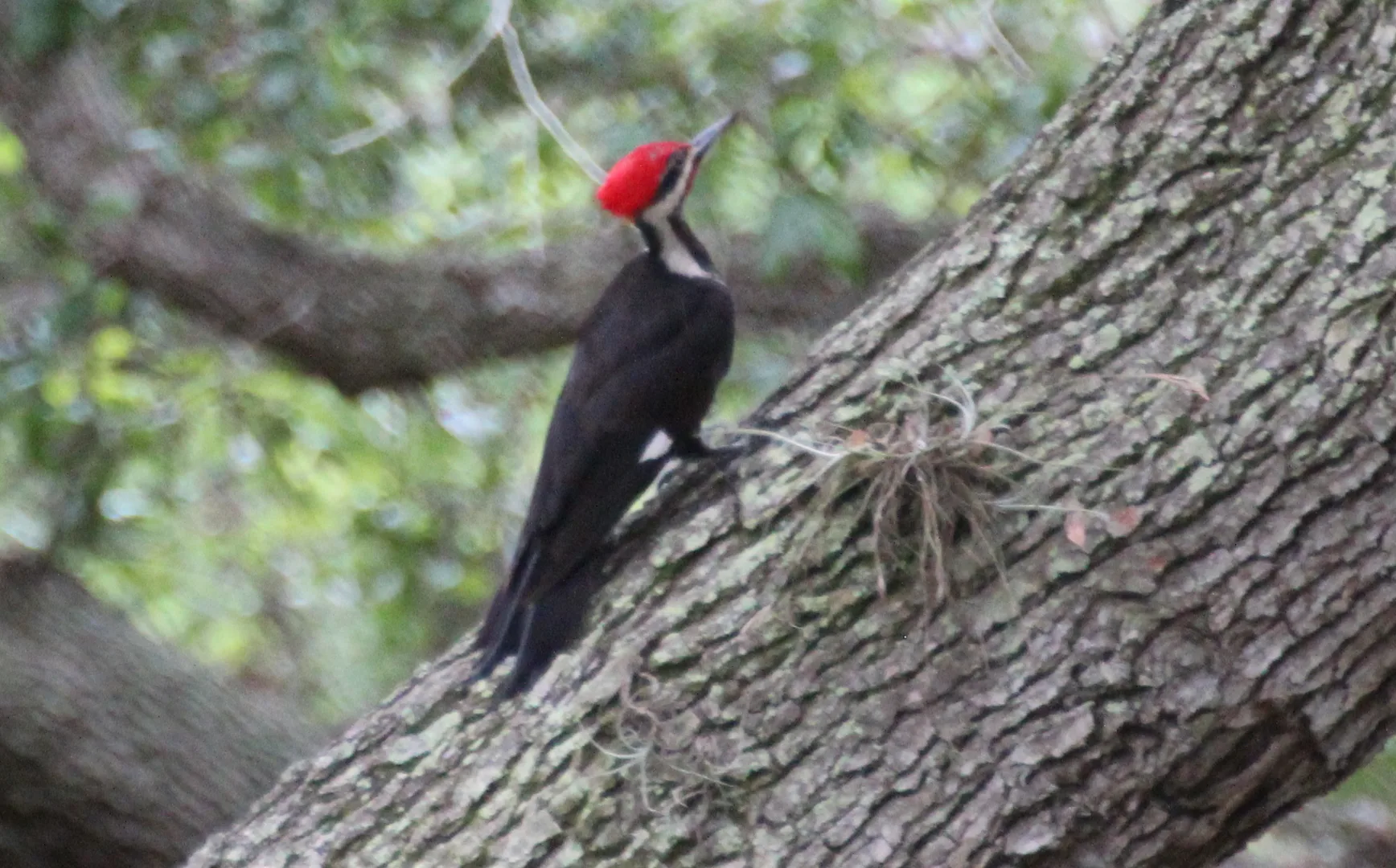
On the trunk.
Field
notes
A Chisel With Feathers
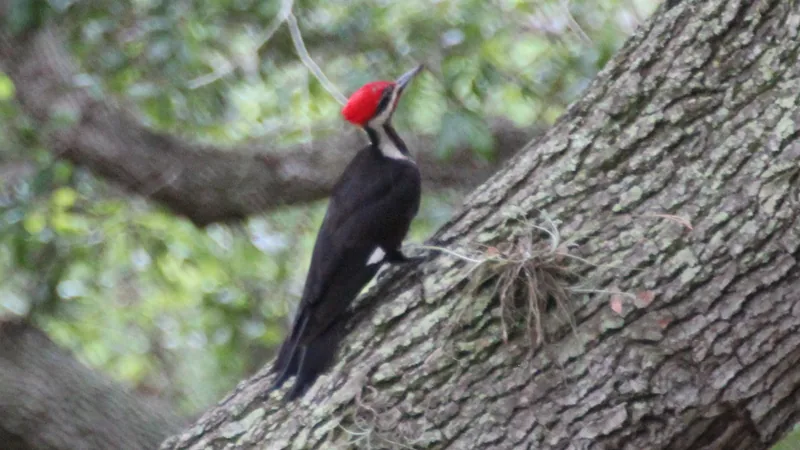
The pileated woodpecker digs for dinner. Its bill is chisel-shaped, and it pries off long slivers of wood to open up the tunnels where ants live. In one study of coastal forests in Washington State, carpenter ants made up more than half of what these birds ate, with beetle larvae and termites filling in during the breeding season.
Built-in ant spear Its tongue is long, stretchy and pointed, with barbs and sticky saliva that snag ants out of their tunnels.
The holes it digs are big and rectangular, and they can be large enough to weaken a smaller tree or even snap it in half.
Crow-Sized, Zebra-Faced
This is the largest woodpecker found in most of North America, with a dull black body and a red crest. Its body runs 16 to 19 inches long and its wingspan is 26 to 30 inches. It weighs 8.8 to 12.3 ounces, and an average adult is about 364 grams. Filmed fleeing, pileated woodpeckers flap rapidly just after take-off, then settle into a more relaxed level flight.
Landlord of the Forest
Pileated woodpeckers live year-round in forests across southern Canada and the eastern, midwestern and western United States, from Nova Scotia south to Florida. They prefer to nest in moist areas close to streams. A nest hole is about 8 inches wide and 2 feet deep, and those excavations provide habitat for many other species. That makes it a possible keystone species, one whose work shapes a whole community.
It also announces itself. It usually drums on a dead, resonant tree, and the drumming is used to proclaim a territory. It drums most often in the morning, and more often in early spring as courtship begins. A study of 123 nests in northeastern Oregon found birds breeding at a year old, and some surviving to at least nine. The database AnAge lists a maximum recorded longevity of 13 years in the wild.
Logging in the 19th and 20th centuries cut pileated numbers in eastern North America. As many of those forests have grown back in recent decades, woodpecker species have grown in number with them.
Published
Traits
Intel
& FAQ
Guess
first
How big is a Pileated Woodpecker, really? Slide, lock in, and see what the sources say. Every answer is a figure from this page, quoted from where it came from.
Sources
- 01Collinson (2007). Video analysis of the escape flight of Pileated Woodpecker Dryocopus pileatus: does the Ivory-billed Woodpecker Campephilus principalis persist in continental North America? BMC Biology.
- 02Hylatomus pileatus. The IUCN Red List of Threatened Species 2025: e.T22681363A140984457.
- 03Dryocopus pileatus (pileated woodpecker). Animal Diversity Web, University of Michigan.
- 04Pileated Woodpecker. National Geographic.
- 05AnAge entry for Dryocopus pileatus. AnAge: The Animal Ageing and Longevity Database.
- 06Raley & Aubry (2006). Foraging Ecology of Pileated Woodpeckers in Coastal Forests of Washington. Journal of Wildlife Management.
- 07Bull & Meslow (1988). Breeding biology of the pileated woodpecker—management implications. U.S. Department of Agriculture, Forest Service, Pacific Northwest Research Station.
What the sources say: 40 claims checked word for word against these sources →