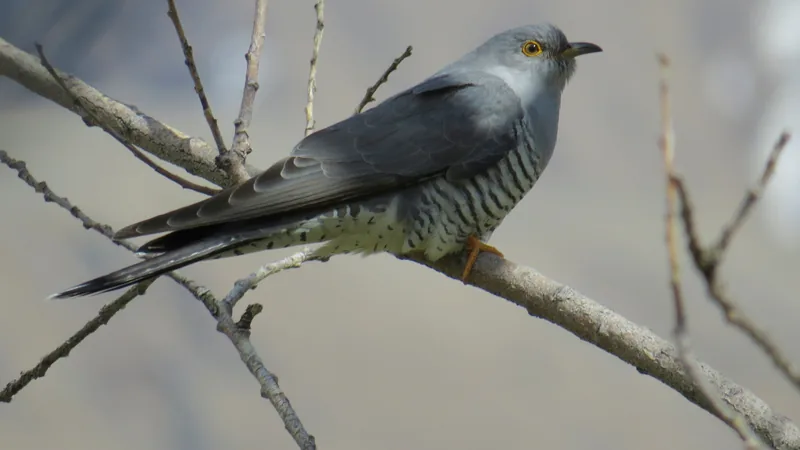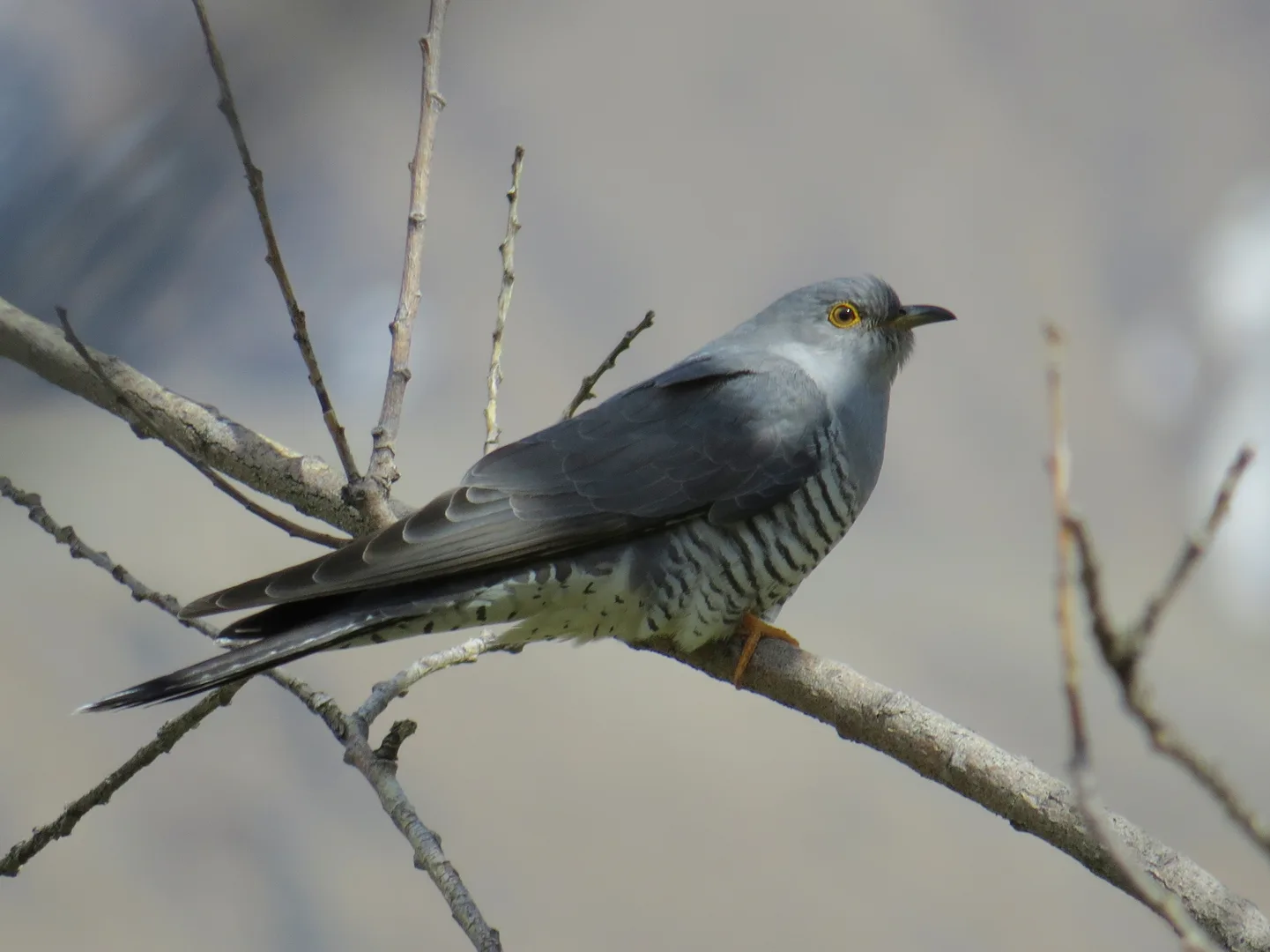
Grey adult on a twig.
Field
notes
A Bird With No Nest
The common cuckoo, Cuculus canorus, is a brood parasite. That means it lays its eggs in the nests of other bird species, called hosts, and leaves the parenting to them. Animal Diversity Web says a female takes one egg out of the host nest and lays her own in its place. Once the cuckoo hatches, it removes the host’s eggs and nestlings. A female visits up to fifty nests in a season and lays 12 to 22 eggs.
Eggs in Disguise
The species is split into host-specific races called gentes. Each race’s females lay their own type of egg, which tends to look like their host’s: brown and spotted where meadow pipits are the host, plain blue where redstarts are. A genetic study found that these races follow the mother’s line, while males mate across races and keep the cuckoo one species.
Hosts fight back. Researchers who measured egg markings through a model of bird vision, across eight host species, found that cuckoo races copy egg patterns more closely for hosts that reject foreign eggs more strongly. Hosts also learn: reed warblers that watched neighbours mob a cuckoo increased their own mobbing, which suggests that social learning lets hosts build up their defence quickly. Even a warning can backfire. Great reed warblers that sounded the alarm more often suffered more parasitism, and cuckoos in an experiment paid attention to those alarm calls.
Hawk costume Great tits and blue tits were alarmed by mounted cuckoos as much as by mounted sparrowhawks, and cuckoos with barred underparts were treated like hawks while unbarred ones were treated like doves.
Size, Colour and Lifespan
Animal Diversity Web gives the body length as 32 to 34 cm. British Trust for Ornithology figures for live adults give an average of 114.3 g, with the middle 90% between 93 and 143 g. Adult males are gray. Females come in two plumages, gray or rufous (a reddish brown), and a 2024 genetic study traced that difference to the female-restricted genome. The AnAge database lists a maximum longevity of 12.9 years in the wild.
Caterpillars, Africa and Decline
Adults eat insects, including hairy caterpillars that many other birds avoid, and females also eat the eggs and nestlings of host species. Animal Diversity Web says the species breeds across much of Europe, north to Sweden and Russia, and has been found breeding as far afield as China, India and Japan. Afterwards it migrates to central and southern Africa, Vietnam, Thailand and Sri Lanka. In Britain, the BTO says males arrive in late April and can leave again as early as the first week of June. Tracked British cuckoos all winter in the same part of central Africa.
The bird is globally Least Concern on the IUCN Red List, assessed in 2024. In the UK the picture is different: the BTO reports a 33% drop in the breeding population from 1995 to 2024, and estimated it at 18 thousand pairs in 2016.
Published
Traits
Intel
& FAQ
Guess
first
How big is a Common Cuckoo, really? Slide, lock in, and see what the sources say. Every answer is a figure from this page, quoted from where it came from.
Sources
- 01Cuculus canorus (common cuckoo). Animal Diversity Web, University of Michigan Museum of Zoology.
- 02BirdFacts: Cuckoo (Cuculus canorus). British Trust for Ornithology.
- 03AnAge: Cuculus canorus (common cuckoo). Human Ageing Genomic Resources, AnAge database.
- 04Cuculus canorus. The IUCN Red List of Threatened Species 2024: e.T22683873A264553575.
- 05Gibbs et al. (2000). Genetic evidence for female host-specific races of the common cuckoo. Nature.
- 06Stoddard & Stevens (2010). Pattern mimicry of host eggs by the common cuckoo, as seen through a bird's eye. Proceedings of the Royal Society B: Biological Sciences.
- 07Davies & Welbergen (2008). Cuckoo-hawk mimicry? An experimental test. Proceedings of the Royal Society B: Biological Sciences.
- 08Marton et al. (2019). Host alarm calls attract the unwanted attention of the brood parasitic common cuckoo. Scientific Reports.
- 09Merondun et al. (2024). Evolution and genetic architecture of sex-limited polymorphism in cuckoos. Science Advances.
What the sources say: 54 claims checked word for word against these sources →