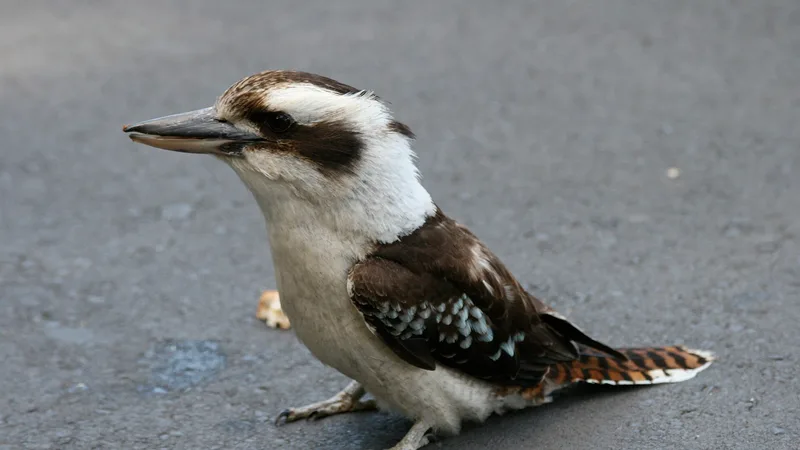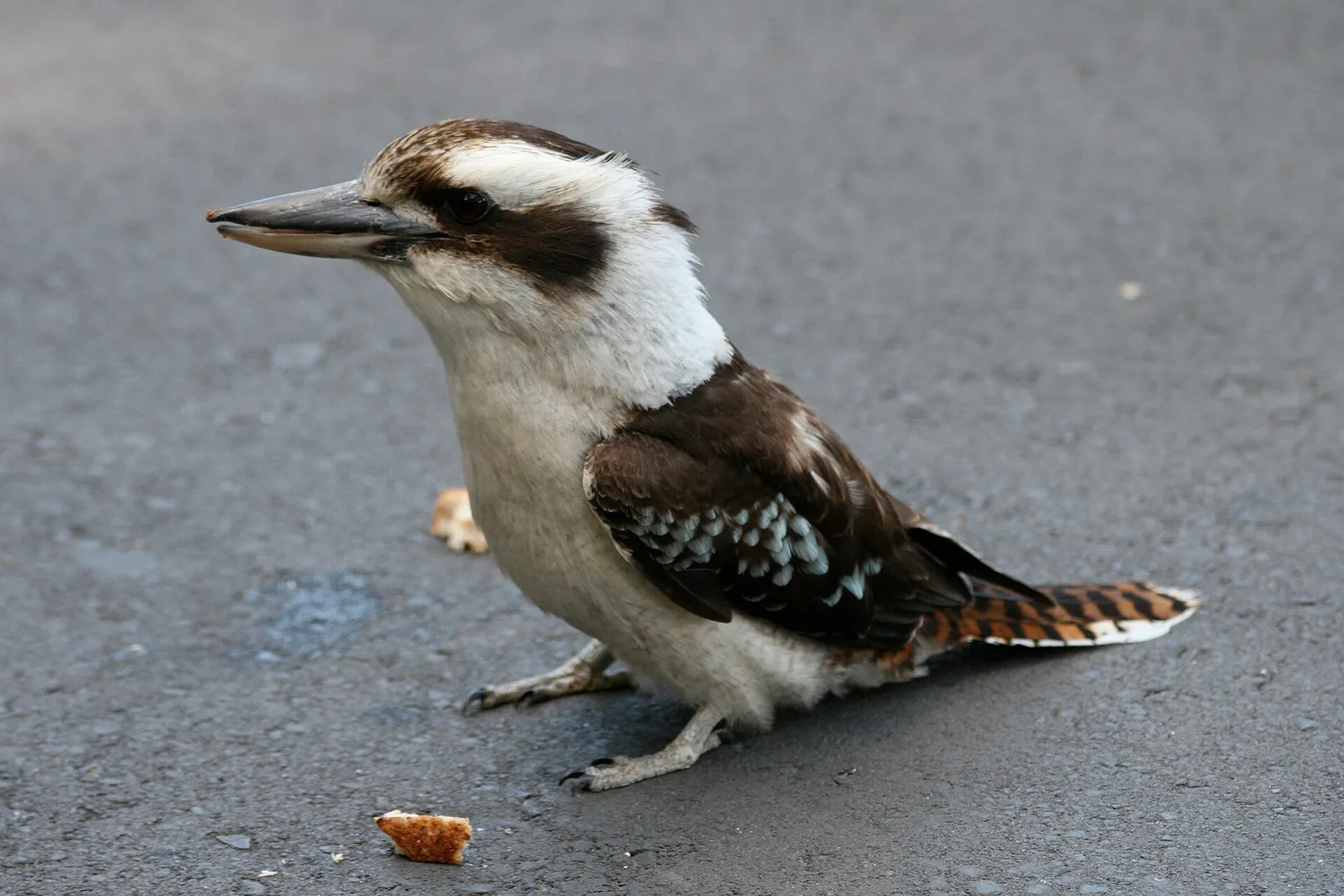
Laughing Kookaburra in Sydney, Australia.
Field
notes
A Chorus That Isn’t Actually Laughing
The laughing kookaburra’s cackling call is instantly recognisable, and it is not laughter. The cackle is a territorial call, and family groups sing it together at dawn and dusk to warn other birds to stay away. Each group’s chorus appears to carry its own signature: a researcher who recorded the laugh-song choruses of eight different family groups in Western Australia ran the recordings through a statistical test that correctly matched 24 of 25 samples back to the group that produced them.
The Giant Kingfisher
The laughing kookaburra is the largest member of the kingfisher family and was once called the giant kingfisher. It stands 39 to 42 centimetres tall and weighs 196 to 465 grams, with females slightly heavier than males. Its lifespan is about 11 years, and up to 15 in zoos. Its range covers woodland, open and dry forest, parks, and gardens across eastern Australia, with introduced populations in Tasmania, the far southwest of Western Australia, and around Auckland, New Zealand.
A Beak Built to Smash Snakes
Despite being a kingfisher, the laughing kookaburra rarely eats fish. Most of its diet is insects, worms, and crustaceans, and it also eats lizards, snakes, frogs, and rodents. Hunting is a waiting game: the bird sits motionless on a perch, keeping its head perfectly still even while its body sways with the branch below, and watches for prey to pass by. When it spots something, it swoops down, seizes the animal with its heavy, boat-shaped bill, and carries it back up to a perch. Prey gets beaten several times against the branch or the ground to kill and soften it, then swallowed whole, head first.
A kookaburra can kill a snake up to a metre long by grabbing it behind the head and smacking it against the ground.
One Big, Sometimes Vicious, Family
Laughing kookaburras are believed to pair for life and reuse the same nest hole each year, a hollow in a tree or a burrow dug into an arboreal termite mound. A breeding pair shares its year-round territory with four to five of its own grown offspring, who act as helpers: they take turns incubating the eggs, keep the chicks warm, feed their younger siblings, and help defend the family’s patch.
More helpers do not mean more food for the nest. A study of one population found that as a family group grows, every bird, especially the helpers, actually cuts back its own feeding effort and delivers smaller prey items, so the overall provisioning to the nest does not increase. Breeding males brought the most food of anyone in the group, and female helpers brought the least.
Sibling rivalry in the nest can turn deadly. Chicks hatch blind and featherless but already carry a sharp hooked bill, and the first chick to hatch may turn on its younger siblings, biting and often killing them, especially if food is scarce. Helpers move on at about four years old to establish territories of their own.
Published Updated
Traits
Intel
& FAQ
Guess
first
How big is a Laughing Kookaburra, really? Slide, lock in, and see what the sources say. Every answer is a figure from this page, quoted from where it came from.
Sources
- 01Laughing Kookaburra. San Diego Zoo Wildlife Alliance.
- 02Laughing Kookaburra. Australian Museum.
- 03Baker (2004). The Chorus Song of Cooperatively Breeding Laughing Kookaburras (Coraciiformes, Halcyonidae: Dacelo novaeguineae): Characterization and Comparison Among Groups. Ethology.
- 04Legge (2000). Helper contributions in the cooperatively breeding laughing kookaburra: feeding young is no laughing matter. Animal Behaviour.
- 05Kookaburra: King of the Bush. CSIRO Publishing, 2004.
- 06Dacelo novaeguineae. The IUCN Red List of Threatened Species 2024: e.T22683189A253968941.
- 07Dacelo novaeguineae. Animal Diversity Web, University of Michigan.
What the sources say: 43 claims checked word for word against these sources →