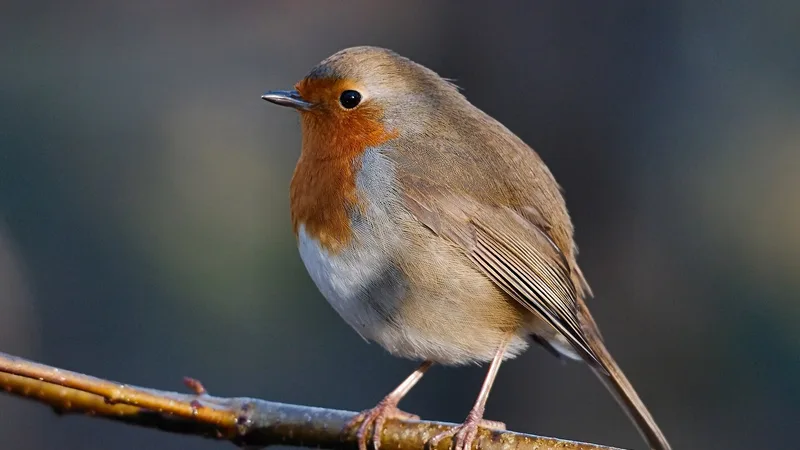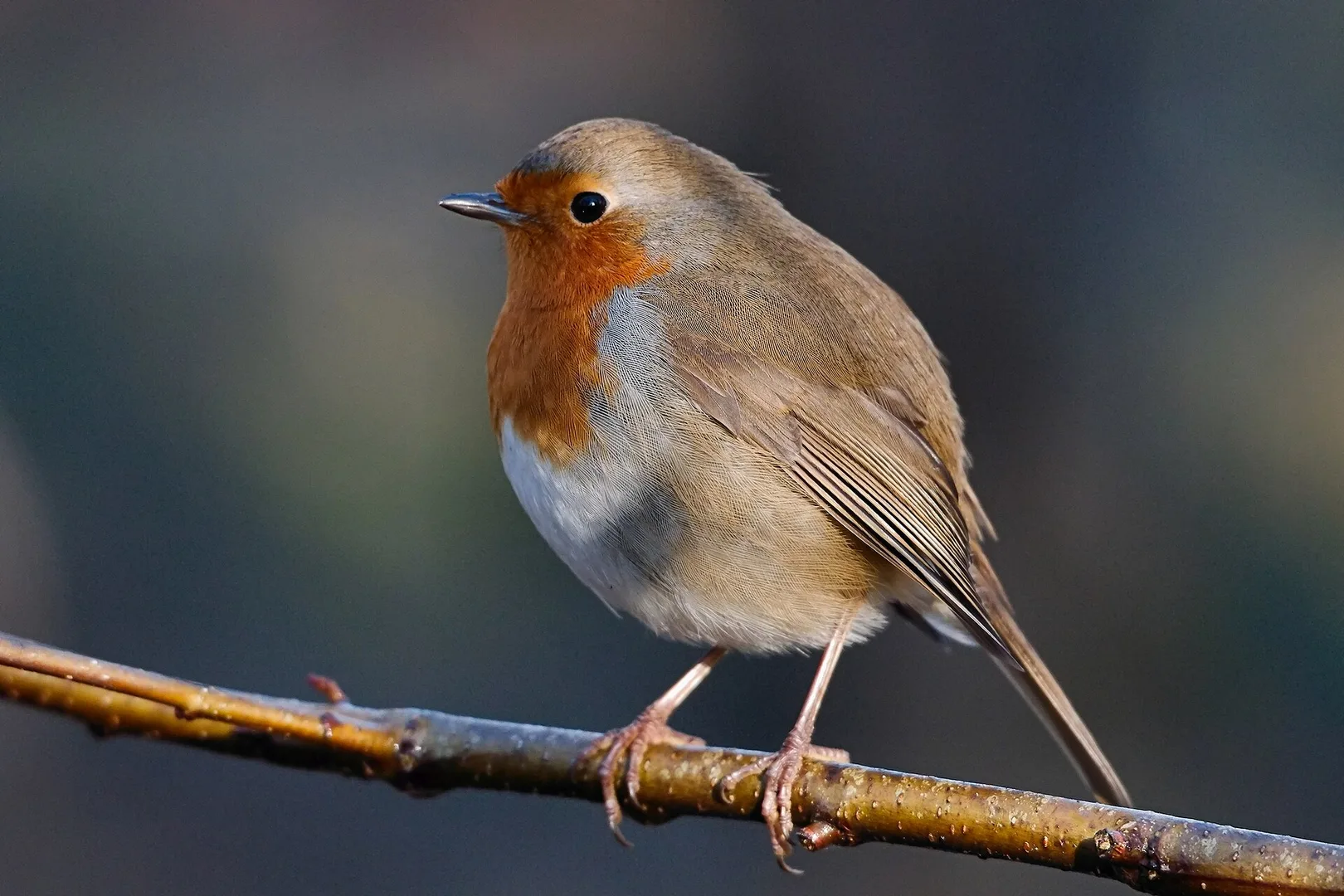
European robin at Lackford Lakes, Suffolk, England
Field
notes
A Compass in the Eye?
The European robin’s eyes may double as an internal compass. A light-sensitive protein called cryptochrome 4 (CRY4) sits in the robin’s retina, and when researchers tested it in the lab, robin CRY4 turned out to be more magnetically sensitive than the same protein from two non-migratory birds, the chicken and the pigeon. Mutating specific sites on the protein revealed the roles of four successive light-triggered “radical pairs” in producing that magnetic response. The protein sits in the outer segments of the robin’s double cones and long-wavelength single cones, and robin retinas make more of its mRNA during the spring and autumn migratory seasons, something not seen in chickens. In vertebrates, cryptochromes are the only proteins known to form radical pairs when struck by light, so they are currently the only candidates for a light-dependent magnetic sense.
The Compass Kill Switch Robins tested inside unscreened wooden huts on the University of Oldenburg campus in Germany could not orient using their magnetic compass. Grounded, aluminum-screened huts, which cut electromagnetic noise between 50 kHz and 5 MHz about a hundredfold, brought their magnetic orientation back, and deliberately generating broadband noise inside the screened huts took it away again.
Territory, Testosterone and Song
Robins hold territory as a pair in summer and individually in winter, and both sexes defend it with surprising ferocity. Male robins guarding a winter feeding territory carry low testosterone, while males defending a spring breeding territory carry higher levels, and song is part of the defense in both seasons. When a study blocked testosterone in male robins with the anti-androgen flutamide, the results suggested that aggressive defense of a breeding territory is facilitated by the hormone while winter defense does not need it, and singing rate was not significantly reduced in either season. The authors suggest the year-round “keep out” song is independent of testosterone. Urban robins sing at night in areas that are noisy during the day, which reduces acoustic interference, and light pollution, often blamed for night singing in city birds, has a much weaker effect than daytime noise.
Size, Diet, Range and Lifespan
A robin measures about 14 cm long, with a 20 to 22 cm wingspan and a body weight of roughly 14 to 21 g, and on a cold night it can use up to a tenth of its body weight staying warm. Its diet is seeds, fruit, insects, worms and other invertebrates; it visits garden feeders for scraps and mealworms, and often follows gardeners to take freshly dug-up worms. The species ranges from western Europe, northwestern Morocco and the Atlantic islands east to the Urals, southwestern Siberia and northern Iran. British robins can be seen in gardens and hedgerows all year round, and in winter birds from northern and eastern Europe arrive to help swell their numbers, while robins from the Urals and southwestern Siberia winter in southwestern Asia. Typical life expectancy for a robin that reaches breeding age is two years. The oldest ringed robin in the BTO’s records reached 8 years, 4 months and 30 days, a record set in 1977, but EURING’s Europe-wide list of ringing records holds a robin ringed in the Czech Republic that was found dead more than 19 years and 4 months later.
Published Updated
Traits
Intel
& FAQ
Guess
first
How big is a European Robin, really? Slide, lock in, and see what the sources say. Every answer is a figure from this page, quoted from where it came from.
Sources
- 01Xu et al. (2021). Magnetic sensitivity of cryptochrome 4 from a migratory songbird. Nature.
- 02Günther et al. (2018). Double-Cone Localization and Seasonal Expression Pattern Suggest a Role in Magnetoreception for European Robin Cryptochrome 4. Current Biology.
- 03Nießner et al. (2011). Avian Ultraviolet/Violet Cones Identified as Probable Magnetoreceptors. PLoS ONE.
- 04Engels et al. (2014). Anthropogenic electromagnetic noise disrupts magnetic compass orientation in a migratory bird. Nature.
- 05Schwabl & Kriner (1991). Territorial aggression and song of male European robins (Erithacus rubecula) in autumn and spring: Effects of antiandrogen treatment. Hormones and Behavior.
- 06Fuller, Warren & Gaston (2007). Daytime noise predicts nocturnal singing in urban robins. Biology Letters.
- 07De La Hera et al. (2017). Habitat segregation by breeding origin in the declining populations of European Robins wintering in southern Iberia. Ibis.
- 08Collar (2020). European Robin (Erithacus rubecula). Birds of the World.
- 09Robin (Erithacus rubecula). Natural History Museum.
- 10Robin. BTO BirdFacts.
- 11Fransson et al. (2010). EURING list of longevity records for European birds.
- 12Erithacus rubecula. The IUCN Red List of Threatened Species 2021: e.T22709675A166350059.
What the sources say: 50 claims checked word for word against these sources →