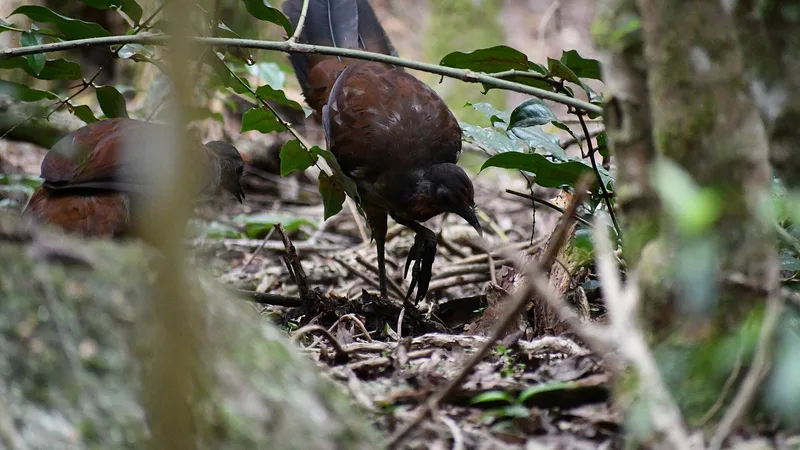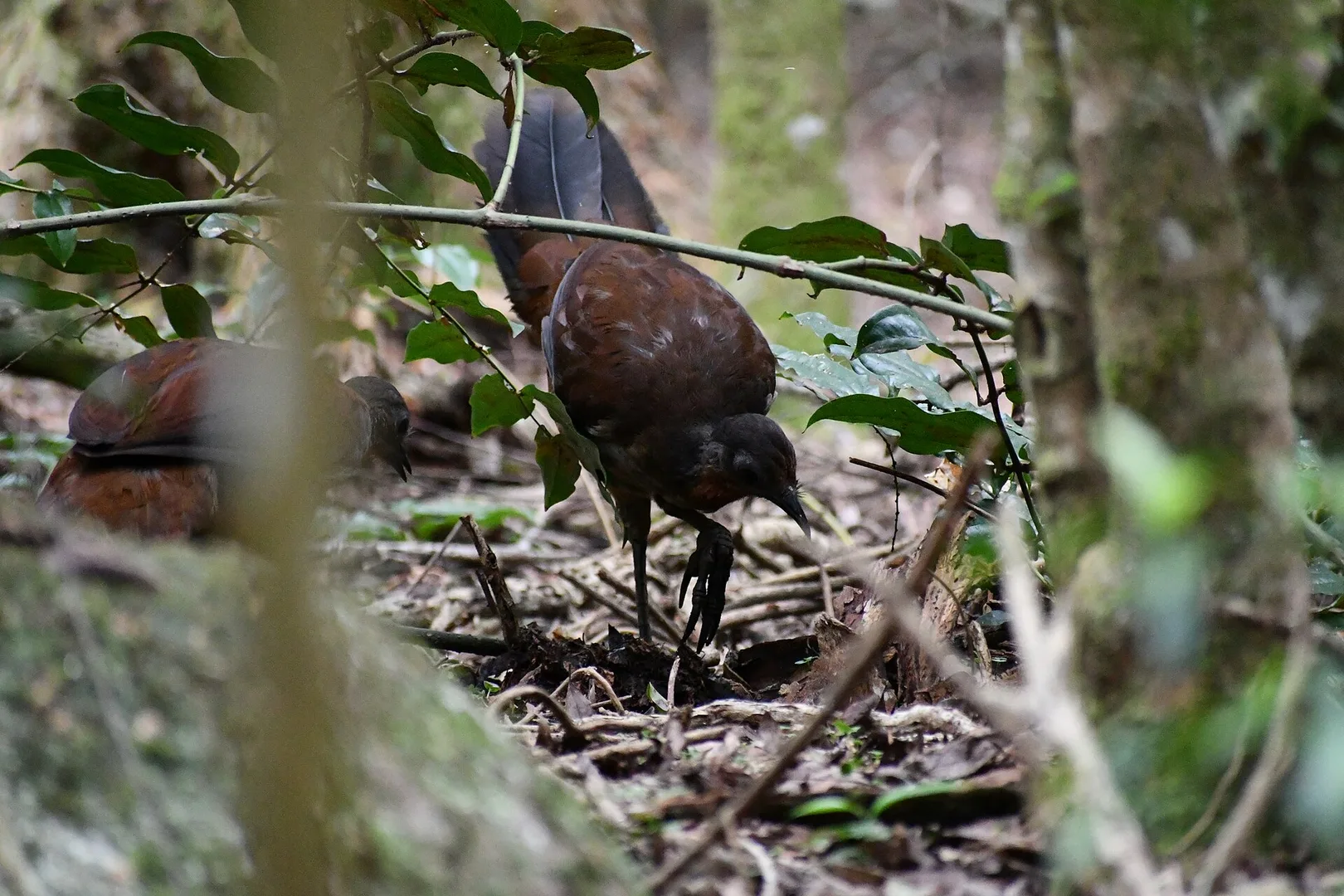
Superb lyrebirds foraging on the forest floor
Field
notes
The Forest’s Own Soundtrack
The superb lyrebird is a big, ground-dwelling bird of the moist eucalypt forests of south-eastern Australia, growing 80 to 100 centimetres long including its tail. About 80% of its song is mimicry of sounds from its surroundings, from local native birds to chainsaws, car engines and dog barks.
A staged alarm. During his song and dance displays, a male superb lyrebird can build an acoustic illusion of a mixed-species mobbing flock, mimicking several species’ alarm calls together and even imitating the wingbeats of small birds, convincing enough that real birds treated it as genuine in a playback test.
A Performance With Choreography
He performs on a display mound of scratched earth that he builds himself, up to 90 centimetres wide and 15 centimetres high, and one territory may hold 10 to 15 of them. A male sings four different song types and matches each with its own set of movements, delivering song and dance in a predictable sequence; a 2013 study concluded that coordinating the two in this way is not a uniquely human trait. The adult male’s tail carries specially curved feathers that take the shape of a lyre in display, while females and young males have long tails without them. Breeding runs from April to October, slightly shorter in the north of the range. A male mates with several females, and the female alone builds the nest, incubates the eggs and cares for the young.
An Ecosystem Engineer That Farms
Lyrebirds find food by scratching through leaf litter with their feet. In a study in forests of Victoria’s Central Highlands, they turned over an average of 155.7 tonnes of litter and soil per hectare in 12 months, an amount the authors call unparalleled by any other vertebrate soil engineer on land. A 2025 study found that this mixing and turning of litter and soil replenishes the biomass and diversity of the invertebrates the birds eat, making up for what they take. The authors’ word for it is farming.
A Long Life, an Expanding Range
Wild superb lyrebirds have been recorded living up to 17.9 years, according to banding records, and an average adult weighs about 980 grams. The species is not native to Tasmania: it was introduced at Mount Field in 1934 and Hastings in 1945, both in the island’s south-east, and a 2026 paper reports that it has since spread across much of the island’s central bioregions. The IUCN’s 2018 assessment lists the superb lyrebird as Least Concern. Australia’s 2019 to 2020 “Black Summer” fires came after it, burning an estimated 41.5% of the habitat of the southern subspecies, M. n. victoriae. A year later, surveys found lyrebird foraging almost completely absent from sites burned at high severity, except in rainforest.
Published Updated
Traits
Intel
& FAQ
Guess
first
How big is a Superb Lyrebird, really? Slide, lock in, and see what the sources say. Every answer is a figure from this page, quoted from where it came from.
Sources
- 01Menura novaehollandiae. The IUCN Red List of Threatened Species 2018: e.T22703605A132071218.
- 02Superb Lyrebird. Australian Museum, 2023.
- 03Lyrebirds. NSW Department of Climate Change, Energy, the Environment and Water.
- 04Menura novaehollandiae. AnAge: The Animal Ageing and Longevity Database, Human Ageing Genomic Resources.
- 05Dalziell et al. (2013). Dance Choreography Is Coordinated with Song Repertoire in a Complex Avian Display. Current Biology.
- 06Dalziell et al. (2021). Male lyrebirds create a complex acoustic illusion of a mobbing flock during courtship and copulation. Current Biology.
- 07Maisey et al. (2020). Foraging by an avian ecosystem engineer extensively modifies the litter and soil layer in forest ecosystems. Ecological Applications.
- 08Maisey, Haslem & Bennett (2025). Foraging activity by an ecosystem engineer, the superb lyrebird, 'farms' its invertebrate prey. Journal of Animal Ecology.
- 09Brook & Buettel (2026). Edge-of-range camera-trap records of Superb Lyrebird Menura novaehollandiae in western and central-north Tasmania (2018–2025). Australian Field Ornithology.
- 10Maisey et al. (2023). Effects of a megafire vary with fire severity and forest type: The impact of Australia's 'Black Summer' fires on the superb lyrebird (Menura novaehollandiae), an iconic forest species. Biological Conservation.
What the sources say: 30 claims checked word for word against these sources →