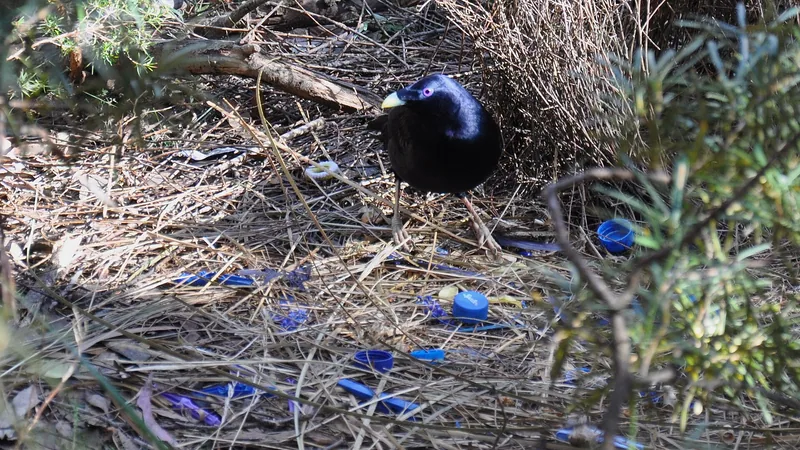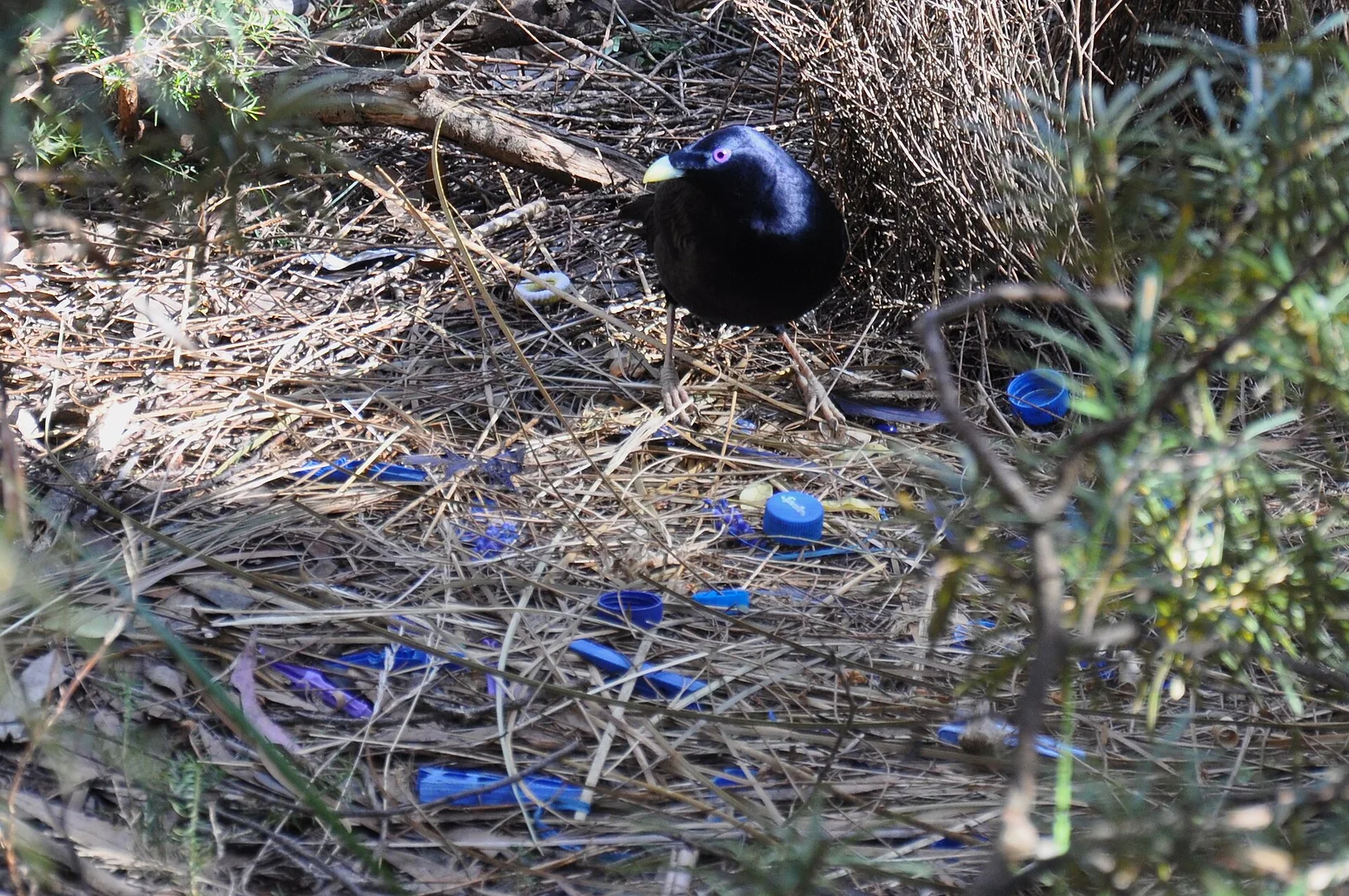
A male satin bowerbird at his bower, among the blue bottle caps and plastic he collected
Field
notes
A Late Bloomer in Glossy Blue-Black
A satin bowerbird is a stocky, medium-sized bird of Australia’s eastern coast. It measures 27 to 33 centimetres long and weighs 170 to 290 grams, about 204 grams on average. It is the heaviest bowerbird. Both males and females are known to live 20 to 30 years.
The adult male is glossy blue-black. Younger males and females look alike, olive-green above and off-white with dark scalloping below, and are known as “green” birds. A young male may begin to grow his adult feathers in his fifth year, but he isn’t fully “attired” in blue-black until he is seven.
His shine is built in layers. Scientists looked at feathers from adult males of one subspecies under an electron microscope. The tiny strands on each feather, called barbules, are flat. They have an outer layer of keratin (the protein feathers are made of) over a layer of melanin, a dark pigment, several granules thick. Light waves scattering off these layers combine to make the glossy ultraviolet-blue shine, and small differences in the barbules can predict differences in colour between males.
An Architect With One Favourite Colour
To attract females, a male builds a bower on the ground: two parallel walls of sticks with an avenue between them. He paints the walls with a mixture of chewed plant matter and saliva, and maintains the bower meticulously throughout the year.
He decorates it with blue objects he collects. Away from people, most decorations are bright blue parrot feathers, flowers and brown snail shells. Near people, his favourite stolen items include blue clothes pegs, drinking straws and bottle tops. Where blue items are hard to find, he occasionally adds other colours, especially greenish-yellow.
A Display Tuned Not to Scare Her
When a female arrives, the male leaps into a set routine of exaggerated moves, such as strutting and bowing with his wings outstretched and quivering. He usually holds one of his decorations in his bill and gives mechanical-sounding buzzing and rattling calls mixed with mimicry. If she is impressed, she moves into the avenue to mate, then leaves to nest on her own.
Successful males give aggressive, intense displays without startling the female. He adjusts to her crouching, which signals how intense a display she will tolerate. Researchers found evidence that females are less likely to be startled by males with better bower decorations, which helps those males succeed.
Where They Live, What They Eat
Satin bowerbirds live along most of Australia’s eastern and south-eastern coast. They prefer the wetter forests and woodlands and nearby open areas, though birds around the Atherton Tableland live largely in rainforest. Fruit makes up most of the diet throughout the year. In summer, the breeding season, they also eat a large number of insects, and in winter they often eat leaves. The IUCN Red List of Threatened Species rates the satin bowerbird Least Concern.
Published Updated
Traits
Intel
& FAQ
Guess
first
How big is a Satin Bowerbird, really? Slide, lock in, and see what the sources say. Every answer is a figure from this page, quoted from where it came from.
Sources
- 01Ptilonorhynchus violaceus. The IUCN Red List of Threatened Species 2018: e.T22703679A130219832.
- 02Satin Bowerbird. Birds in Backyards.
- 03Satin Bowerbird. Australian Museum, 2022.
- 04Satin Bowerbird. BirdLife Australia.
- 05Bowerbird. San Diego Zoo Wildlife Alliance.
- 06Doucet et al. (2006). Iridescent plumage in satin bowerbirds: structure, mechanisms and nanostructural predictors of individual variation in colour. Journal of Experimental Biology.
- 07Patricelli, Uy & Borgia (2003). Multiple male traits interact: attractive bower decorations facilitate attractive behavioural displays in satin bowerbirds. Proceedings of the Royal Society of London. Series B: Biological Sciences.
- 08Coleman et al. (2007). Female preferences drive the evolution of mimetic accuracy in male sexual displays. Biology Letters.
What the sources say: 45 claims checked word for word against these sources →