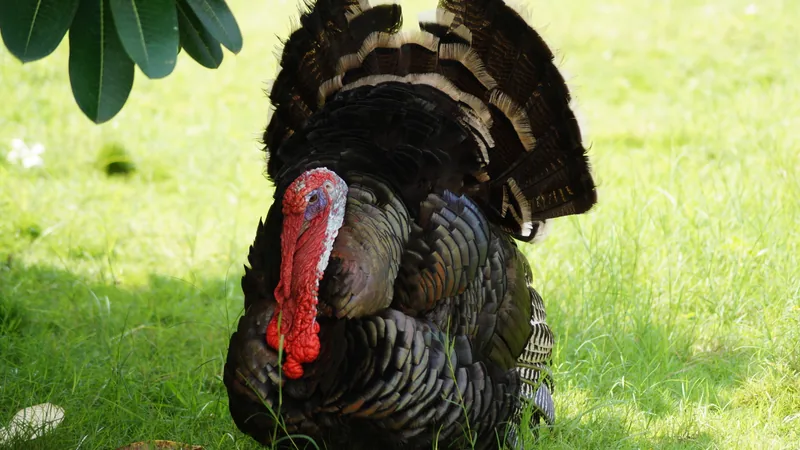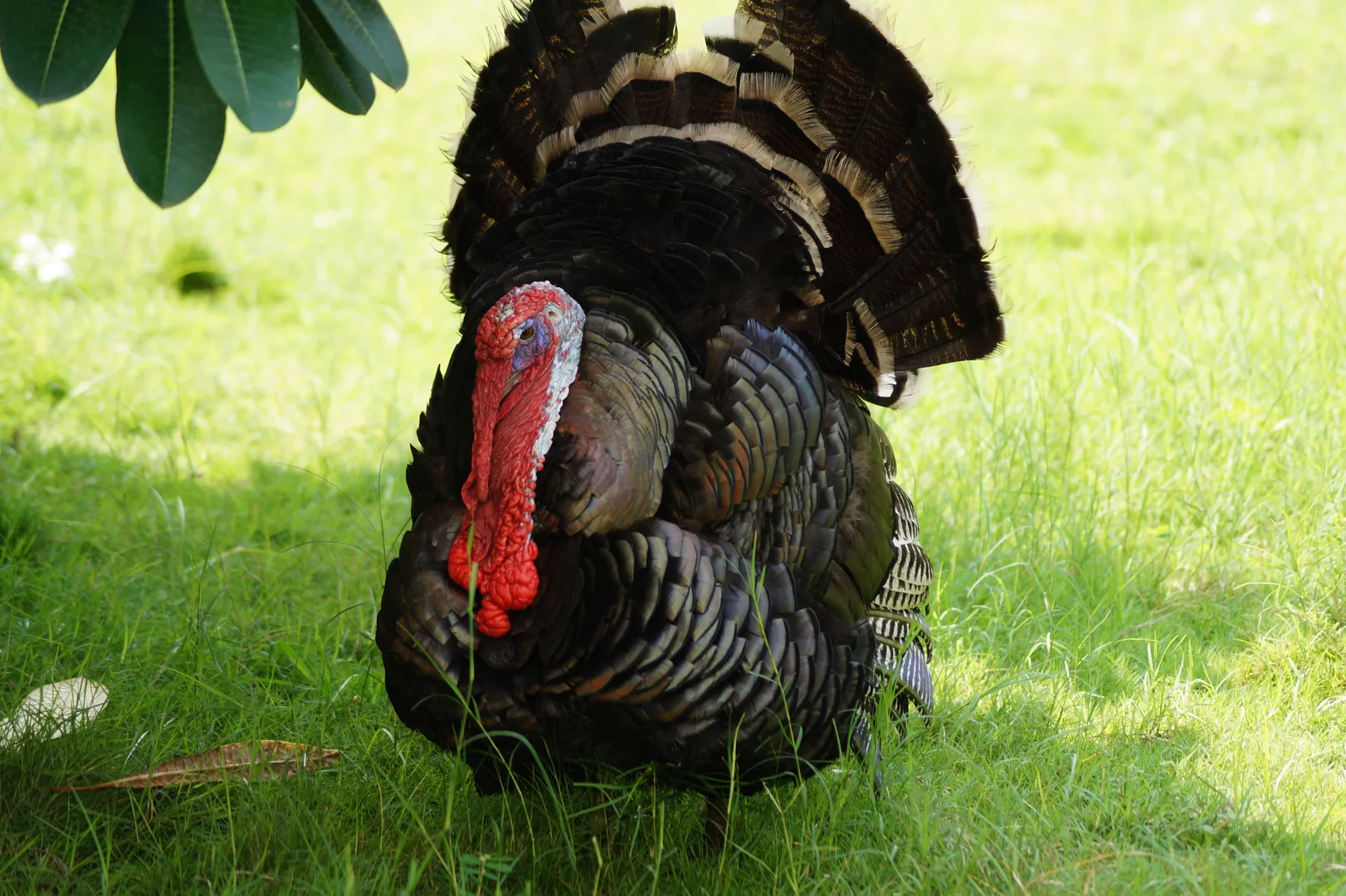
A tom in full strut.
Field
notes
A gobble you can hear a mile away
Male wild turkeys court with noise and theatre. In spring a displaying male struts with his tail fanned out, wings lowered and dragging on the ground, back feathers erect and head thrown back, and he gobbles. That gobble can be heard up to a mile (1.6 kilometers) away. Its job is to attract females and drive off rival males.
The gobble is one of at least 15 different wild turkey calls that biologists have identified.
Flight speed A wild turkey rarely flies more than 100 yards (91 meters), but in the air it can hit up to 54 miles per hour (88.5 kilometers per hour). It can swim, too.
Big, colour-changing and up a tree at night
A male stands about 4 feet (1.2 meters) tall and weighs 15 to 25 pounds (6.8 to 11.3 kilograms). A female stands about 3 feet (1 meter) tall and usually weighs 3.6 to 5.4 kilograms. Wild turkeys are the heaviest members of Galliformes, the order that includes chickens, quails and pheasants. A male has a red wattle, a fleshy lobe hanging from his throat, and a head that turns red, white or blue depending on the season.
They live in hardwood and mixed forests with scattered clearings, across most of the United States east of the Rocky Mountains, with pockets in northern Montana and central California. By day they graze on acorns, nuts, berries, seeds and leaves, plus insects and salamanders. At night they roost in trees. The Smithsonian puts a wild turkey’s lifespan at about three to five years, and the oldest known wild turkey lived at least 13.
Mothers do all the work
A hen nests in a shallow scrape in the ground ringed by deep vegetation, and lays eight to 15 eggs, which she incubates for 25 to 31 days. The chicks can feed themselves within a day of hatching. Fathers are not involved in raising the young.
Some hens practise egg dumping, a tactic where they lay eggs in another female’s nest. They can even use the nests of ruffed grouse.
Brought back, and a Franklin myth
The wild turkey was once a species in decline. Releasing captive-bred birds did not work. Instead, conservationists captured wild turkeys from one area and moved them to others. Today the Smithsonian calls it plentiful and abundant, and the Red List rates it Least Concern.
You may have heard that Benjamin Franklin wanted the turkey as the national bird. The Franklin Institute calls that a myth. Franklin did write, in a letter to his daughter, that the eagle design for the Great Seal looked more like a turkey, and he called the turkey “a much more respectable Bird” than the eagle. He did not propose it as a national symbol.
Published
Traits
Intel
& FAQ
Guess
first
How big is a Wild Turkey, really? Slide, lock in, and see what the sources say. Every answer is a figure from this page, quoted from where it came from.
Sources
- 01Meleagris gallopavo. The IUCN Red List of Threatened Species 2018: e.T22679525A132051953.
- 02Turkey (Meleagris gallopavo). Smithsonian's National Zoo and Conservation Biology Institute.
- 03Meleagris gallopavo (wild turkey). Animal Diversity Web, University of Michigan.
- 04Did Benjamin Franklin Want The National Bird To Be A Turkey? The Franklin Institute.
What the sources say: 54 claims checked word for word against these sources →