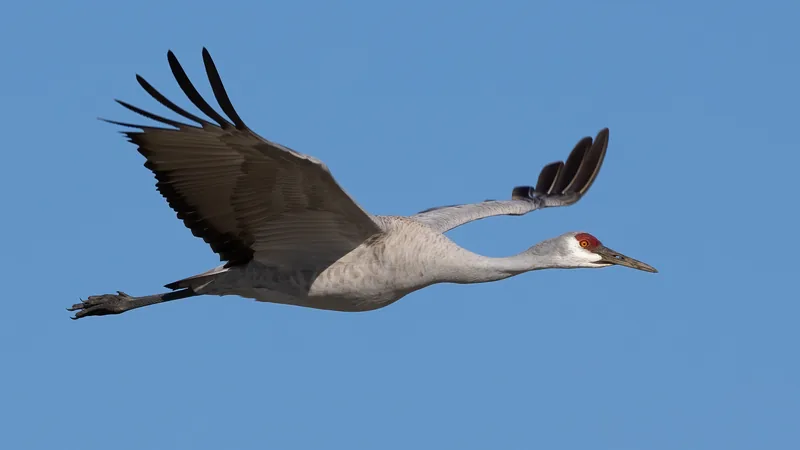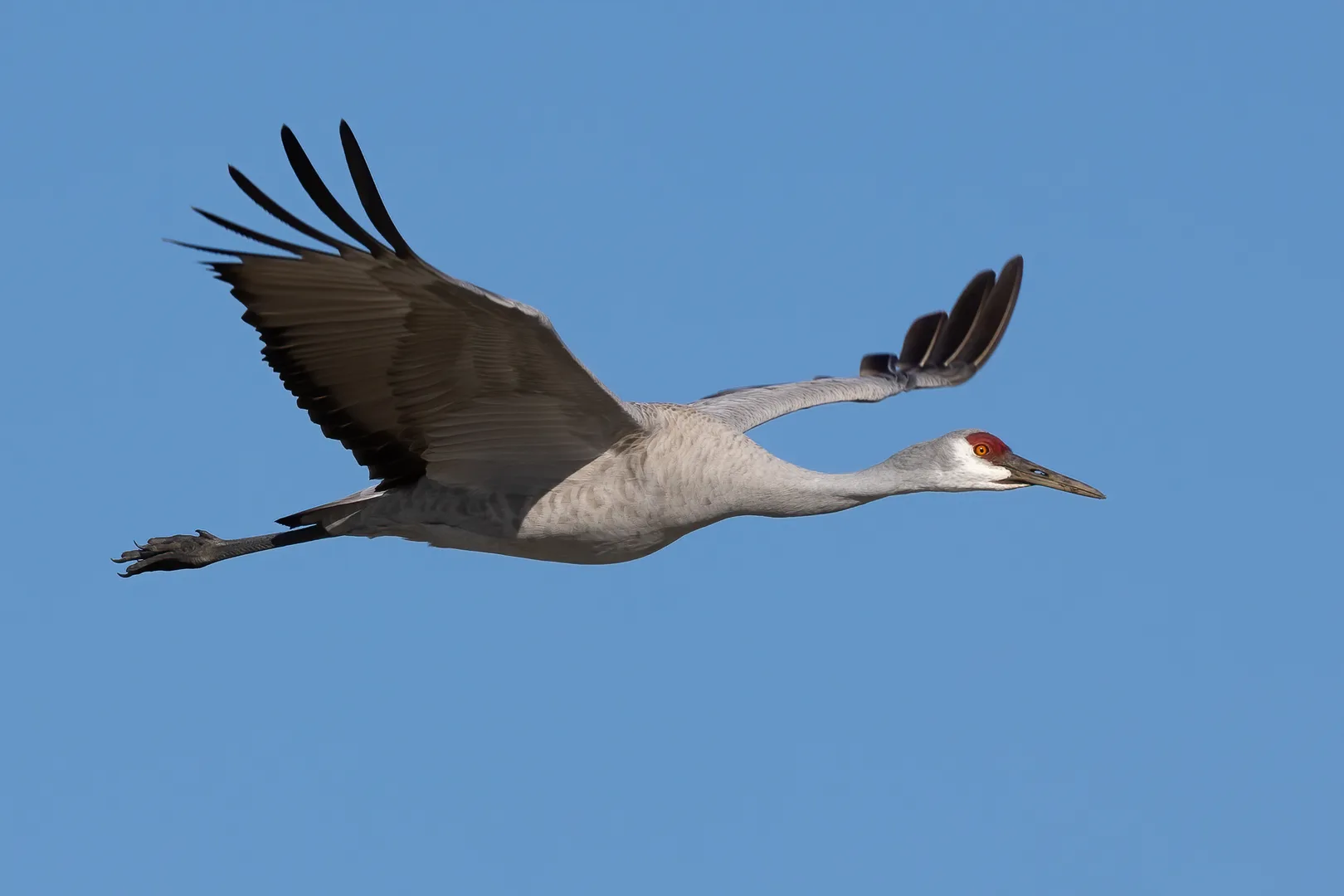
In flight, neck and legs stretched out.
Field
notes
A duet that locks a pair together
A mated sandhill crane pair stands close together and calls at the same moment. The sound is a rattling trumpet, and it can be quite loud. The International Crane Foundation calls this unison duet a way to strengthen the pair bond and protect their territory. Courtship has its own display: once a male has found a potential mate, he performs a dance of head bobbing and jumping in the air.
Ancient lineage Fossil records show that sandhill cranes have been around for nearly 2.5 million years.
Tall and grey, with a red forehead
Adults stand 3 to 4 feet (0.9 to 1.2 meters) tall and weigh 7 to 11 pounds (3 to 5 kilograms), with a wingspan of 5.5 to 6.5 feet. They are grey with some tan body feathers, a long pointed beak, a bright red patch on the forehead and long legs that trail behind them in flight. The International Crane Foundation gives a wider 3 to 6.5 kilograms and notes that body size varies by subspecies.
They can live 20 years or more, according to the Smithsonian’s National Zoo, and AnAge lists a wild record of 36.6 years.
From tundra to the Bosque del Apache
The two migratory subspecies breed across the northern United States and Canada and in eastern Siberia, then winter in the southern United States and northern Mexico. Three non-migratory subspecies have small ranges in the southern United States and Cuba. Across all of that, sandhill cranes are usually found in open country near water: prairies, swamps, farm fields, river valleys and, in the far north, marshy tundra.
They often winter together in huge flocks. Some wintering grounds, such as the Bosque del Apache National Wildlife Refuge in New Mexico, hold up to 10,000 birds. Their large wingspan allows them to soar, conserving energy by coasting along thermal updrafts (rising columns of warm air) instead of flapping constantly. Young cranes fly with their parents during migration and need nine to 10 months of close care before they live on their own.
What they eat, and a comeback
Sandhill cranes are omnivores. Seeds, berries and roots are common food, along with crops such as corn and wheat grains, depending on availability. They also take rodents, snails, insects, frogs, lizards and nestling birds, probing with their pointed beaks in marshy ground. Unlike herons, they rarely wade into open water to hunt fish. Most sleep standing on one leg in shallow water, heads and necks tucked under their shoulders.
Sandhill cranes were once nearly extinct east of the Mississippi River, and their populations have rebounded. The International Crane Foundation estimates about 1,460,000 birds, give or take 230,000, with an increasing trend, and the Red List rates the species Least Concern. Some subspecies are still in trouble: the Mississippi sandhill crane is listed as endangered under the US Endangered Species Act.
Published Updated
Traits
Intel
& FAQ
Guess
first
How big is a Sandhill Crane, really? Slide, lock in, and see what the sources say. Every answer is a figure from this page, quoted from where it came from.
Sources
- 01Grus canadensis. The IUCN Red List of Threatened Species 2021: e.T22692078A188597759.
- 02Sandhill crane (Antigone canadensis). Smithsonian's National Zoo and Conservation Biology Institute.
- 03Sandhill Crane. International Crane Foundation, Species Field Guide.
- 04AnAge entry for Grus canadensis. AnAge: The Animal Ageing and Longevity Database, Human Ageing Genomic Resources.
- 05Sandhill Cranes. Florida Fish and Wildlife Conservation Commission.
What the sources say: 50 claims checked word for word against these sources →